Michigan Herp Atlas
HRM administers the Michigan Herpetological Atlas (Michigan Herp Atlas), a statewide community science initiative dedicated to increasing our knowledge of the distribution, status, and long-term population trends of Michigan’s amphibians and reptiles, collectively known as herpetofauna or “herps.”
The Michigan Herp Atlas brings together observations from community scientists, natural resource professionals, researchers, organizations, and herp enthusiasts across the state to build a comprehensive database of Michigan’s amphibians and reptiles. These records provide valuable information that can help improve our understanding of species distributions, identify changes over time, document new and expanding occurrences, and support informed conservation and management decisions.
Help Us Map Michigan’s Herps
Do you enjoy searching for salamanders under logs, listening to frogs calling on a summer evening, spotting turtles basking along a wetland, or finding a snake in your own backyard?
Your observations matter.
From the most common backyard frog to an unexpected observation of a rare species, every verified record adds to our understanding of Michigan’s herpetofauna. Anyone can participate by submitting past or present observations from anywhere in Michigan.
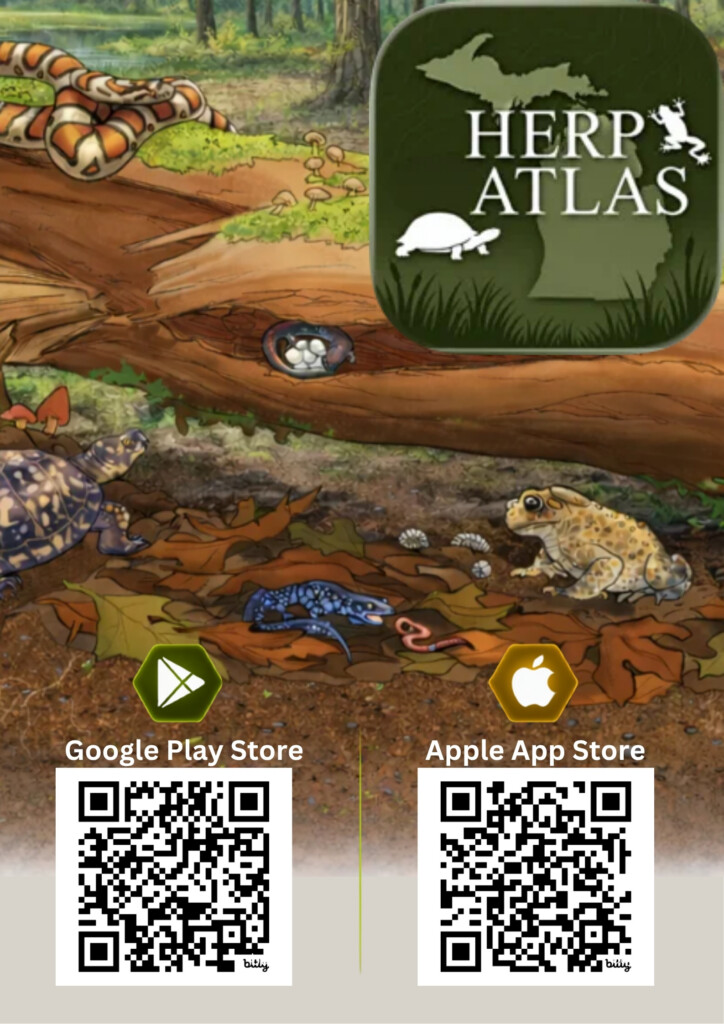
The Michigan Herp Atlas now makes contributing even easier with our new mobile apps for both iOS and Android. Users can document observations directly from the field, submit photographs and observation information, explore Michigan’s amphibians and reptiles, and contribute directly to this growing statewide conservation resource.
Participants can:
- Download the Michigan Herp Atlas app for iOS or Android
- Submit amphibian and reptile observations directly from the field
- Submit past and present observations through the Michigan Herp Atlas website
- Use our online field guide to identify Michigan amphibians and reptiles
- Download the official Michigan Herp Atlas Project Guide
- Download a printable Survey Card for observations submitted by mail
- Explore statewide species information and distribution trends
Your Data and Sensitive Locations
Protecting sensitive locality information is an important part of the Michigan Herp Atlas. Publicly available observation information is limited to the county level, while more specific locality information associated with a submission is available only to the observer and authorized Atlas administrators.
This allows contributors to provide scientifically valuable location information while helping protect sensitive species and locations.
Community Science Making a Difference
The Michigan Herp Atlas demonstrates just how valuable individual observations can be. With the help of Atlas contributors, observations have helped document remarkable findings, including the rediscovery of the Western Lesser Siren, which had not been observed in Michigan since the 1950s, and the Marbled Salamander, which had not been detected in the state since the 1980s.
These discoveries demonstrate why continued statewide documentation is so important. A single observation can help fill a distribution gap, document a previously unknown population, identify a change in a species’ range, or provide information that contributes to future research and conservation.
Whether you are a professional biologist, educator, student, naturalist, photographer, landowner, or simply someone who happens to encounter a turtle crossing the road, you can contribute to our understanding of Michigan’s amphibians and reptiles.
Document. Contribute. Conserve. Help us map Michigan’s herps.