Amphibian & Reptile Best Management Practices for Michigan
The Michigan Amphibian & Reptile Best Management Practices manual is a comprehensive resource on amphibian and reptile conservation and management provided through a partnership with Herpetological Resource Management (HRM) and the Department of Environment, Great Lakes, and Energy (EGLE) for no cost.
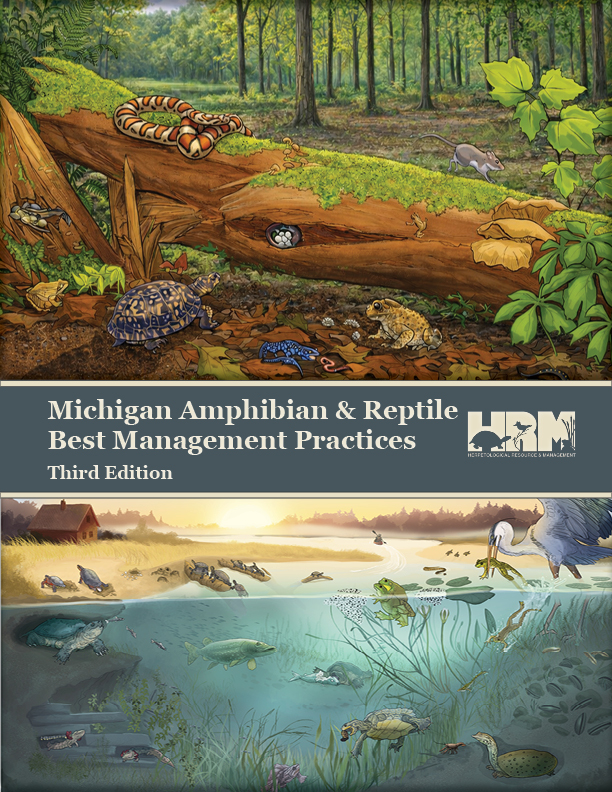
Download MI BMP
A Complete Guide to the Conservation of Michigan Herpetofauna
HRM created the Michigan Amphibian and Reptile Best Management Practices (BMPs) Third Edition for EGLE to provide the most comprehensive and up-to-date guide available for improving and maintaining the viability of Michigan amphibian and reptile populations. Building upon the success of both previous editions, the Third Edition represents the most significant expansion of the manual to date, incorporating new scientific research, expanded conservation guidance, additional case studies, and enhanced technical resources for practitioners, land managers, regulators, developers, and conservation professionals.
Similar to previous editions, this manual addresses existing and emerging threats to Michigan’s amphibian and reptile (herpetofauna) communities posed by development, habitat alteration, infrastructure projects, restoration activities, and land management practices. The manual provides science-based alternatives and recommendations to facilitate conservation actions that protect individual species and the ecological communities that support them.
The BMPs are designed to inform land management, development, infrastructure planning, ecological restoration, mitigation, and conservation activities throughout Michigan. This Michigan-focused guide provides practical recommendations to regulators, agency land managers, consultants, commercial and residential developers, utility companies, conservation organizations, and private citizens seeking to protect, preserve, enhance, and restore amphibian and reptile populations and their habitats.
This manual is intended to serve as a quick-reference guide throughout all phases of project planning, site development, construction, mitigation, restoration, and long-term management. Applicable laws, regulations, and BMPs for minimizing impacts to amphibians and reptiles are provided throughout the document and organized by management scenario to help practitioners quickly identify appropriate conservation measures.
As with previous editions, it is our hope that this resource will remain a living document. As new scientific information, technologies, threats, and management techniques emerge, future revisions will continue to improve and expand the guidance available for conserving Michigan’s herpetofauna.
Third Edition Updates
The Michigan Amphibian and Reptile BMP Third Edition represents the largest expansion of the manual since its inception. The document has been significantly enhanced to serve as a comprehensive conservation resource for Michigan herpetofauna and the habitats upon which they depend.
All BMP categories have been finalized and expanded, including detailed guidance on habitat restoration, water quality protection, landscape connectivity, ecological restoration, development planning, and long-term habitat management.
Major additions and expansions include:
• Dam Drawdowns – Comprehensive guidance for evaluating and mitigating the impacts of seasonal and permanent drawdown events on aquatic and semi-aquatic amphibians and reptiles, including habitat protection and restoration considerations.
• Lake Level Alterations – Expanded management recommendations addressing water level fluctuations, shoreline habitat conservation, breeding habitat protection, and long-term ecosystem stability.
• Riverine Herpetofauna – A substantial new section focused on Michigan’s river-associated amphibian and reptile communities, including species composition, ecological requirements, natural history, conservation challenges, restoration opportunities, and management techniques designed to mitigate threats and improve habitat quality.
• Expanded Scientific Resources – More than 40 additional pages of scientific literature reviews, technical guidance, and supporting resources have been added to strengthen the manual’s evidence-based approach to conservation and habitat management.
• Enhanced Visual Resources – The Third Edition includes over 100 additional pages of new content, photographs, illustrations, diagrams, and conservation examples designed to visually communicate herpetofaunal ecology, habitat relationships, threats, and conservation solutions.
In addition to these major additions, the Third Edition incorporates updated State and Federal regulations, recent scientific findings, expanded case studies, and revised management recommendations to ensure users have access to the most current conservation information available.
Content Included
• Natural History of Michigan Herpetofauna
• Geologic and Climatic History of Michigan Herpetofauna
• Rare Species Profiles and Conservation Considerations
• Threats to Amphibians and Reptiles
• Conservation Efforts and Planning
• Project Planning and Environmental Review
• Ecological Restoration, Mitigation, and Habitat Design
• Wetland, Lake, River, and Vernal Pool Management
• Water Quality Protection
• Landscape Connectivity and Wildlife Movement
• Dam Drawdown and Water Level Management
• Riverine Habitat Conservation and Restoration
• Habitat Management Techniques
• Development Planning and Construction BMPs
• Monitoring, Adaptive Management, and Long-Term Stewardship
• State and Federal Regulatory Guidance
• Case Studies, Illustrations, and Technical Resources