
Eastern Spiny Softshell Turtle
Overview:
Scientific Name: Apalone spinifera spinifera
Size: 5 – 18.9” (adult carapace length)
Status: Locally abundant in the western part of its Great Lakes range but can be less abundant to rare in the eastern portion, almost completely extirpated from the western end of Lake Ontario, they have suffered significant decline as a result of pollution and loss of nesting sites
Habitat:
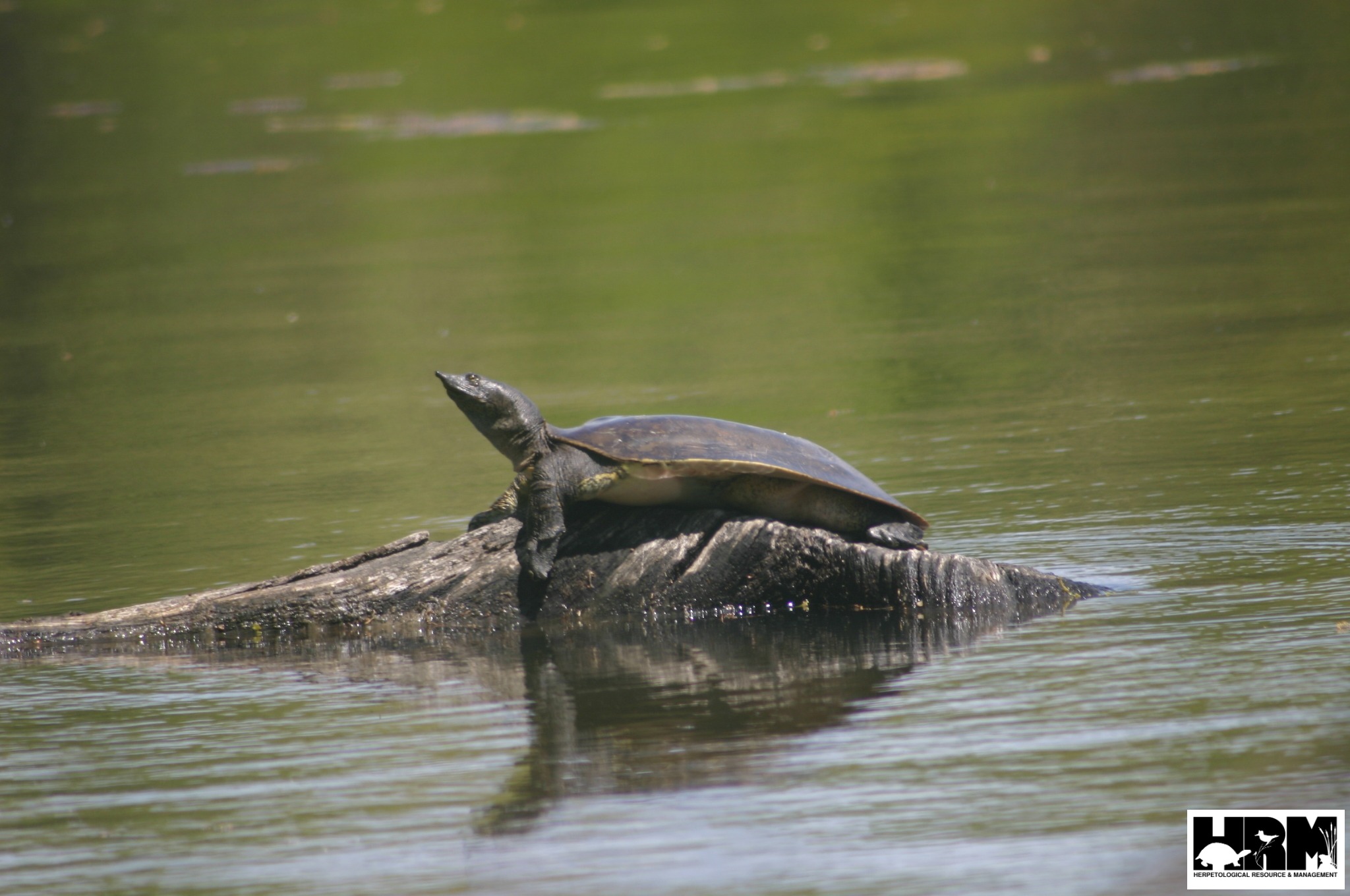
Inhabit rivers and larger streams, inland lakes, reservoirs, and even protected bays and river mouth areas in the Great Lakes. Tolerant of relatively swift currents but prefer sand or mud bottoms and avoid streams with sharp-edged rocks or coarse gravel. Open habitats with little aquatic vegetation are favored over those with denser vegetation. Basking spots and sandy nesting areas are an important component of their habitat requirements.
Conservation:
Rarely eat game fish and it is unlikely they significantly outcompete those species. The use of cloacal respiration makes them sensitive to pollutants that kill fish, especially those who require a high dissolved oxygen content and especially sensitive to rotenone. Shoreline development (reduction or elimination of nesting sites), injuries by boat propellers and vandalism by firearms are other major threats. Occasionally caught and marketed for human consumption with larger females bearing the brunt but states and provinces now limit and regulate their harvest. There is no sustainable harvest for this species.
Best Management:
Avoid artificially elevating and drawing water levels during egg development and for potential desiccation of species. Maintain or enhance nesting areas of importance to the species. Boating mitigation including lower-powered motors, speed limits, no wake zones, and closing off areas of a lake or river with high densities of species may reduce strikes. Application of piscicides and rotenone should be limited and considered on a species by species basis.
Adult Coloration:
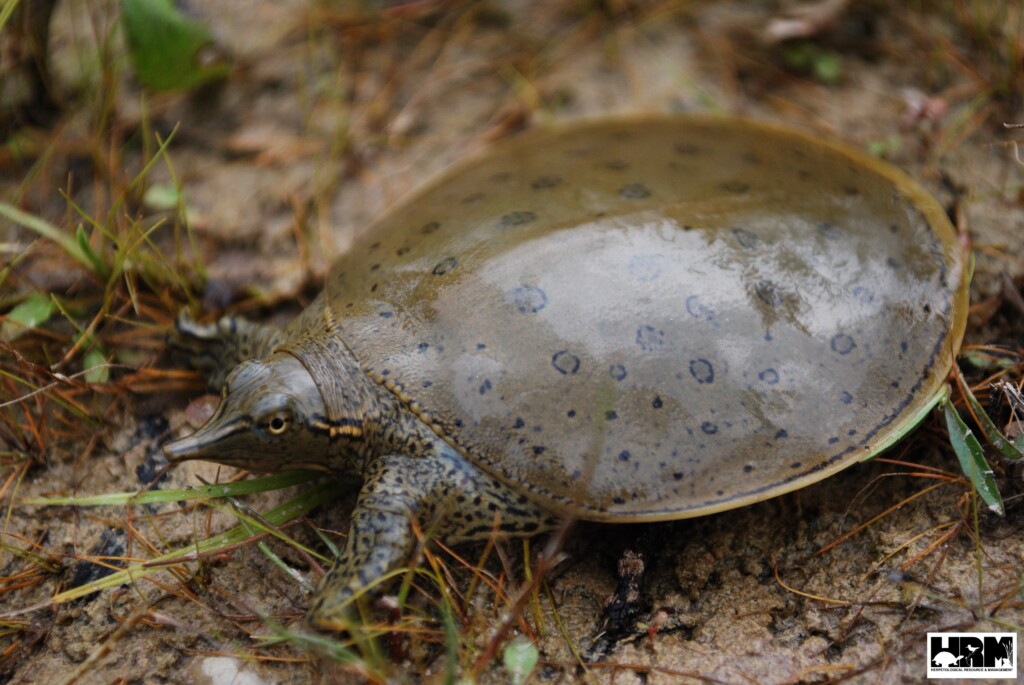
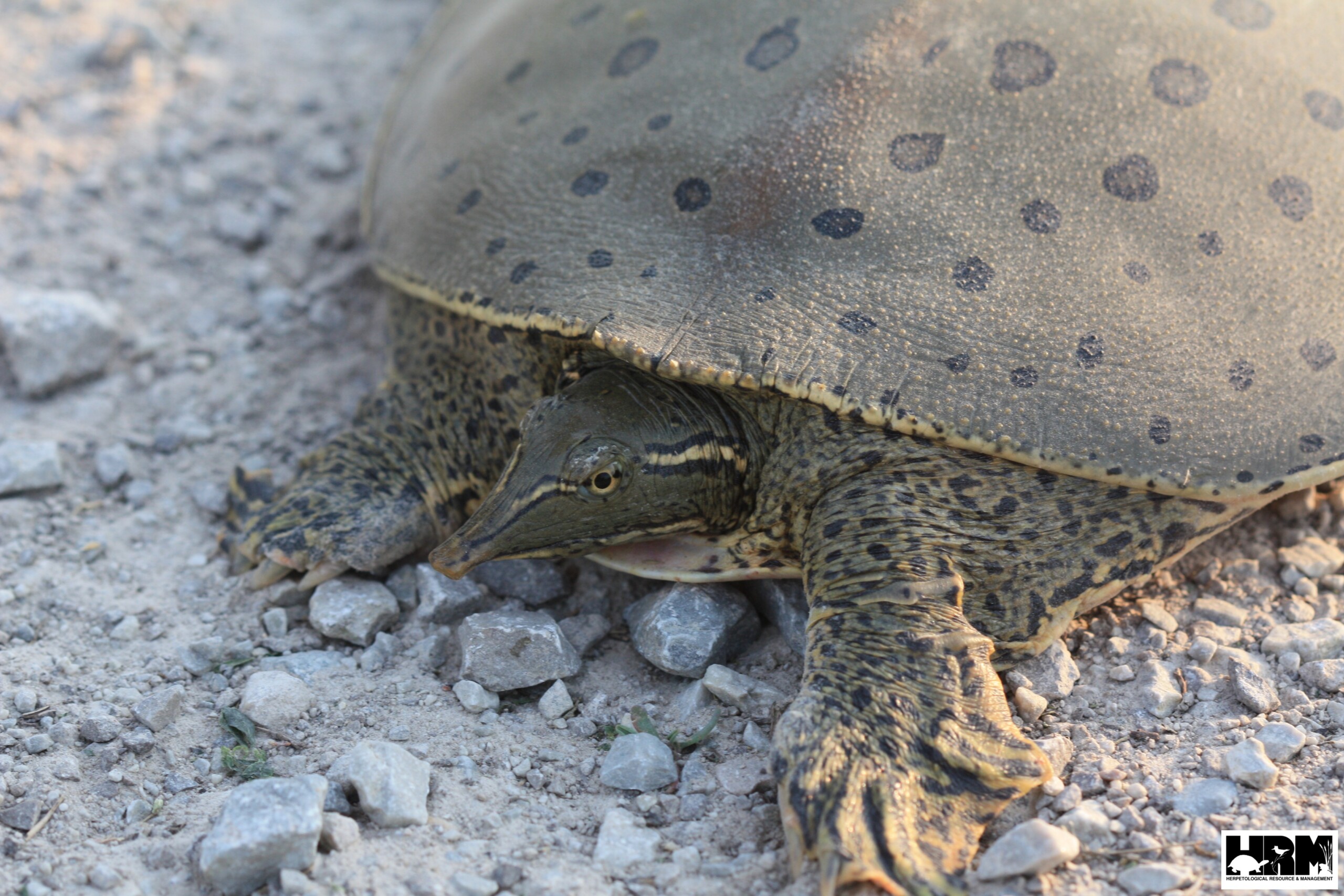
Tan, brown, or olive colored carapace with black spots, flecking and circles in males while females are darked and become blotched or mottled with grey or brown. The plastron is white or pale yellow with underlying bones visible as grey patched. The head, neck, and legs are tan or olive from above and speckled or mottled with black. The feet often streaked or mottled with yellow and black. Usually two black-boarded yellowish stripes on each side of the head behind the eye and jaw.
Adult Characteristics:
A smooth, flat, oval or round carapace and long pig-like snout. Both the carapace and plastron lack scutes and are soft and rubbery with flexible edges. Short, inconspicuous spines are present at the front of the carapace. All four feet are fully webbed. Females are much large than males (9.4 – 18.9” vs 5 – 9.4” carapace length). Males also have a slightly granular carapace surface and a longer, thicker tail that can project well beyond the rear carapace margin.
Juvenile Characteristics:
1.2 – 1.6” long with a circular tan or olive-brown carapace with a pattern of dark spots or circles and a light border. New hatchlings have a curled shell and an up-turned nose which unfold within a day or two after emergence.
Species Confused With:
No other Great Lakes turtle has a flat, scuteless carapace and tubular nose. Softshell Turtle eggs are spherical like Snapping Turtle eggs but are smaller and have a less rigid shell.
Photos:
References:
- Amphibians and Reptiles of the Great Lakes Region by Jim Harding
- Conant, R., and Collins, J. T. 1998. Reptiles and Amphibians: Eastern, Central North America. Houghton Mifflin Harcourt Press.
- Harding, J and D. Mifsud. 2017. Amphibians and Reptiles of the Great Lakes Region: Revised Edition. Ann Arbor: The University of Michigan Press.
- Harding, J.H. and J.A. Holman. 1990. Michigan Turtles and Lizards. MSU Cooperative Extension Service and MSU Museum. 96 pp.
- Holman, J. A. 2012. The Amphibians and Reptiles of Michigan: A Quaternary and Recent Faunal Adventure. Detroit, Mich., Wayne State University Press.
- Mifsud, David A., Sano, Melissa R., Seguchi, Kotaro J., 2026. Michigan Amphibian and Reptile Best Management Practices Third Edition. Herpetological Resource and Management Technical Publication 2026
- Ruthven, A. G., H. B. T. Gaige, et al. 1912. The herpetology of Michigan, by Alexander B. Ruthven. Crystal Thompson and Helen Thompson; Memoranda towards a bibliography of the archaeology of Michigan, by Harlan I. Smith; prepared under the direction of Alexander G. Ruthven. Lansing, Mich., Wynkoop Hallenbeck Crawford, State Printers.