Five-lined Skink
Overview:
Scientific Name: Plestiodon fasciatus
Size: 5 – 8.5” (total length)
Status: Can be locally abundant in some areas of the Great Lakes region but populations are spotty throughout its northern range
Habitat:
Inhabit woodlands or partially wooded areas with ample cover and basking sites. More abundant in ecotone or transitional areas like clearings, woodland edges, or partially burned areas. Sometimes found in accumulations of driftwood on beaches. Prefer moist habitats over very dry ones.
Conservation:
Harmless to human interests. May benefit from selective logging operations that open the forest canopy, leave behind stumps, bark slabs, and sawdust piles. However, the clearing of woodlands for development of the removal of fallen logs, stumps, or beach debris is a detriment to the species. They tend to exist in small, isolated populations making them sensitive to even small-scale habitat disruptions.
Best Management:
Construction of lizard basking and cover structures can help support a healthy population. Preserving or creating nesting sites can help maintain population health and stability. Selective forest management can help provide crucial habitat components.
Adult Coloration:
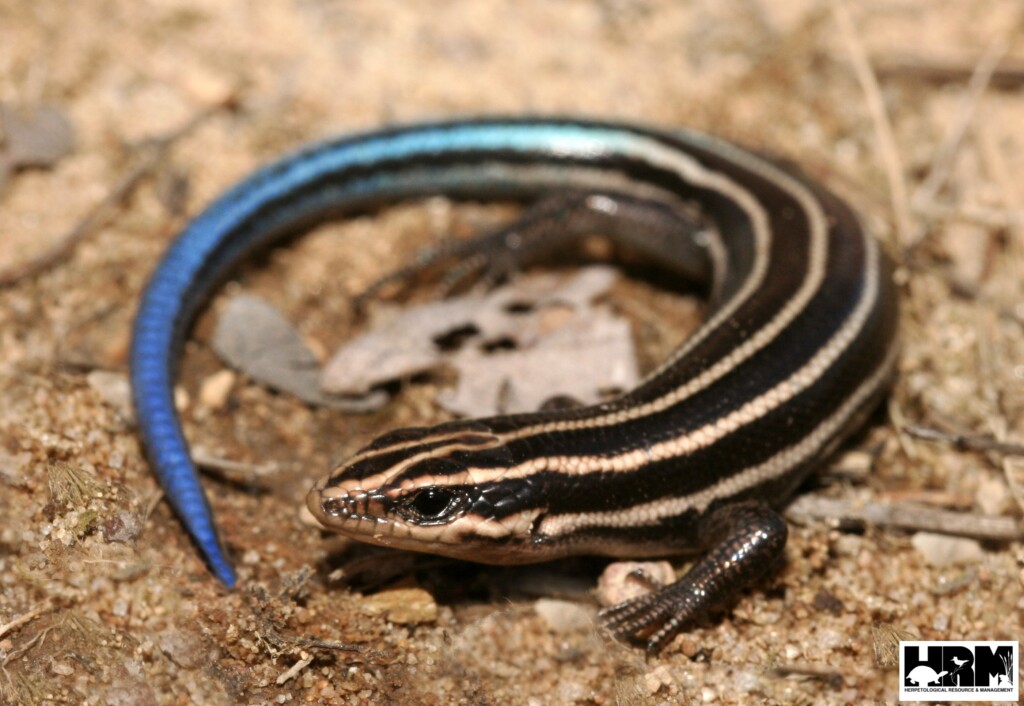
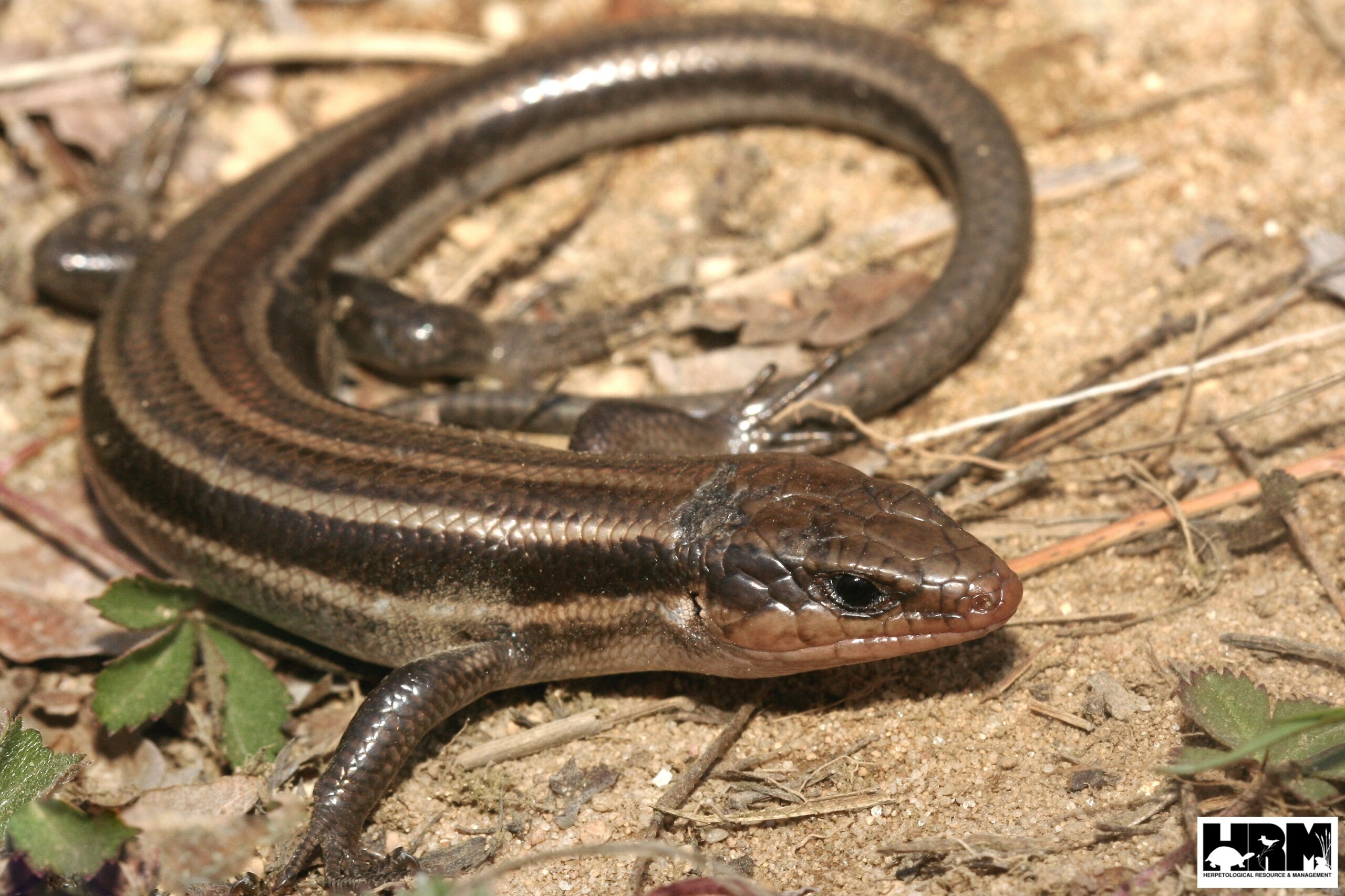
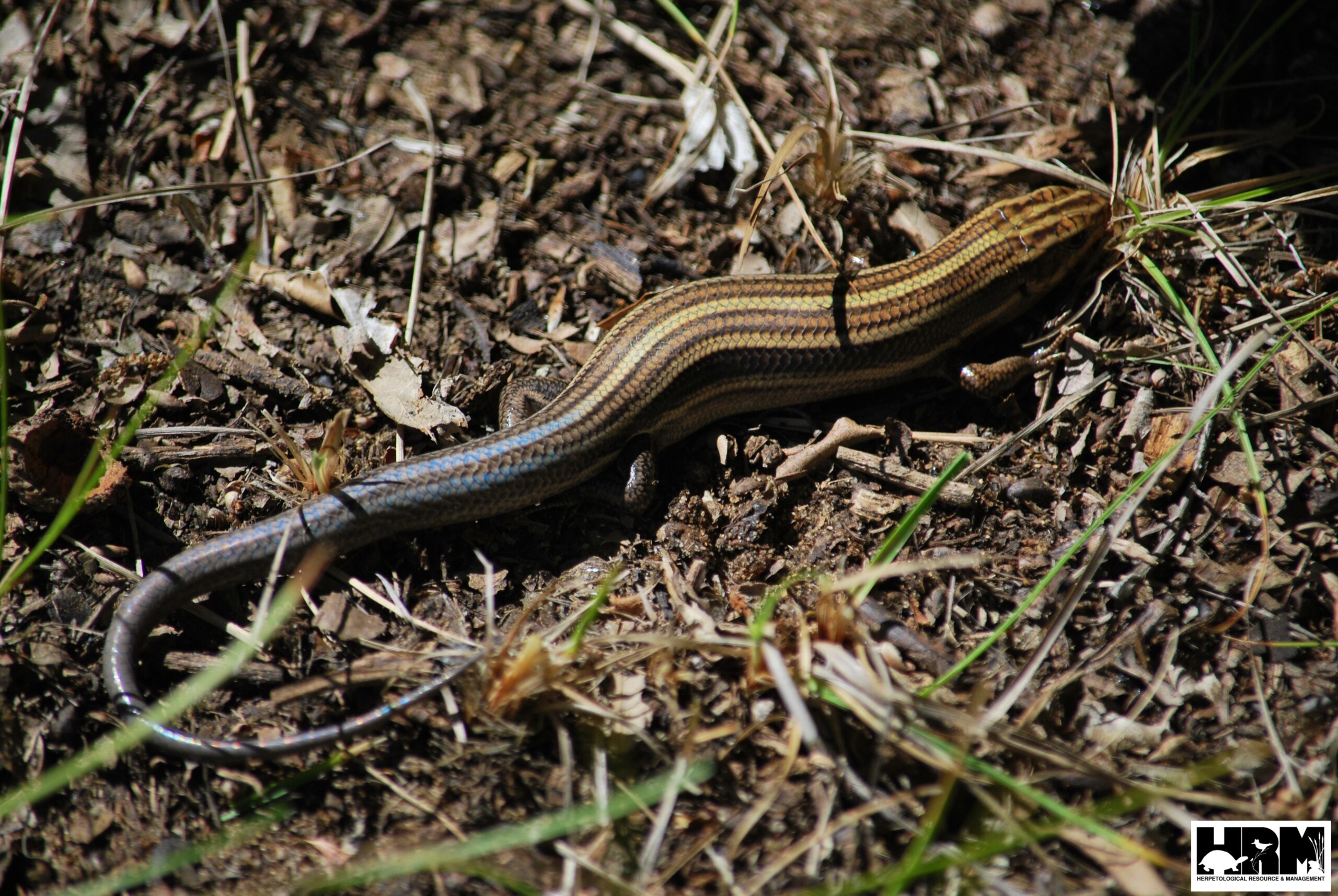
Five yellowish or cream-colored stripes that run from the snout down the back, sides, and tail but may darken with age (especially in males). The body is black and may also fade with age, turning brown, grey, or olive in older adults. Adult females retain the characteristic metallic blue found in hatchlings and juveniles while in males the tail is grey.
Adult Characteristics:
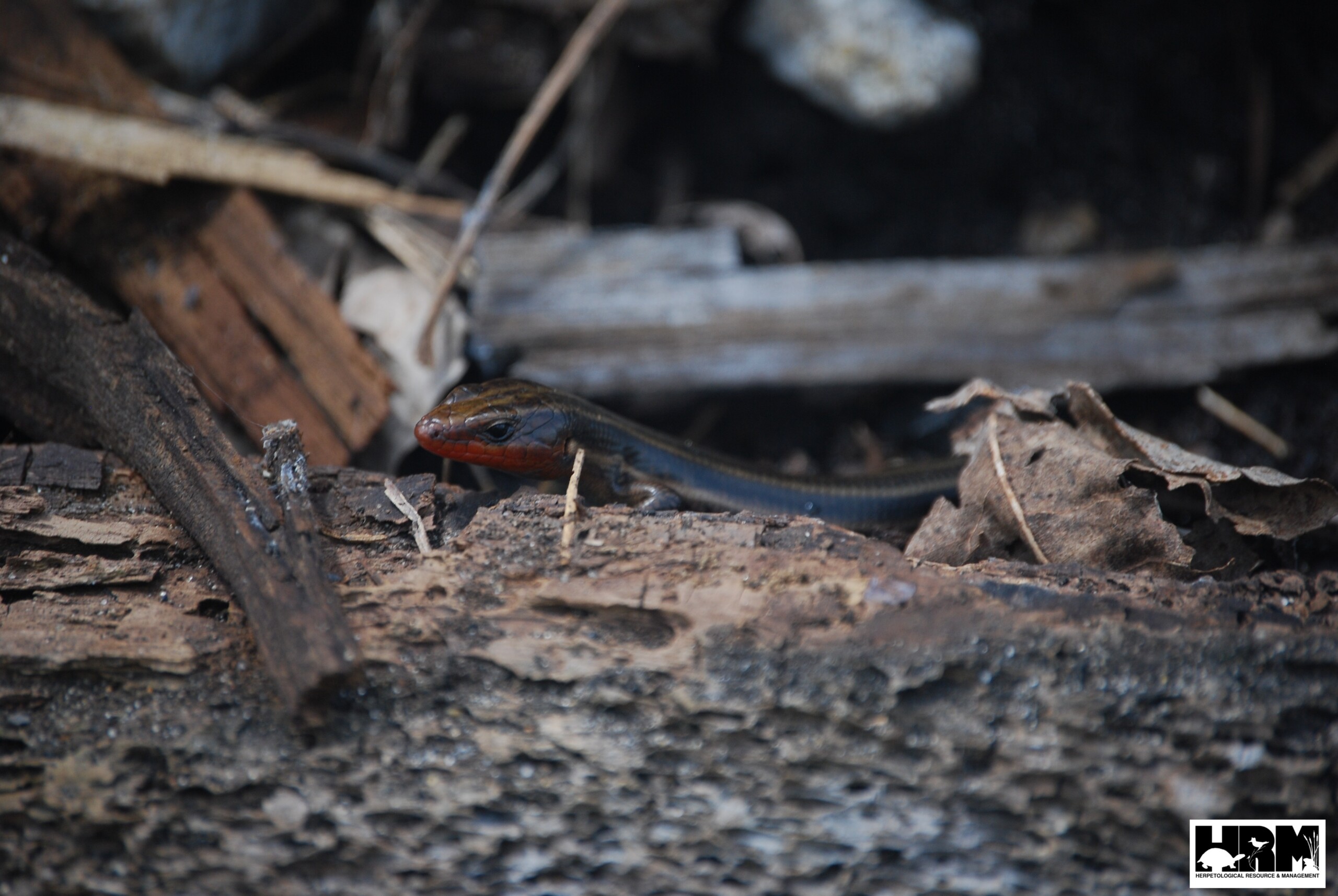
Scales are shiny and small. Males have a widened head and a reddish-orange coloration on the snout and jaws with age. These features are more apparent during the spring breeding season.
Juvenile Characteristics:
Black bodies with defined white or yellow stripes with a conspicuous metallic blue tail. Are 2 – 2.5” at hatching.
Species Confused With:
Six-lined Racerunners are the states only other lizard species and is confined to Tuscola County. Has six lines on the body and granular scales.
Photos:
References:
- Amphibians and Reptiles of the Great Lakes Region by Jim Harding
- Conant, R., and Collins, J. T. 1998. Reptiles and Amphibians: Eastern, Central North America. Houghton Mifflin Harcourt Press.
- Harding, J and D. Mifsud. 2017. Amphibians and Reptiles of the Great Lakes Region: Revised Edition. Ann Arbor: The University of Michigan Press.
- Harding, J.H. and J.A. Holman. 1990. Michigan Turtles and Lizards. MSU Cooperative Extension Service and MSU Museum. 96 pp.
- Holman, J. A. 2012. The Amphibians and Reptiles of Michigan: A Quaternary and Recent Faunal Adventure. Detroit, Mich., Wayne State University Press.
- Mifsud, David A., Sano, Melissa R., Seguchi, Kotaro J., 2026. Michigan Amphibian and Reptile Best Management Practices Third Edition. Herpetological Resource and Management Technical Publication 2026
- Ruthven, A. G., H. B. T. Gaige, et al. 1912. The herpetology of Michigan, by Alexander B. Ruthven. Crystal Thompson and Helen Thompson; Memoranda towards a bibliography of the archaeology of Michigan, by Harlan I. Smith; prepared under the direction of Alexander G. Ruthven. Lansing, Mich., Wynkoop Hallenbeck Crawford, State Printers.