
Green Frog
Overview:
Scientific Name: Rana (Lithobates) clamitans
Size: 2.4 – 4.2” (adult size)
Status: One of the most abundant frogs throughout the Great Lakes region
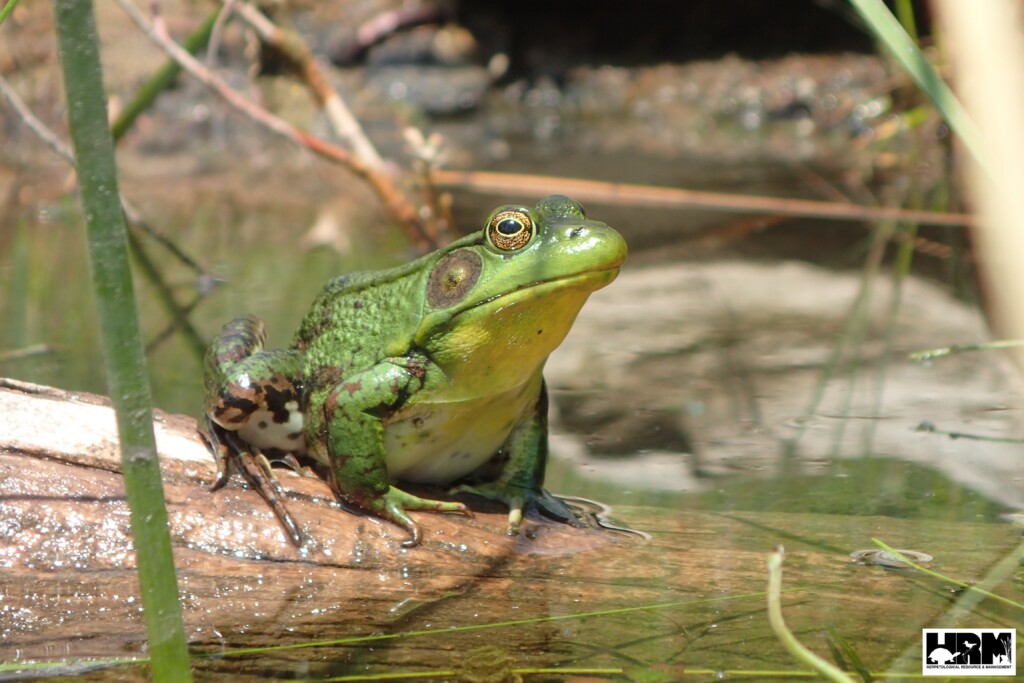
Habitat:
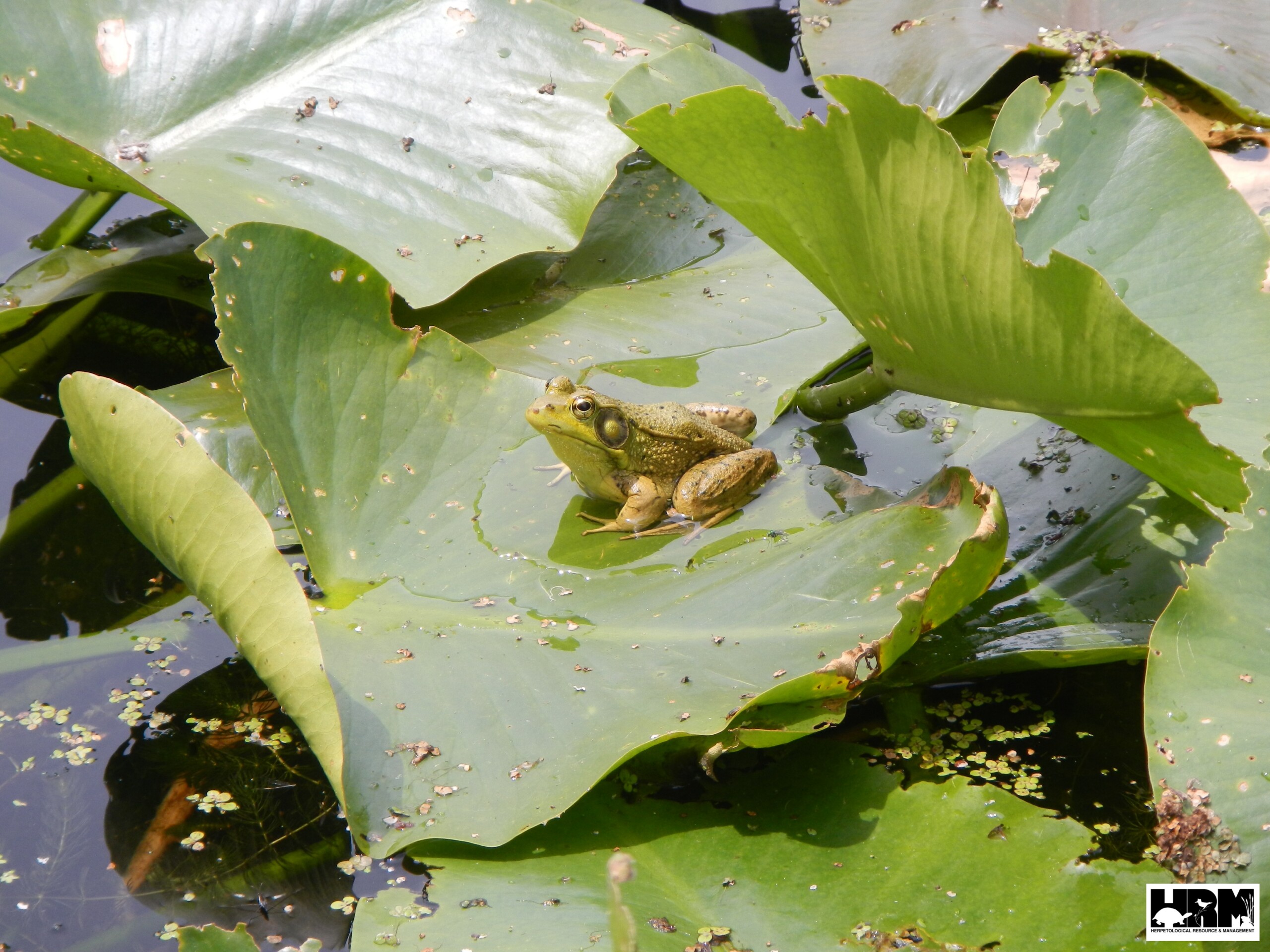
Inhabits ponds, lakes, swamps, sloughs, impoundments, and slow streams. More tolerant of open, sparsely vegetated areas than other frogs (notably Bullfrogs). Usually avoid shallow water and temporary waters.
Conservation:
Occasionally may be harvested for “frog legs” though few individuals reach such size. Widespread and reasonably common in most of the region but should be monitored and studied nonetheless. It is important to understand the success of common species as it is rare and declining species.
Best Management:
Pesticide application should occur in late summer and fall when larvae have metamorphosed and hibernation begins, care should be taken as tadpoles are still present for this species. Maintaining inundation during drawdowns will allow tadpoles to overwinter. Consider the effects of altering or destroying vernal pools and other fish-free ponds. Do not impact the pool depression or core buffer area within 100 feet of the pools and aim to protect a wider buffer of 600 – 1000 feet around the pools. Try to maintain any habitat corridors to other vernal pools and upland habitats. Minimize the spread of salt on roadways near wetlands which can reduce the survival of pollution sensitive species.
Adult Coloration:
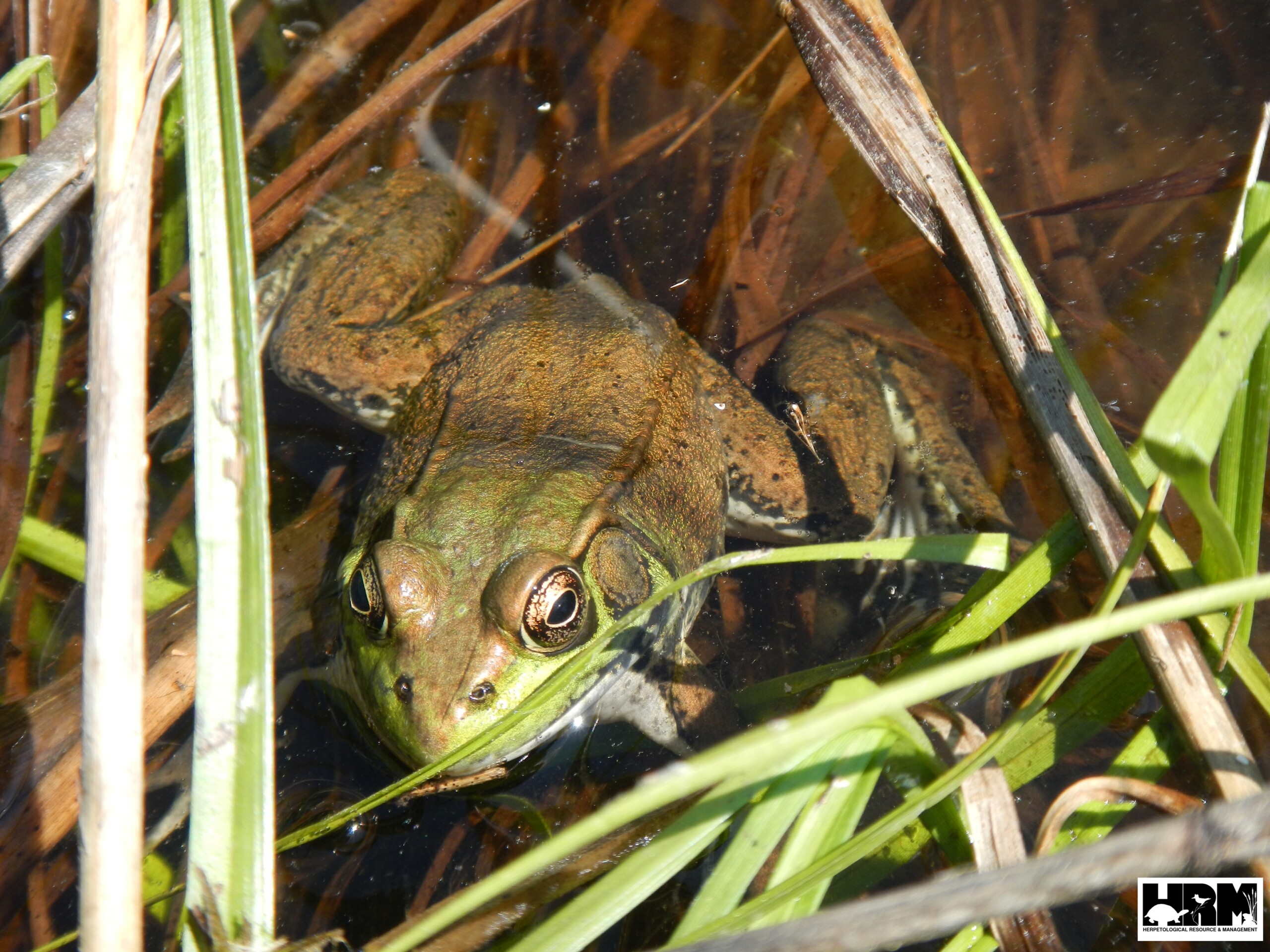
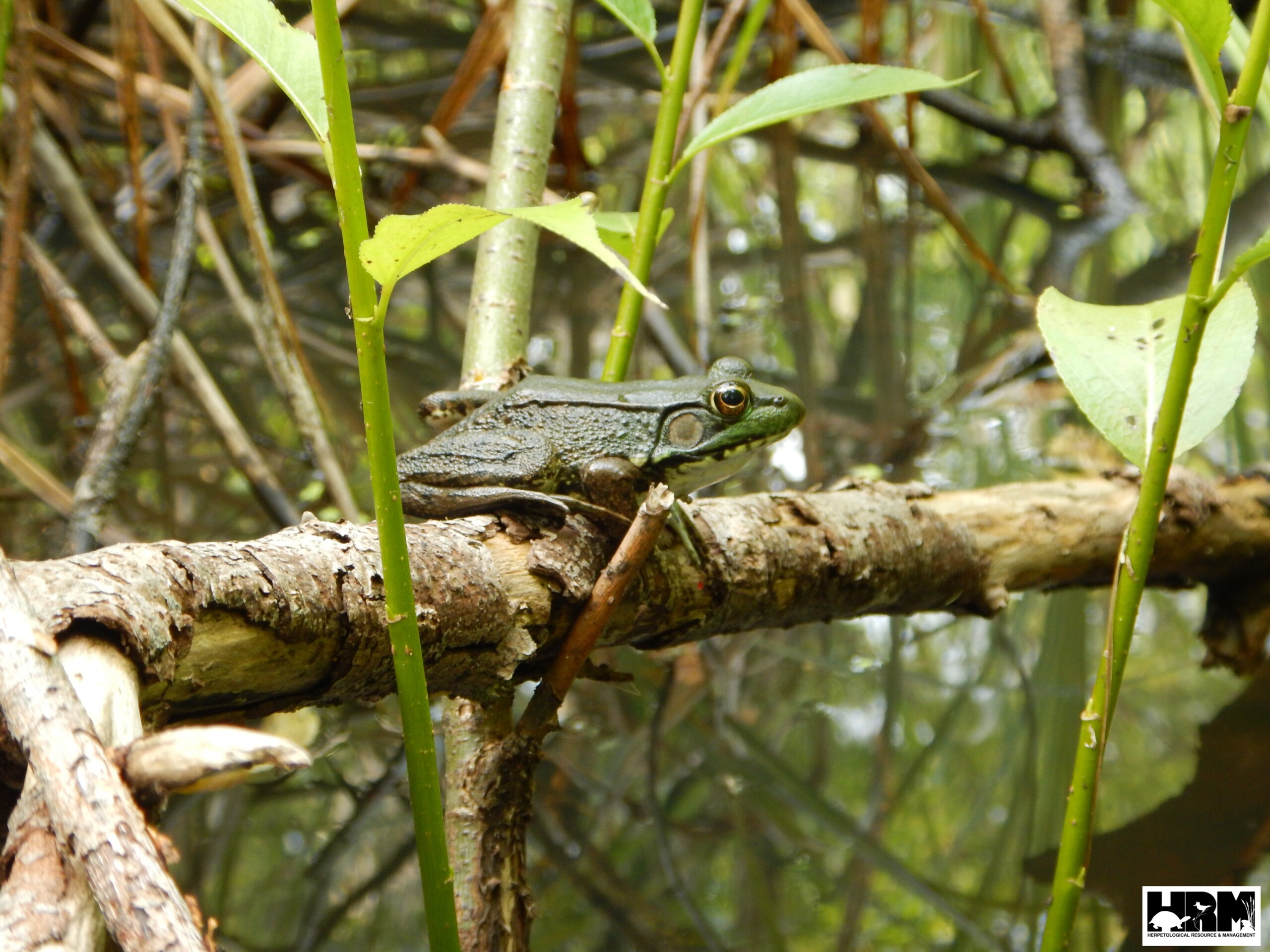
May be green, yellowish-green, olive, brown, or any combination. Occasionally a blue individual may be found. The upper lip is green or yellow. Dark spotting on the back and sides is common with the hind legs having dark bars. The belly is white with occasional grey mottling.
Adult Characteristics:
Dorsolateral folds (raised ridges running extending down each side of the back) extend from the eye down one-half to two-thirds of the back. Mature males have a yellow throat with the tympanum (circular “ear” structure on the side of the head) larger than the eye while in females it is smaller or similar in size as the eye with a white, light yellow, or cream throat with dark mottling. Their call is a brief “clung!” compared to the plucking of strings on a banjo. Sometimes, a low growl is heard during territorial aggression and fights.
Larvae Characteristics:
Tadpoles are plump with long tails and are olive to brownish-green from above with dark flecking on the back and tail fins. The belly is iridescent white or cream with grey mottling and intestines are not visible through the skin.
Species Confused With:
Bullfrogs are similar but are larger and lack dorsolateral folds. Bullfrog tadpoles are similar to Green Frog tadpoles but the dark spots on the tail fin are restricted to the upper lobe. Mink Frogs have similar dark markings on the back but lack dorsolateral folds; however, in areas where the ranges overlap, Green Frogs may also not have dorsolateral folds to mimic the Mink Frogs. Distinction must be made between the two by the musky odor of the Mink Frog and the different markings on the hindlegs with Green Frogs having dark crossbands and Mink Frogs having rounded spots or lengthwise stripes.
Photos:
References:
- Amphibians and Reptiles of the Great Lakes Region by Jim Harding
- Conant, R., and Collins, J. T. 1998. Reptiles and Amphibians: Eastern, Central North America. Houghton Mifflin Harcourt Press.
- Harding, J and D. Mifsud. 2017. Amphibians and Reptiles of the Great Lakes Region: Revised Edition. Ann Arbor: The University of Michigan Press.
- Harding, J.H. and J.A. Holman. 1992. Michigan Frogs, Toads, and Salamanders. MSU Cooperative Extension Service and MSU Museum. Extension Bull. E-2350, 144 pp.
- Holman, J. A. 2012. The Amphibians and Reptiles of Michigan: A Quaternary and Recent Faunal Adventure. Detroit, Mich., Wayne State University Press.
- Mifsud, David A., Sano, Melissa R., Seguchi, Kotaro J., 2026. Michigan Amphibian and Reptile Best Management Practices Third Edition. Herpetological Resource and Management Technical Publication 2026
- Ruthven, A. G., H. B. T. Gaige, et al. 1912. The herpetology of Michigan, by Alexander B. Ruthven. Crystal Thompson and Helen Thompson; Memoranda towards a bibliography of the archaeology of Michigan, by Harlan I. Smith; prepared under the direction of Alexander G. Ruthven. Lansing, Mich., Wynkoop Hallenbeck Crawford, State Printers.