
Queen Snake
Overview:
Scientific Name: Regina septemvittata
Size: 13.4 – 36.3” (total adult length)
Status: Locally present, but in rapid decline as a result of habitat degradation, can still be locally abundant where ideal habitat remains
Michigan State Status: Special Concern
MDNR Wildlife Action Plan Status: Species of Greatest Conservation Need
Habitat:
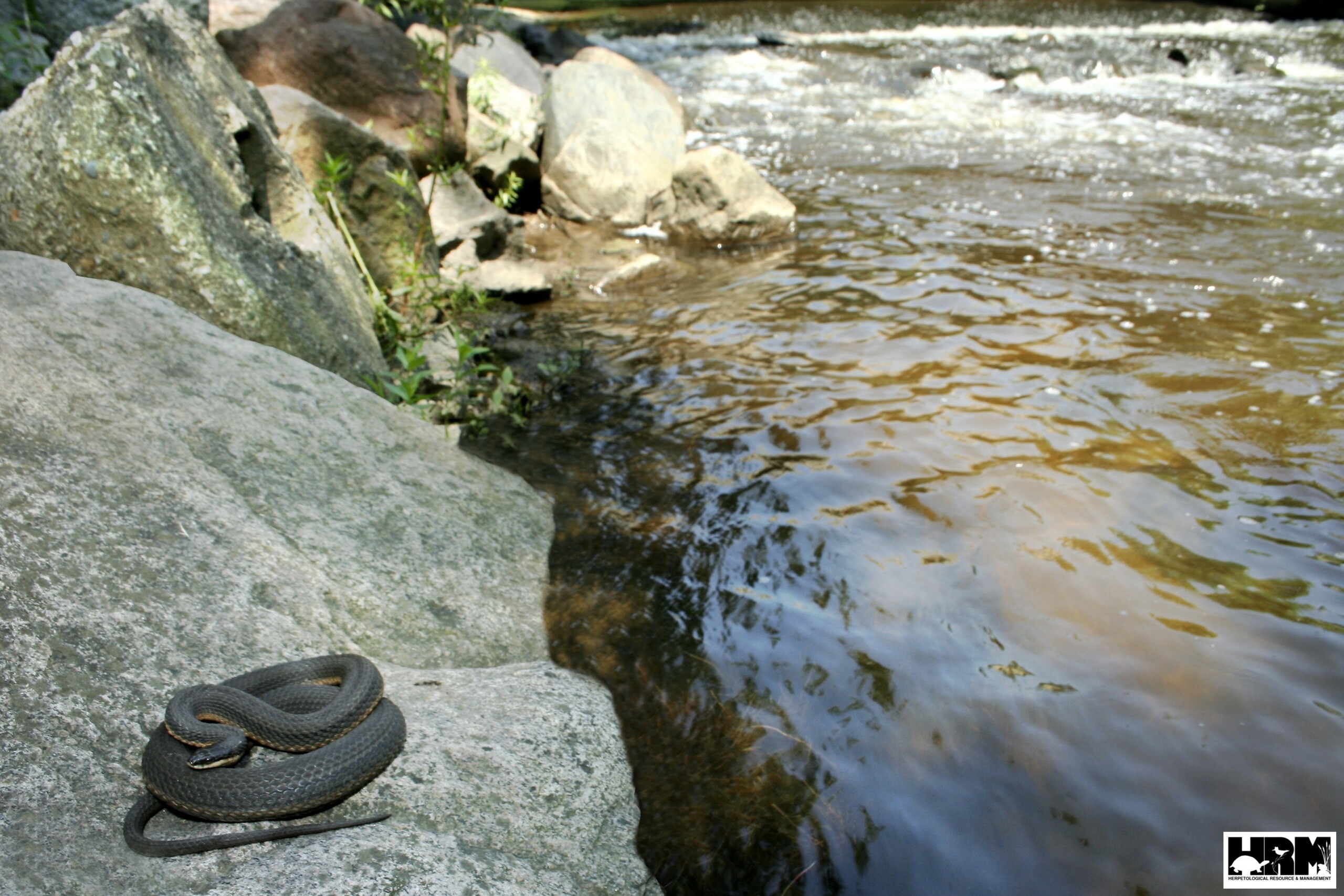
Found in or near warm, shallow, rocky-bottomed streams inhabited by crayfish. Will also occupy the edges of ponds, lakes, marshes, ditches, and canals. Generally, will avoid completely shaded sites but will inhabit areas with an open to moderately closed canopy.
Conservation:
Although considered generally stable throughout much of its range, the Queen Snake is facing population declines in much of the Great Lakes region, including Michigan, where it has been elevated to a species of special concern. Activities such as the development of streams and rivers as well as the draining of wetlands have had major implications to the quality of queen snake habitat. Other factors like pollution and siltation runoff can decimate native crayfish populations which Queen snakes depend upon as their primary food source.
Best Management:
Ensure the protection of quality riparian and streamside habitat as well as the edges of ponds, lakes, rivers, and other forms of wetlands that have been identified as containing crayfish populations. The maintenance and management of native crayfish on the site will greatly benefit this species. Manage for invasive species like the round goby or rusty crayfish that reduce native crayfish populations. Avoid disturbing riparian/streamside zones and adjacent terrestrial areas, but, if necessary, maintain an understory and place temporary erosion control measures to prevent siltation. Implement vegetated buffer zones between areas of chemical application and aquatic systems. Furthermore, identify and prevent non-point nutrient input and chemical runoff from entering the aquatic system. Provide supplemental snake hibernacula structures by excavating a pit to a depth of 8’ and fill the pit with objects such as rocks, logs, tubing, pipes, and rubble before covering it with soil. Ensure access and exit points are available into and out of the hibernacula. Provide snake basking areas by placing rocks or logs in piles in sunny areas while ensuring the material is arranged in a manner that allows for cracks and gaps to act as cover. Provide nesting structures if naturally occurring features are not present. If mowing is to be conducted, mow infrequently and during the hottest times of the year. Additionally, set mower decks high (>6”) to avoid ground-dwelling wildlife or alternatively set mower decks low (<2”) to discourage the movement of herpetofauna into the area. It’s important to note that wildlife clearance surveys must be conducted prior to any mowing operations in areas containing rare herpetofauna.
Adult Coloration:
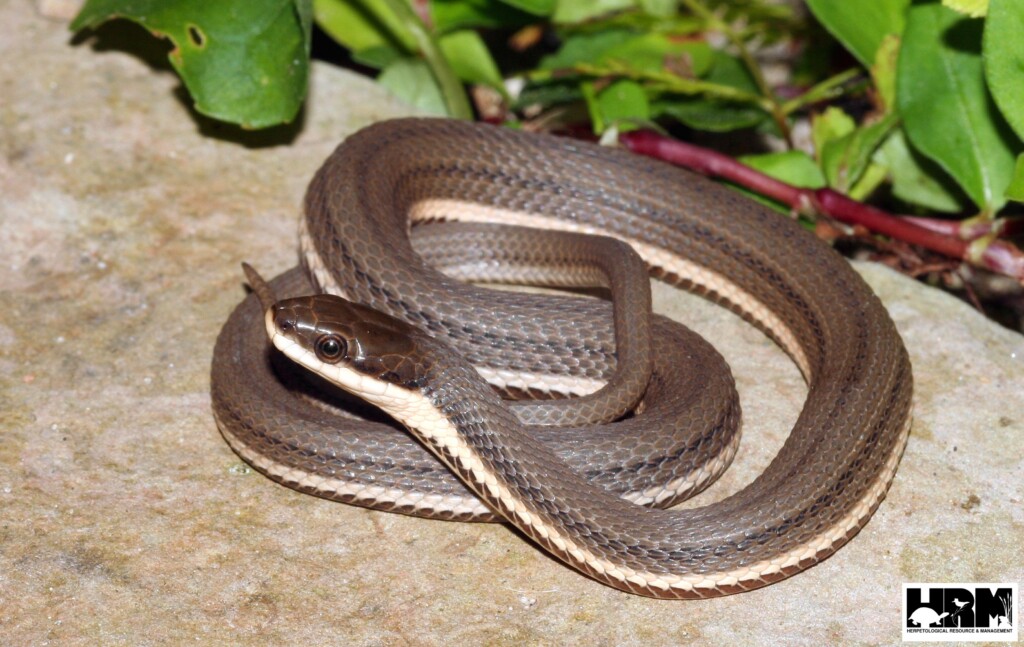
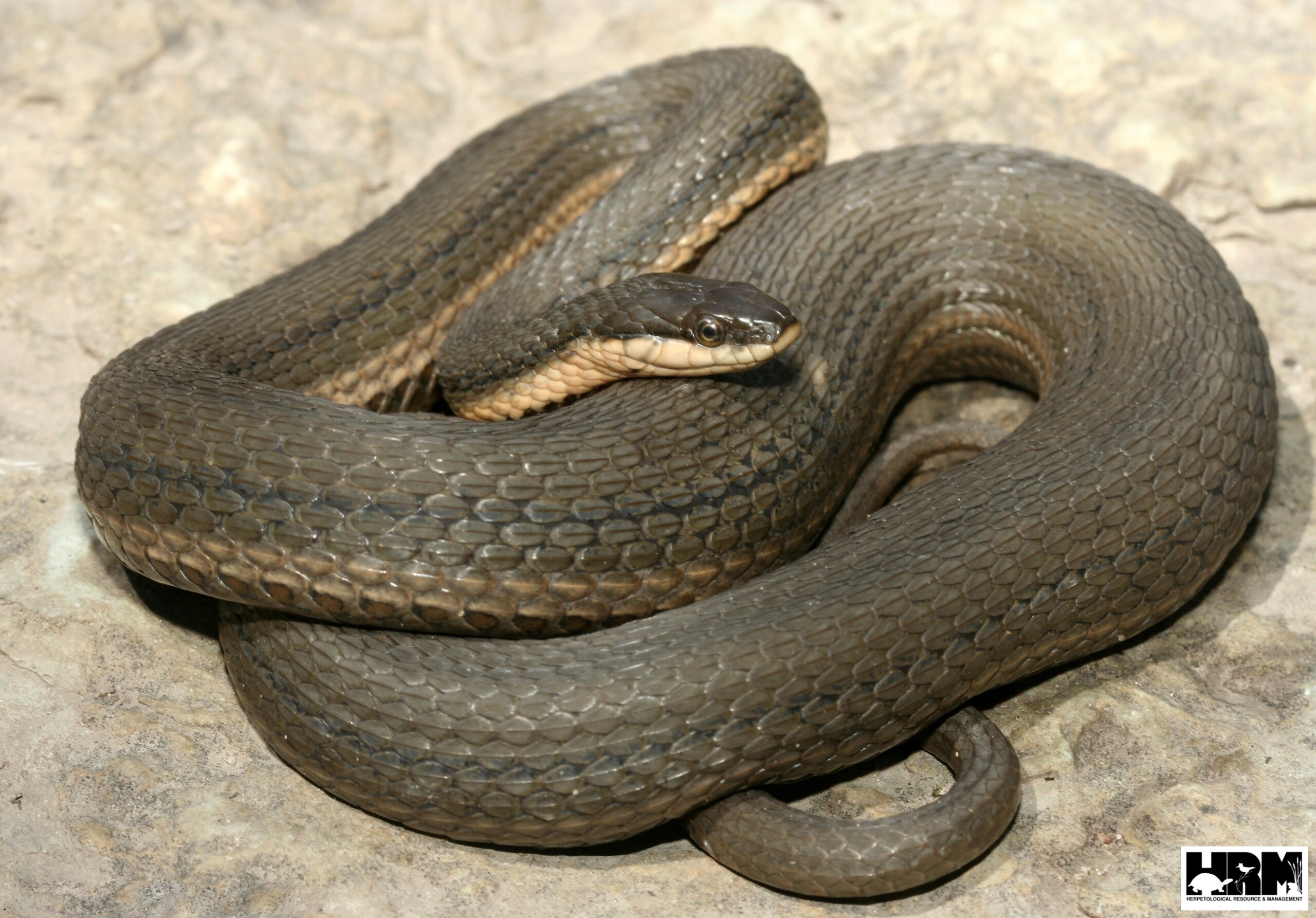
Brown, olive, or grey body color with a light yellow or white stripe along each side of the body located on the second and upper half of the first scale rows. Will continue onto the labial scales (along the mouth) and meet on the bottom of the rostral plate (the nose). Three dark stripes can be found on the backs of some adults that are more commonly seen in juveniles. Older individuals may lose the striping and become entirely dark. The throat, chin, and belly are yellow. The belly has four brown stripes that may fuse or fade toward the tail.
Adult Characteristics:
Small-headed and slender snake with keeled scales (each scale has a small central ridge) and a divided anal plate.
Typical lifespan in wild: 19 years in captivity
Breeding interval: Once yearly
Breeding season: May
Range of number of offspring: 5 – 31
Range gestation period: 11
Average age at sexual/reproductive maturity (female): 2 years
Average at sexual/reproductive maturity (males): 2 years
Diet: Crayfish comprise of their main diet, but they will also occasionally prey on small fish and tadpoles.
Predators: herons, raccoons, Northern River Otters, American Mink, larger snakes, predatory fish, large frogs, and hawks
Juvenile Characteristics:
Range from 6.9 – 9” in length. Their coloration is similar to an adult but the markings, especially the stripes on the belly, are more conspicuous.
Scale Count:
19 scale rows at midbody
Species Confused With:
Garter and Ribbon Snakes are similar in size and have keeled scales but have an unstriped belly, a light stripe down the middle of the back, and an undivided anal plate.
Photos:
References:
- Amphibians and Reptiles of the Great Lakes Region by Jim Harding
- Conant, R., and Collins, J. T. 1998. Reptiles and Amphibians: Eastern, Central North America. Houghton Mifflin Harcourt Press.
- Harding, J and D. Mifsud. 2017. Amphibians and Reptiles of the Great Lakes Region: Revised Edition. Ann Arbor: The University of Michigan Press.
- Harding, J.H. and J.A. Holman. 2006. Michigan Snakes. MSU Extension Ext. Bulletin E-2000,74 pp. [revised].
- Holman, J. A. 2012. The Amphibians and Reptiles of Michigan: A Quaternary and Recent Faunal Adventure. Detroit, Mich., Wayne State University Press.
- Mifsud, David A., Sano, Melissa R., Seguchi, Kotaro J., 2026. Michigan Amphibian and Reptile Best Management Practices Third Edition. Herpetological Resource and Management Technical Publication 2026
- Ruthven, A. G., H. B. T. Gaige, et al. 1912. The herpetology of Michigan, by Alexander B. Ruthven. Crystal Thompson and Helen Thompson; Memoranda towards a bibliography of the archaeology of Michigan, by Harlan I. Smith; prepared under the direction of Alexander G. Ruthven. Lansing, Mich., Wynkoop Hallenbeck Crawford, State Printers.