
Northern Map Turtle
Overview:
Scientific Name: Graptemys geographica
Size: 3.9 – 10.7” (adult carapace length)
Status: Locally present throughout much of the lower Great Lakes basin, but have been extirpated from more heavily polluted urban rivers
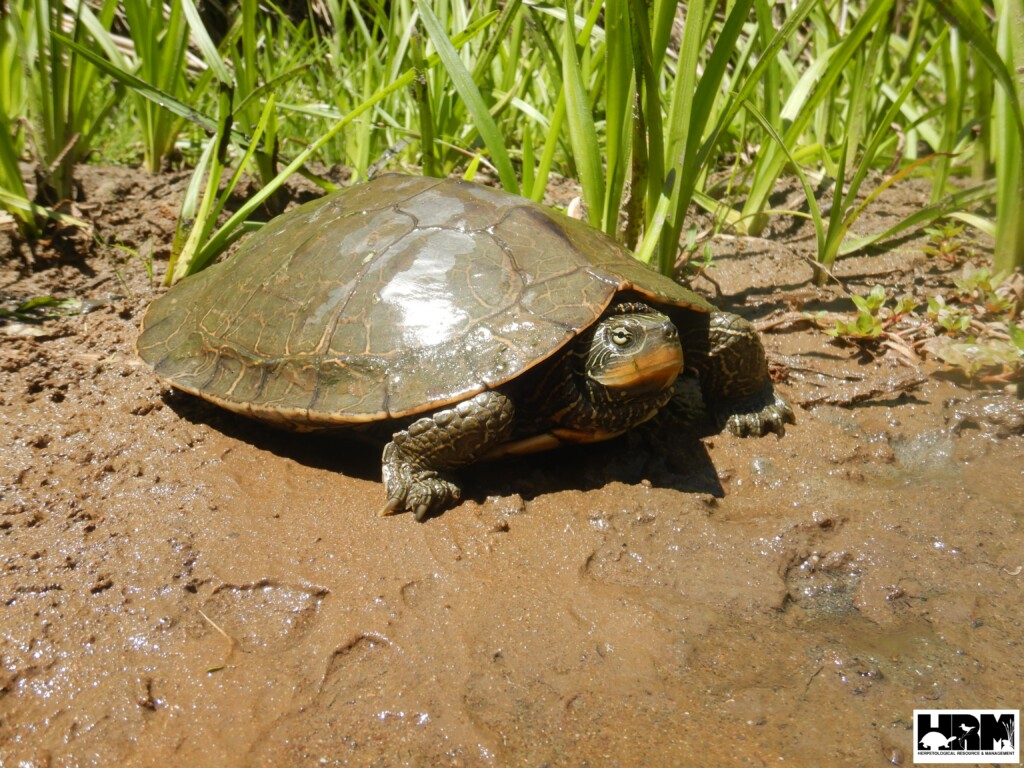
Habitat:
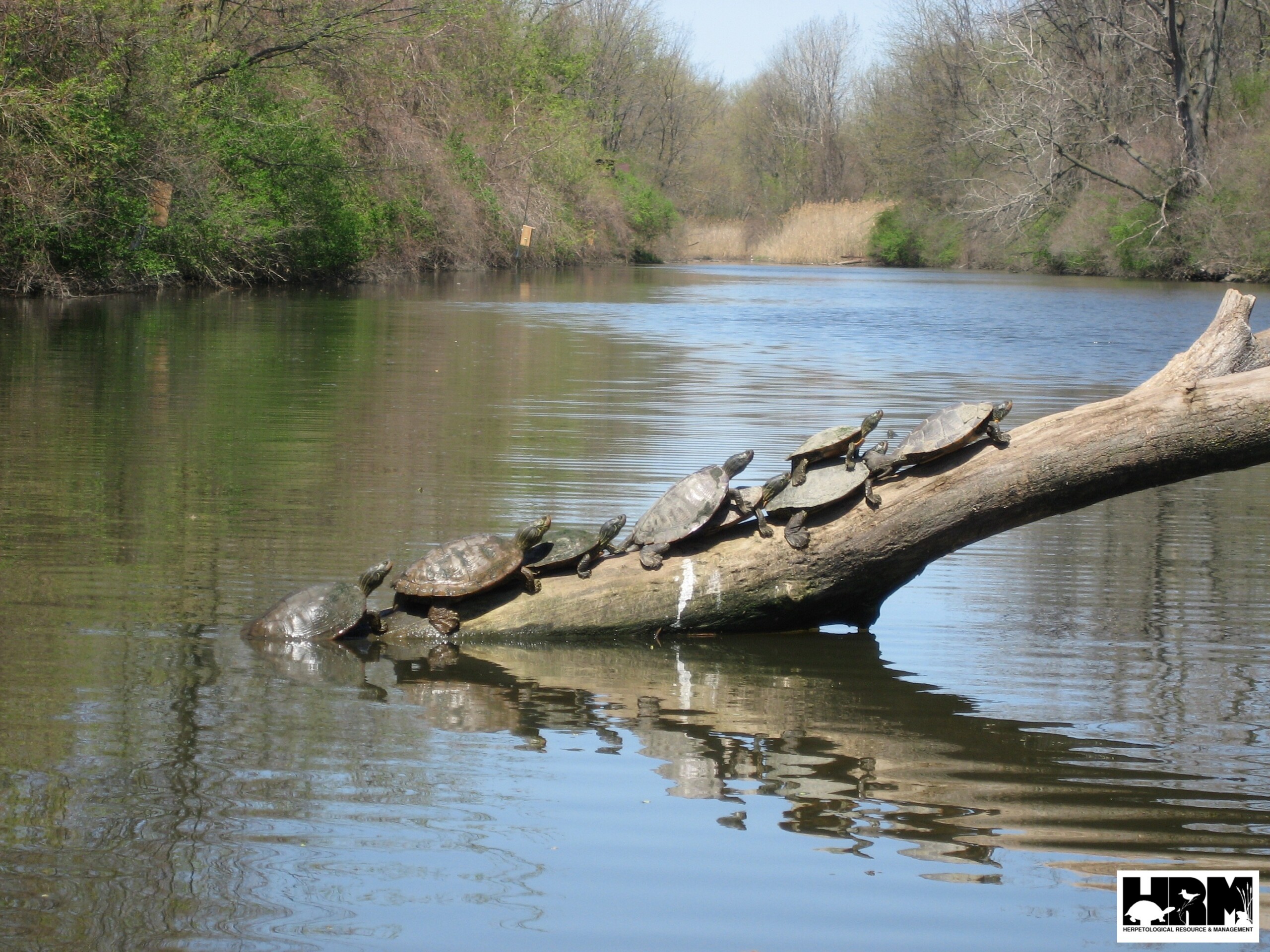
Inhabit larger lakes, rivers, reservoirs, oxbow sloughs, and open marshes including some bays and inlets of the Great Lakes.
Conservation:
This species does no harm to human interests or game species with their mollusk-eating habits being beneficial reducing trematode worms which parasitize game animals, domestic animals and humans. They also eat some invasive mollusks like Zebra Mussel. Formerly were captured for food markets but through regulation and a drop in demand are hardly exploited for food or the pet trade. Populations have been reduced or extirpated in some localities due to pollution and destruction of nesting sites. They frequently persist in rivers running through suburban and agricultural areas including those with modest levels of organic pollution. Those living in lakes are often injured or killed by boat propellers or caught on fishhooks. Basking turtles are often targets of vandals who use them as target practice.
Best Management:
Boating mitigation including lower-powered motors, speed limits, no wake zones, and closing off areas of a lake or river with high densities of species may reduce strikes. In areas with high levels of invasive species of mollusks, consider the species for natural biologic control. Install basking sites and maintain or restore nesting areas that are used. When creating wetlands, make several wetlands with a variety of hydroperiods and conditions for the species and others around them.
Adult Coloration:
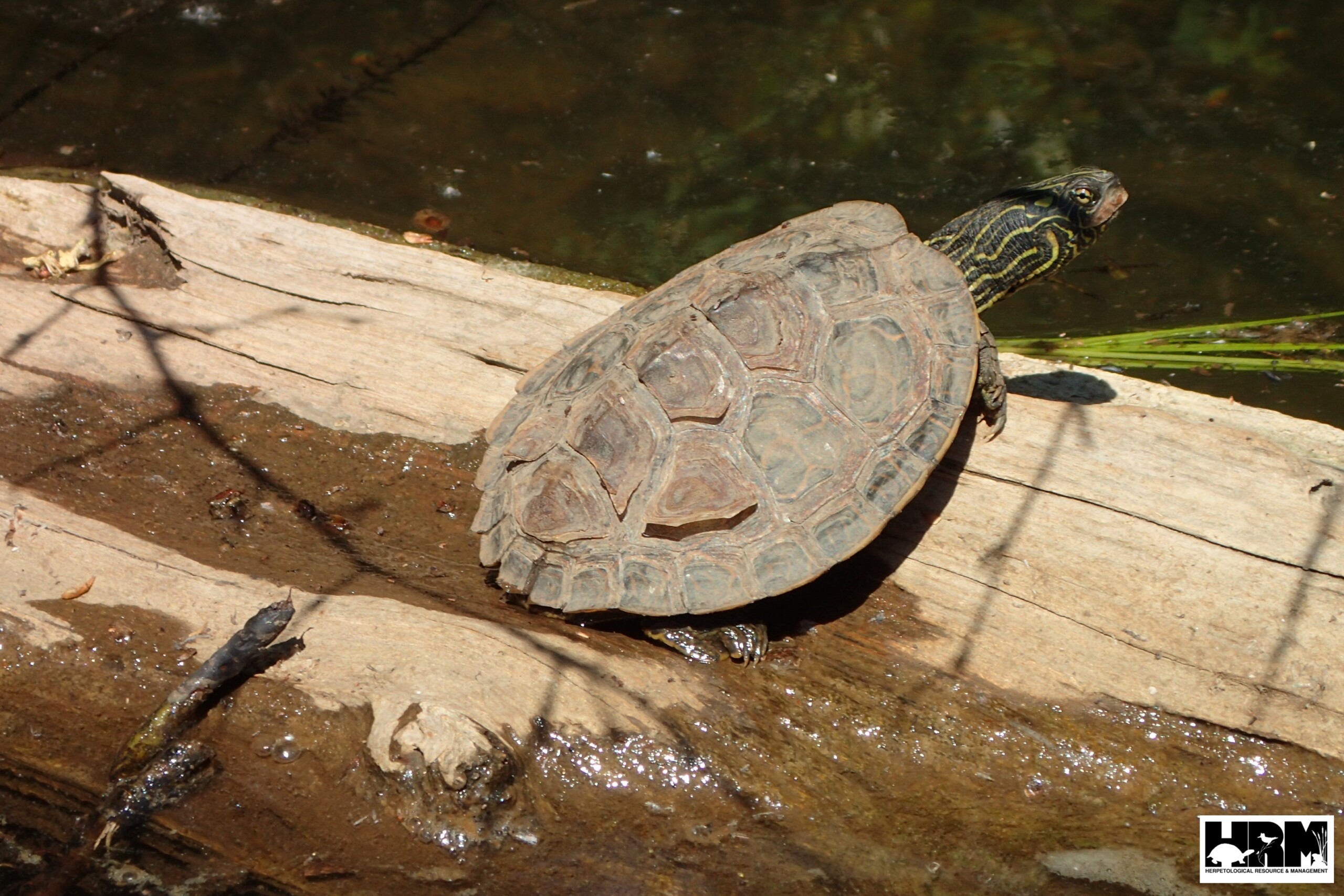
Narrow, dark-bordered yellowish to orange lines that form a network on the olive or greyish-brown carapace. They may become obscured by dark pigment with age. The plastron is yellow with occasional dark markings along scute borders in juveniles and males. The head, neck, and limbs are dark olive, brown, or black with many thin yellow, green, or orangish stripes. Most individuals have a small oval or triangular light spot behind each eye.
Adult Characteristics:
The carapace is fairly broad with a low to moderate keel along the middle of the back with a flared, serrated hind margin from the projecting rear edges of the marginal scutes. The plastron is broad and flat. Females tend to grow larger than males (6.7 – 10.7” compared to 3.9 – 6.3” carapace length). Males have a oval carapace with a distinct central keel, narrower head, longer front claws, and a longer, thicker tail.
Juvenile Characteristics:
Hatchlings have a rounded grey or grayish-brown carapace about 1.1” long with light circular markings and a distinct central keel. The plastron is light yellow or off-white with dark borders on the scutes. There is a stripped pattern on the head and limbs as an adult.
Species Confused With:
Wood Turtles lack yellow stripping on the head and have a sculptured-looking carapace. Painted Turtles have a smooth, unserrated and unkeeled carapace with red markings under the marginal scutes. Red-eared Sliders have a broad reddish or orange stripe behind the eye and large black spots on the plastron (except in some older males).
Photos:
References:
- Amphibians and Reptiles of the Great Lakes Region by Jim Harding
- Conant, R., and Collins, J. T. 1998. Reptiles and Amphibians: Eastern, Central North America. Houghton Mifflin Harcourt Press.
- Harding, J and D. Mifsud. 2017. Amphibians and Reptiles of the Great Lakes Region: Revised Edition. Ann Arbor: The University of Michigan Press.
- Harding, J.H. and J.A. Holman. 1990. Michigan Turtles and Lizards. MSU Cooperative Extension Service and MSU Museum. 96 pp.
- Holman, J. A. 2012. The Amphibians and Reptiles of Michigan: A Quaternary and Recent Faunal Adventure. Detroit, Mich., Wayne State University Press.
- Mifsud, David A., Sano, Melissa R., Seguchi, Kotaro J., 2026. Michigan Amphibian and Reptile Best Management Practices Third Edition. Herpetological Resource and Management Technical Publication 2026
- Ruthven, A. G., H. B. T. Gaige, et al. 1912. The herpetology of Michigan, by Alexander B. Ruthven. Crystal Thompson and Helen Thompson; Memoranda towards a bibliography of the archaeology of Michigan, by Harlan I. Smith; prepared under the direction of Alexander G. Ruthven. Lansing, Mich., Wynkoop Hallenbeck Crawford, State Printers.