
Spotted Salamander
Overview:
Scientific Name: Ambystoma maculatum
Size: 4.3 – 9.8” (adult size)
Status: Can be locally abundant when high quality habitat remains intact but will disappear quickly if habitat is altered
Habitat:
Moist deciduous or mixed woodlands with closed canopies are preferred. Usually avoid swampy forests where flooding occurs, uncommon or absent in recently disturbed forests especially those that are fragmented by human activities like logging, grazing or burning. Habitats must contain or be near temporary or semi-permanent ponds.
Conservation:
The presence of relatively undisturbed woodlands and temporary and/or permanent fishless ponds is tied to their future persistence. Human activities that open forest canopies can lower humidity and create unsuitable conditions. The construction of roads between wooded uplands and breeding lowlands can lead to mass mortality of breeding salamanders. Historically captured for the biological supply and pet trades, usually while in breeding ponds which can disrupt population stability. Acid precipitation may be a threat to eggs and larvae, though sensitivity to acidification of breeding ponds is variable between populations.
Best Management:
Consider the effects of altering or destroying vernal pools and other fish-free ponds. Do not impact the pool depression or core buffer area within 100 feet of the pools and aim to protect a wider buffer of 600 – 1000 feet around the pools. Try to maintain the forest canopy and any habitat corridors to other vernal pools and upland habitats, these landscape mosaics are important to the species. Crossing structures can help reduce the effects of habitat fragmentation by roadways. Minimize the spread of salt on roadways near wetlands which can reduce the survival of pollution sensitive species.
Adult Coloration:
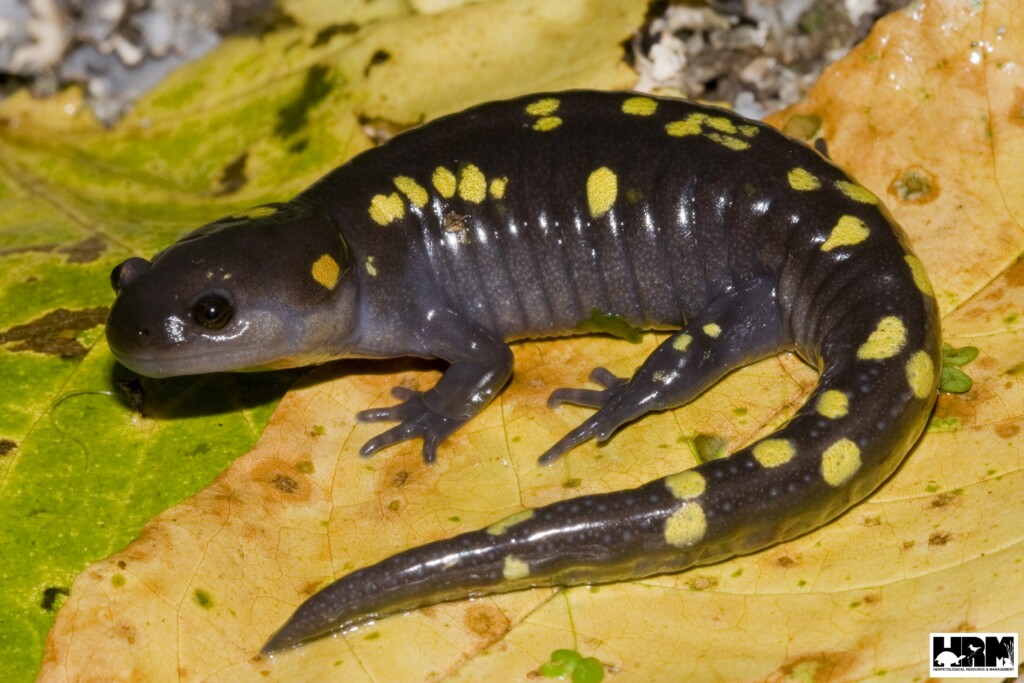
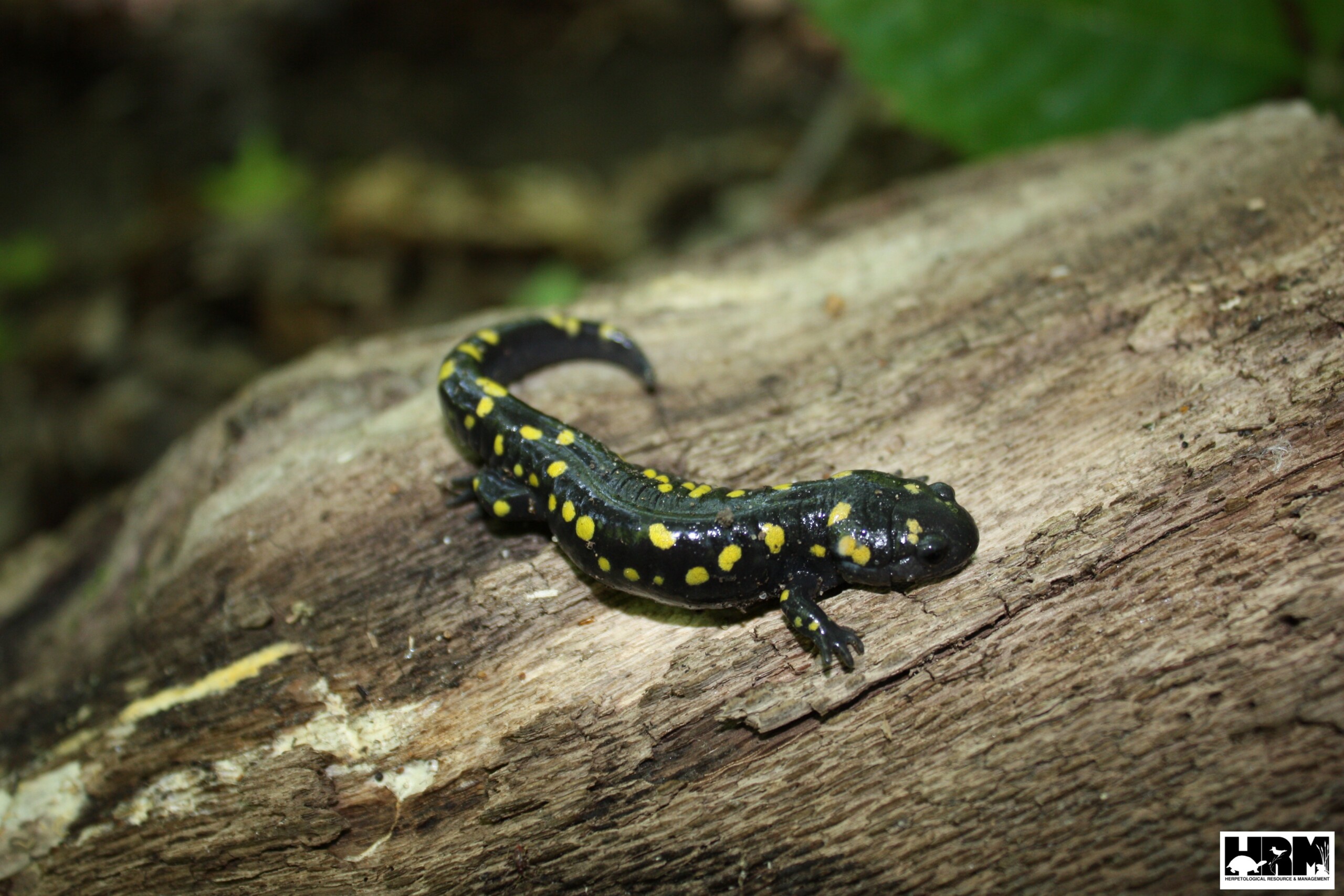
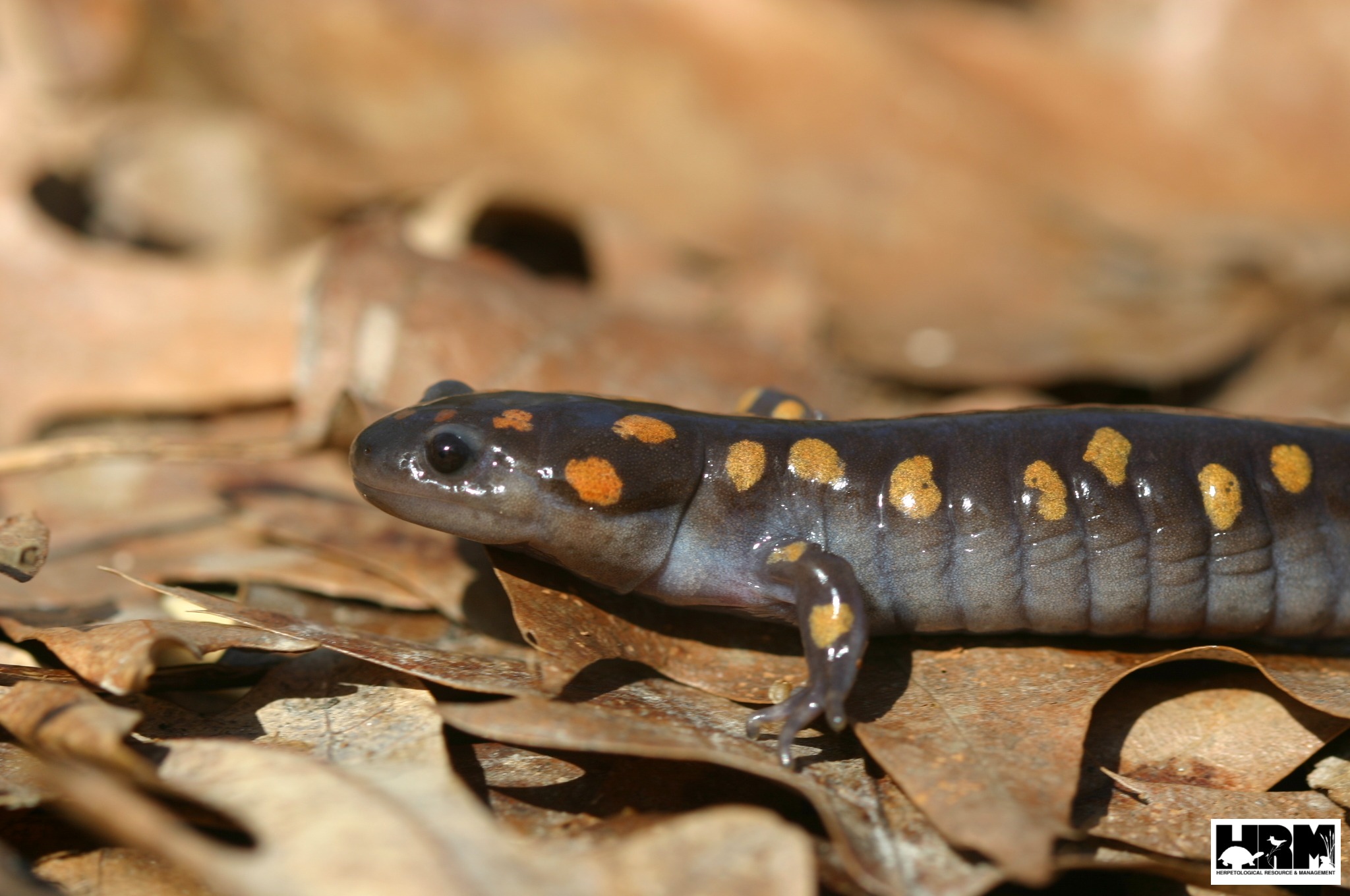
Black, dark grey, or dark brown from above with two irregular rows of rounded yellow spots from the head down onto the tail. Spots may appear on the legs or snout. Sometimes spots on the head are bright orange. Occasionally spots may appear white or tan and, rarely, no spots are presents. Sides and belly are generally unspotted and are grey or purplish in color.
Adult Characteristics:
Stout salamanders with broad heads and rounded snouts. 11-13 costal grooves (grooves between rib-like ridges that run down the sides of the body). Males are usually slimmer bodied than females and have a swollen vent during breeding season.
Juvenile Characteristics:
Metamorphs are typically dark grey or brown with greenish-yellow flecks or patches with dull yellow to tan bellies. Spots appear around the time the salamander reaches 2.4” long.
Larvae Characteristics:
Older larvae (those that are greater than 1.5” in size) are usually greenish gray to brown from above with small, yellow spots along the sides. Tail fins are usually greyish with light yellow mottling.
Species Confused With:
Tiger Salamanders are larger and have irregularly shaped spots or blotches that extend onto the sides and belly. Newly transformed Blue-spotted Salamanders may exhibit yellow spots, but these are restricted to the sides and belly compared to the Spotted Salamanders which usually lack spots in these areas.
Photos:

References:
- Amphibians and Reptiles of the Great Lakes Region by Jim Harding
- Conant, R., and Collins, J. T. 1998. Reptiles and Amphibians: Eastern, Central North America. Houghton Mifflin Harcourt Press.
- Harding, J and D. Mifsud. 2017. Amphibians and Reptiles of the Great Lakes Region: Revised Edition. Ann Arbor: The University of Michigan Press.
- Harding, J.H. and J.A. Holman. 2006. Michigan Snakes. MSU Extension Ext. Bulletin E-2000,74 pp. [revised].
- Holman, J. A. 2012. The Amphibians and Reptiles of Michigan: A Quaternary and Recent Faunal Adventure. Detroit, Mich., Wayne State University Press.
- Mifsud, David A., Sano, Melissa R., Seguchi, Kotaro J., 2026. Michigan Amphibian and Reptile Best Management Practices Third Edition. Herpetological Resource and Management Technical Publication 2026
- Ruthven, A. G., H. B. T. Gaige, et al. 1912. The herpetology of Michigan, by Alexander B. Ruthven. Crystal Thompson and Helen Thompson; Memoranda towards a bibliography of the archaeology of Michigan, by Harlan I. Smith; prepared under the direction of Alexander G. Ruthven. Lansing, Mich., Wynkoop Hallenbeck Crawford, State Printers.