
Eastern Fox Snake
Overview:
Scientific Name: Pantherophis gloydi
Size: 35.4 – 70.5” (total adult length)
Status: Uncommon or rare in many areas.
Michigan State Status: Threatened
MDNR Wildlife Action Plan Status: Species of Greatest Conservation Need
Habitat:
Inhabits Great Lakes shoreline marshes, vegetated dunes and beaches, and occasionally found in nearby farm fields, pastures, and wooded areas near shore.
Conservation:
Historically once abundant along the shores of Lake Huron and Lake Erie stretching from Saginaw Bay to as far east as Buffalo, the eastern fox snake is now limited to an expanse that ranges from Saginaw Bay to the western portion of Lake Erie. Elevated to the status of special concern, the extirpation of the eastern fox snake throughout Michigan can be attributed to threats such as habitat loss, pollution, persecution, illegal collection for the pet trade, and road mortality. Eastern fox snakes serve an important ecological function in controlling rodent populations, which directly correlates to a decrease in crop damage and reinforces the necessity for this species to persist in the landscape.
Best Management:
The identification and protection of known eastern fox snake populations should be conducted as well as the management of their habitat. Restoring large wetland complexes as well as preventing habitat fragmentation will greatly benefit this species. Pollution of suitable habitats can be mitigated by using vegetated buffer zones between areas of known chemical application and aquatic systems. Additionally, identify and prevent non-point nutrients and chemical runoff from entering the system. Prescribed burns may be considered to maintain open habitat; however, burns must adhere to herpetofauna-specific guidelines to reduce incidental mortality. Provide hibernacula structures by excavating a pit to a depth of 8’ and filling it with objects such as rocks, logs, tubing, piping, and rubble. Cover the pit with soil but ensure gaps are present to act as access and exit points. Basking structures may also be provided by piling material like rocks or logs in sunny locations. If needed, supplemental cover objects may also be provided, either from naturally occurring material or artificially. Provide nesting structures if naturally occurring features are not present. If mowing is necessary, mow infrequently and during the hottest times of the year. Furthermore, set the mower deck high (>6”) to avoid wildlife on the ground or low (<2”) to discourage the movement of herpetofauna into specific areas. It’s important to note that wildlife clearance surveys must be conducted prior to any mowing operations in areas containing rare herpetofauna. Education and outreach should be initiated to prevent the indiscriminate killings of eastern fox snakes, which are often mistaken for the eastern Massasauga rattlesnake. Monitor sites with known populations to prevent the collection of eastern fox snakes for the illegal wildlife trade and report suspicious activities to wildlife law enforcement. Consider utilizing wildlife barrier fencing or crossing structures along habitat located adjacent to development or roads to reduce incidental mortality.
Adult Coloration:
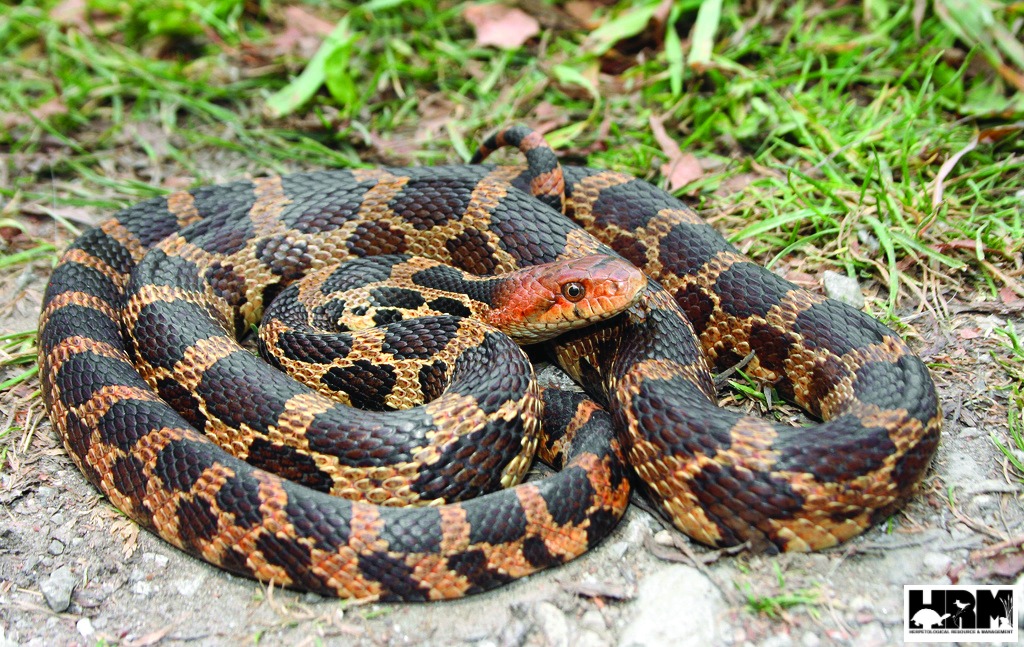
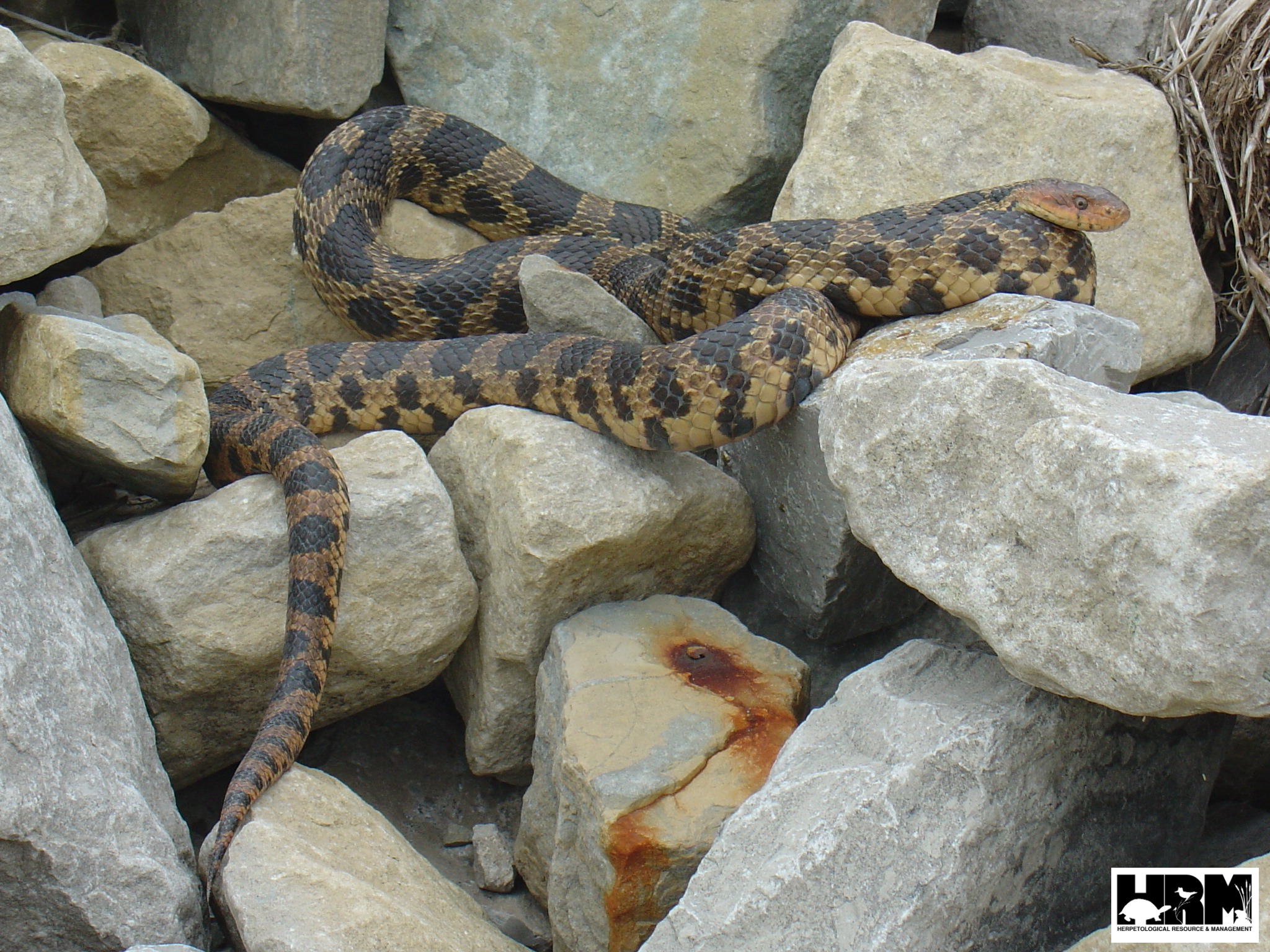
A yellowish or light brown body with a row of dark brown blotches that go down the center of the back and alternate with smaller dark blotches down the sides. T e head can be light brown to a coppery reddish-brown with a dark band between the eyes and another from the bottom of the eye to the corner of the mouth which may fade in older adults. The belly is yellowish with irregular rows of dark squarish spots. Males have longer tails than females while females, particularly when gravid, are thicker bodied than males.
Adult Characteristics:
A robust snake with a short, pointed tail with the upper body scales weakly keeled (each scale has a small central ridge) with a divided anal plate.
Typical lifespan in wild: Unknown, up to 17 years in captivity
Breeding interval: once annually
Breeding season: June and July
Range number of offspring: 7-29
Average number of offspring: 20
Range gestation period: 50 – 65 days
Average age at sexual/reproductive maturity (female): 4 years old
Average age at sexual/reproductive maturity (male): 4 years old
Diet: Mainly feed on small mammals, frogs, birds, and occasionally bird eggs.
Predators: Egrets, herons, hawks, raccoons, foxes, mink.
Juvenile Characteristics:
Hatchlings range from 10.2 to 12.2” in length with a paler body color than adults with more distinct head markings with grey or brown dorsal blotches edged with black.
Scale Count:
23 – 25 scale rows at midbody
Species Confused With:
Eastern Milk Snakes have unkeeled scales and a single anal plate. Juvenile Racers also have unkeeled scales and do not have a stripe from the eye to the end of the jaw. Juvenile Black Rat Snakes are similar to juveniles of this species but have more than 200 ventral scutes (Eastern Fox Snakes have 216 or less). The Western Fox Snake is very similar, but their ranges do not overlap thus distinguishing them. Eastern Fox Snakes have fewer and larger dorsal blotches on the body and tail (28 – 43, averaging 34) than Westerns who have smaller blotches (32 – 52, averaging 41).

References:
- Amphibians and Reptiles of the Great Lakes Region by Jim Harding
- Conant, R., and Collins, J. T. 1998. Reptiles and Amphibians: Eastern, Central North America. Houghton Mifflin Harcourt Press.
- Harding, J and D. Mifsud. 2017. Amphibians and Reptiles of the Great Lakes Region: Revised Edition. Ann Arbor: The University of Michigan Press.
- Harding, J.H. and J.A. Holman. 2006. Michigan Snakes. MSU Extension Ext. Bulletin E-2000,74 pp. [revised].
- Holman, J. A. 2012. The Amphibians and Reptiles of Michigan: A Quaternary and Recent Faunal Adventure. Detroit, Mich., Wayne State University Press.
- Mifsud, David A., Sano, Melissa R., Seguchi, Kotaro J., 2026. Michigan Amphibian and Reptile Best Management Practices Third Edition. Herpetological Resource and Management Technical Publication 2026
- Ruthven, A. G., H. B. T. Gaige, et al. 1912. The herpetology of Michigan, by Alexander B. Ruthven. Crystal Thompson and Helen Thompson; Memoranda towards a bibliography of the archaeology of Michigan, by Harlan I. Smith; prepared under the direction of Alexander G. Ruthven. Lansing, Mich., Wynkoop Hallenbeck Crawford, State Printers.