
Painted Turtle
Overview:
Scientific Name: Chrysemys picta
Size: 3.5 – 10” (adult carapace length)
Status: Locally abundant throughout most of the Great Lakes region, though population densities tend to be lower in far north
Habitat:
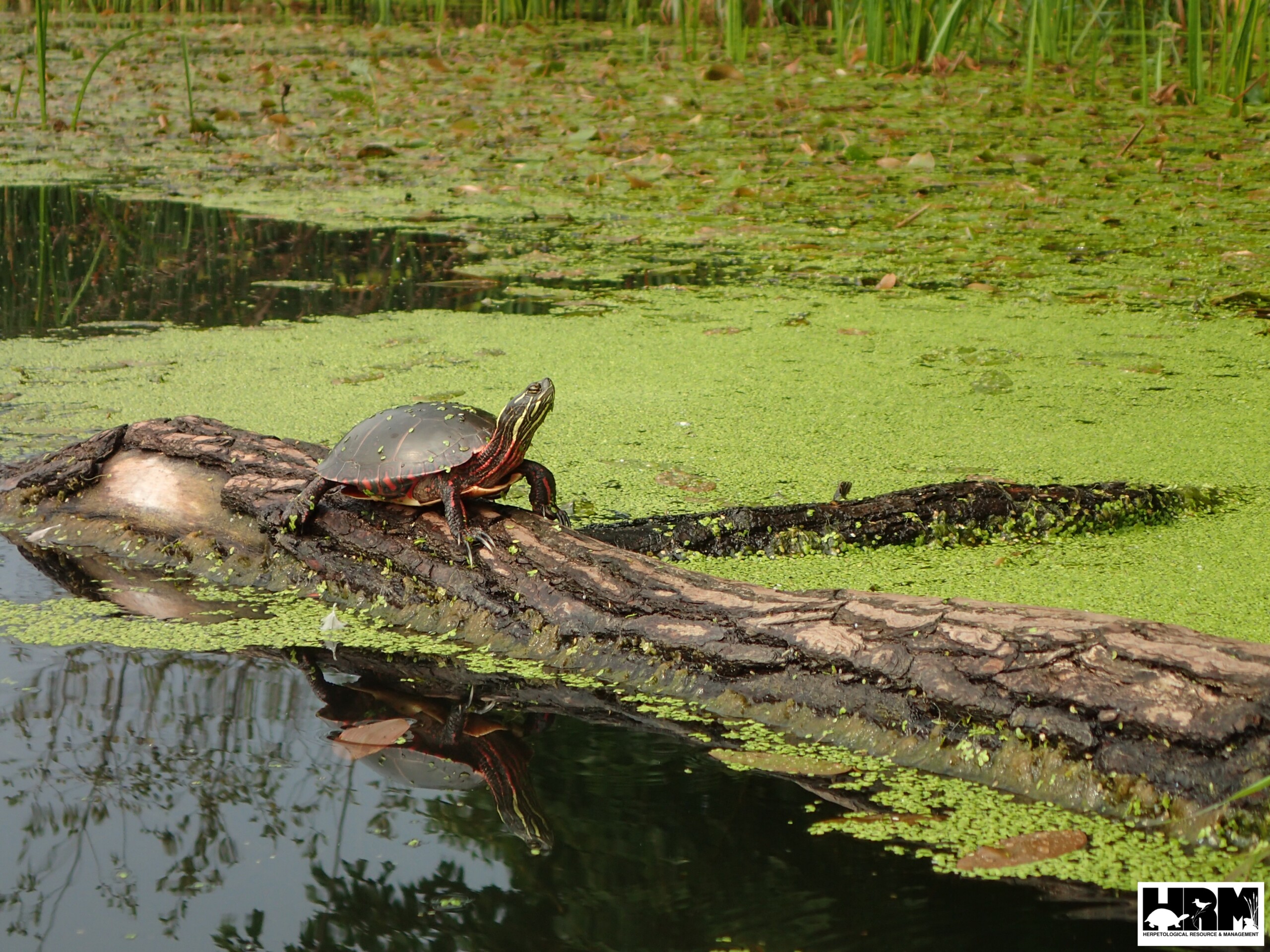
Inhabit quiet or slow-moving permanent waters with soft bottom substrate, abundant aquatic vegetation, and basking sites (logs, rocks, or mats of floating vegetation). Will temporarily occupy vernal pools, sterile impoundments, ditches, and faster–moving streams and rivers, and are able to tolerate fairly high levels of organic pollution. They will move over land if needed. Deeper or spring-fed waters are often favored in the fall and winter with spring migrations to shallower or productive ponds, marshes, and lake edges.
Conservation:
Harmless to human interests and have considerable aesthetics to boaters and recreationists. Occasionally eaten by people but are too small to have commercial value. Some have been exploited for laboratory use and the pet trade. Common in many urban and suburban waters and have benefited from farm and ornamental ponds. However, many are killed on roadways and the human support of predators like racoons have led to increased nest predation. Basking turtles are at risk of vandals who use them as target practice.
Best Management:
Application of pesticides should occur during inactive months when possible, to limit incidental exposure. Maintain or restore nesting sites. Nest site protections like predator control and egg protective devices can help reduce large mortality events. Install basking structures in areas lacking them or in areas they are removed. Crossing structures can help reduce the effects of habitat fragmentation and mortality by roadways or railways.
Adult Coloration:
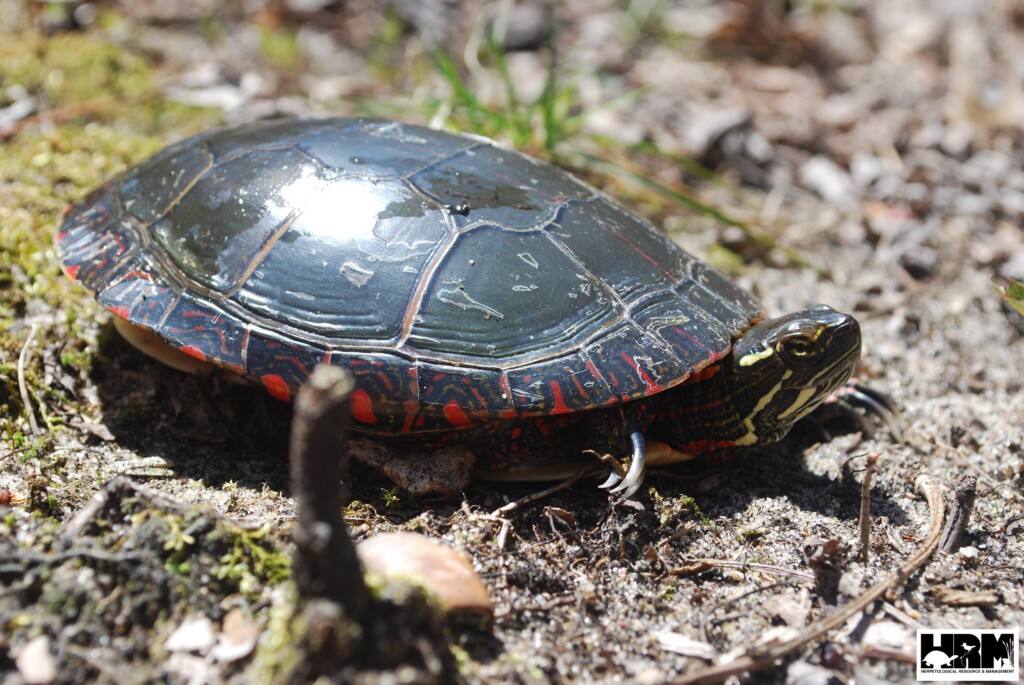
A black or olive carapace with red bars or blotches on the marginal scutes often with a thin red stripe down the midline. The plastron is yellow often tinged with red, pink, or orange and usually has a dark central blotch or figure that varies according to subspecies (see below). Occasionally the entire shell will be stained a dark reddish-brown from minerals absorbed from the water or substrate. The skin is black or olive. Both the head and throat have yellow stripes and sometimes a yellow streak or bar behind the eye. The eye is yellow with a dark horizontal bar through the pupil. The upper neck, legs, and tail are striped red and/or yellow.
Adult Characteristics:
A smooth, unkeeled carapace. The rear marginals scutes are unserrated. The plastron is hingeless. The upper jaw has two toothlike cusps on either side of a terminal notch. Males are generally smaller and flatter than females with greatly elongated front claws.
Juvenile Characteristics:
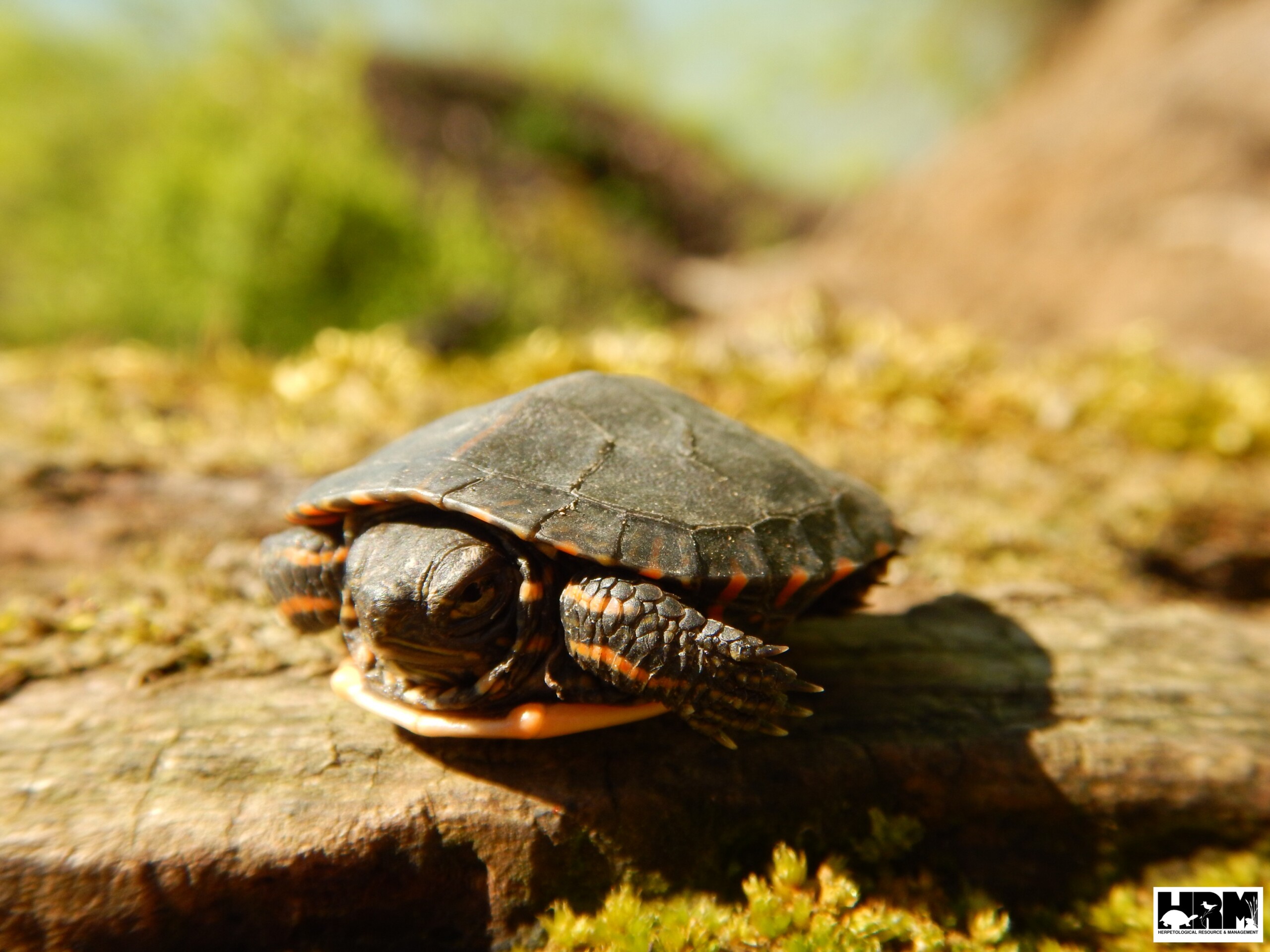
A rounded, slightly keeled carapace that averages 1” in length. Coloration is that of an adult but is brighter and more contrasting.
Species Confused With:
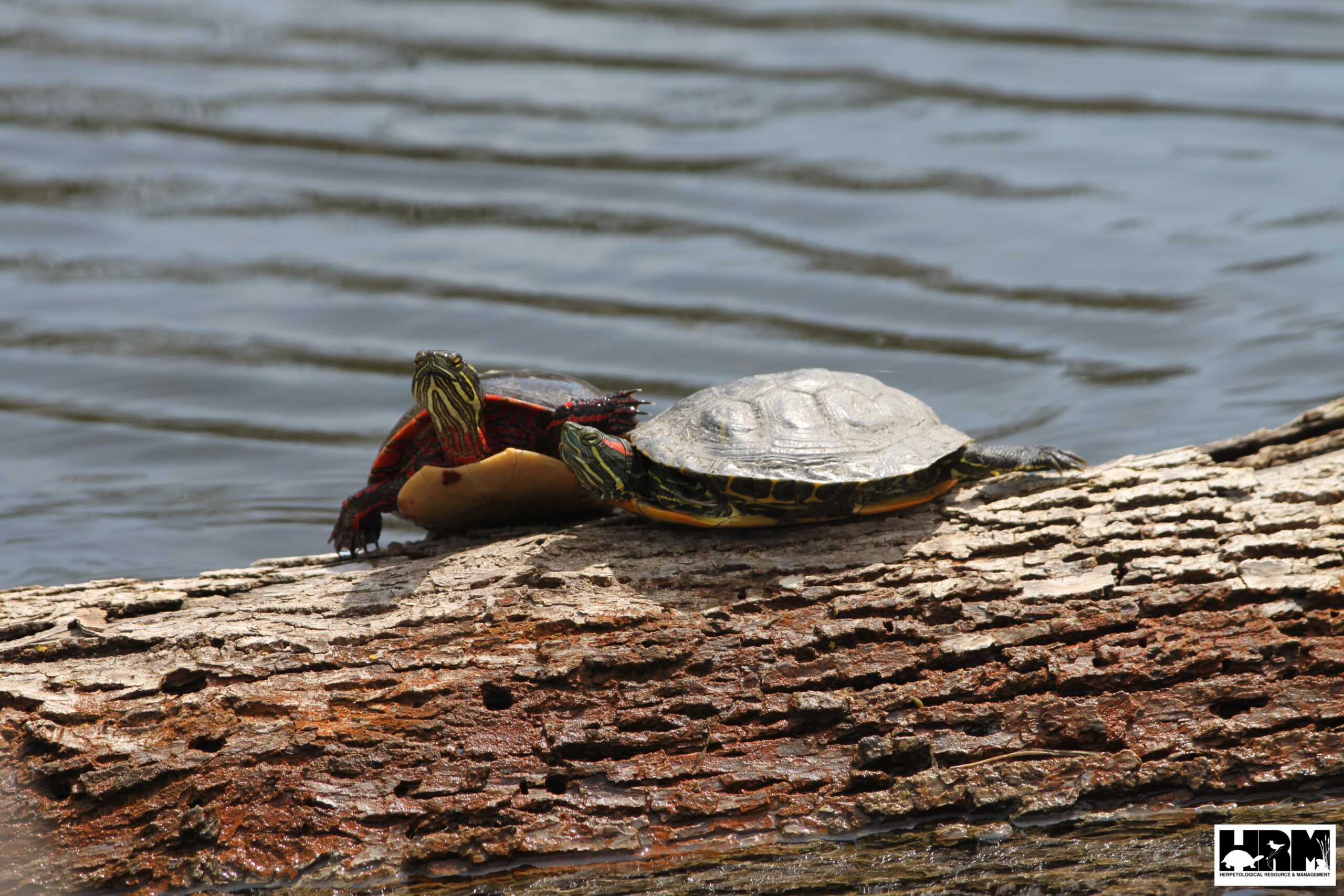
Northern Map Turtles lack red markings and have a keeled carapace with serrated rear margins. Red-eared Sliders have a broad red band or stripe behind the eye, lack red carapace markings, and have a yellow plastron with a single black spot in each scute.
Distinction between subspecies:
There are four distinct subspecies that are recognized, two of which are found in the Great Lakes basin. The Midland Painted Turtle (C. picta marginata) tends to have prominent red stripes on the forelegs and neck, and the plastron is usually yellow or orangish-yellow with an elongated dark central blotch that does not cover more than half the plastral width. The Western Painted Turtle (C. picta belli) usually has narrow yellow stripes on the forelegs and neck and a pattern of light lines on the carapace. The plastron may be reddish or orangish with a complex central pattern of dark and light lines that extend out along the scute seams and often covers more than half of the plastral width. Midland Painted Turtles occur in the Lower Peninsula and Western Painted Turtles occur in the western half of the Upper Peninsula, the central and eastern half of the Upper Peninsula has integrated populations with individuals displaying a variable blending of characteristics from both subspecies.
Photos:
References:
- Amphibians and Reptiles of the Great Lakes Region by Jim Harding
- Conant, R., and Collins, J. T. 1998. Reptiles and Amphibians: Eastern, Central North America. Houghton Mifflin Harcourt Press.
- Harding, J and D. Mifsud. 2017. Amphibians and Reptiles of the Great Lakes Region: Revised Edition. Ann Arbor: The University of Michigan Press.
- Harding, J.H. and J.A. Holman. 1990. Michigan Turtles and Lizards. MSU Cooperative Extension Service and MSU Museum. 96 pp.
- Holman, J. A. 2012. The Amphibians and Reptiles of Michigan: A Quaternary and Recent Faunal Adventure. Detroit, Mich., Wayne State University Press.
- Mifsud, David A., Sano, Melissa R., Seguchi, Kotaro J., 2026. Michigan Amphibian and Reptile Best Management Practices Third Edition. Herpetological Resource and Management Technical Publication 2026
- Ruthven, A. G., H. B. T. Gaige, et al. 1912. The herpetology of Michigan, by Alexander B. Ruthven. Crystal Thompson and Helen Thompson; Memoranda towards a bibliography of the archaeology of Michigan, by Harlan I. Smith; prepared under the direction of Alexander G. Ruthven. Lansing, Mich., Wynkoop Hallenbeck Crawford, State Printers.