
Northern Dusky Salamander
Overview:
Scientific Name: Desmognathus fuscus
Size: 2.8 – 5.6” (adult size)
Status: Locally abundant where suitable habitat is present, small Michigan population is believed to be introduced
Michigan State Status: Special Concern
MDNR Wildlife Action Plan Status: Species of Greatest Conservation Need
Habitat:
Inhabits the edges of rocky streams, hillside springs, and seepages often in wooded or partly wooded locations. Spend a majority of time underneath flat rocks, logs, and objects adjacent to or partially submerged in water.
Conservation:
Deforestation poses a serious implication to the longevity of the Northern Dusky Salamander, which has already been designated as a species of special concern in the state of Michigan. With the landscape continuously being altered for development, much of this salamander’s habitat is under threat by the removal of trees which can create inhospitable microclimate conditions. Other factors that are influencing the decline in northern dusky salamanders in Michigan can be attributed to pollution and collection of this species for use as bait.
Best Management:
Identify and protect quality northern dusky salamander habitat containing extant populations. Riparian zones with adjacent moist woodland habitat are preferred. Avoid disturbing these riparian zones and adjacent terrestrial areas; however, if harvest is necessary, maintain an understory and establish temporary erosion control measures. Harvest during late fall to early winter and utilize various tree harvest techniques instead of clearcutting. Use coarse woody material to create simple habitat structures and maintain the litter layer as well as understory vegetation to provide appropriate microclimate conditions. Try to maintain a canopy of >50% in moist areas and ensure habitat connectivity between breeding sites and adjacent habitat. If vernal pools are present, do not impact the pool depression or core buffer area within a minimum of 100 feet and aim to protect an additional wider buffer of 600-1000 feet. If contaminants are present on the landscape, utilize vegetative buffer zones between areas of contamination and aquatic system. Also, intercept contaminant runoff before reaching the aquatic system. Provide egg laying structure by submerging finely brushed trees or bushes and ensure the presence of native plant communities. Additional aquatic structures may be placed in shallow water. Regulations regarding the take of northern dusky salamanders for use as bait should be further examined.
Adult Coloration:
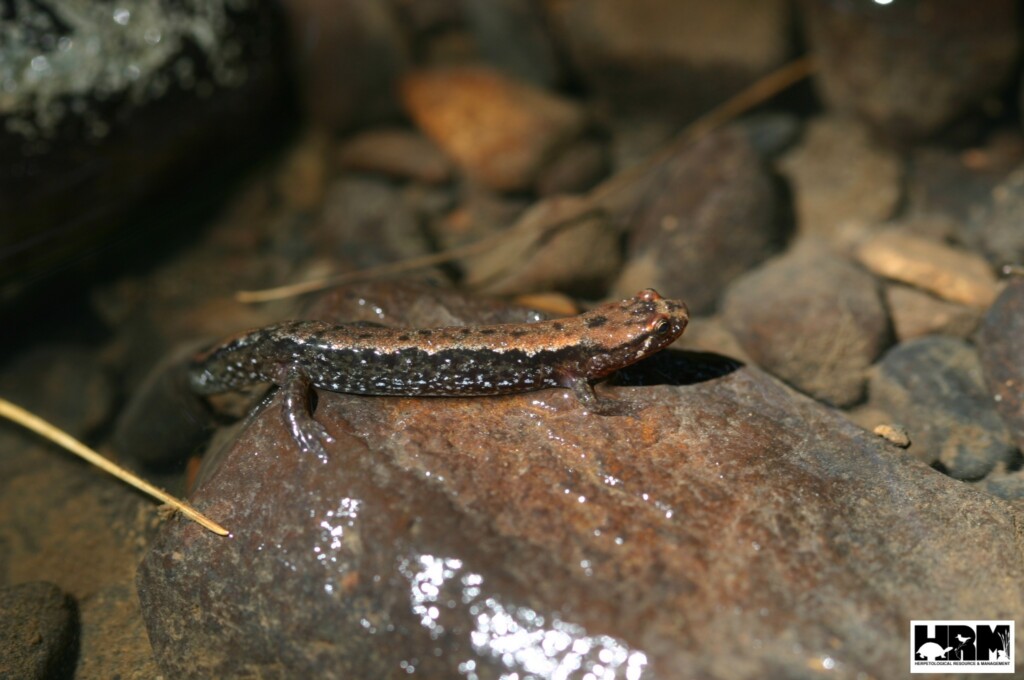
Usually has a light stripe that angles from the eye to the back of the jaw. Overall coloration is variable but most often observed with broad yellowish-grey, tan or reddish-brown stripe from head to tail and an irregular dark brown or black border on each side. The backside pattern may become obscured with darker pigment as they age. The belly is white or grey with dark grey mottling.
Adult Characteristics:
Small, stout salamander with hind legs that are larger than the front legs. The tail is flattened toward the top and has a narrow ridge along the upper edge. Has 14 coastal grooves (grooves between rib-like ridges that run down the sides of the body). Males are longer than females with broader heads. The males vent will become swollen during breeding season with fingerlike projections (called papillae) at the cloacal opening.
Typical lifespan in wild:
Breeding interval: annually (up to twice but uncommon)
Breeding season: Spring & Fall (delayed fertilization)
Range number of offspring: 12 – 51
Average number of offspring: 28
Range time to hatchling: 50 – 80 days (metamorphosis: 7 – 11 months)
Average age at sexual/reproductive maturity (females): 3 – 4 years
Average age at sexual/reproductive maturity (male): 2 – 3 years
Diet: small invertebrates consisting of earthworms, slugs, snails, crustaceans, spiders, mites, flies, and fly larvae, ants, beetles, beetle larvae, centipedes, moths, mayflies. Larvae are known to prey on crustaceans, insect larvae, copepods, mites.
Predators: raccoons, birds, Striped Skunks, shrews, Water Snakes, Garter Snakes
Juvenile Characteristics:
Paired light reddish or yellowish spots along the back that are separated by a light mid-back stripe.
Larvae Characteristics:
Well-developed limbs with white gills at hatching. A grey or brownish back with paired light spots down the back and tail separated by a light central stripe. The belly is white or grey.
Species Confused With:
No other salamander in the region has a light line from the eye to jaw or hind legs that are larger than front legs (usually all limbs are around the same size in other species).
References:
- Amphibians and Reptiles of the Great Lakes Region by Jim Harding
- Conant, R., and Collins, J. T. 1998. Reptiles and Amphibians: Eastern, Central North America. Houghton Mifflin Harcourt Press.
- Harding, J and D. Mifsud. 2017. Amphibians and Reptiles of the Great Lakes Region: Revised Edition. Ann Arbor: The University of Michigan Press.
- Harding, J.H. and J.A. Holman. 1992. Michigan Frogs, Toads, and Salamanders. MSU Cooperative Extension Service and MSU Museum. Extension Bull. E-2350, 144 pp.
- Holman, J. A. 2012. The Amphibians and Reptiles of Michigan: A Quaternary and Recent Faunal Adventure. Detroit, Mich., Wayne State University Press.
- Mifsud, David A., Sano, Melissa R., Seguchi, Kotaro J., 2026. Michigan Amphibian and Reptile Best Management Practices Third Edition. Herpetological Resource and Management Technical Publication 2026
- Ruthven, A. G., H. B. T. Gaige, et al. 1912. The herpetology of Michigan, by Alexander B. Ruthven. Crystal Thompson and Helen Thompson; Memoranda towards a bibliography of the archaeology of Michigan, by Harlan I. Smith; prepared under the direction of Alexander G. Ruthven. Lansing, Mich., Wynkoop Hallenbeck Crawford, State Printers.