
Six-lined Racerunner
Overview:
Scientific Name: Aspidoscelis sexlineatus
Size: 6 – 10.5” (total length)
Status: Not present historically but now one disjunct colony exists in the Great Lakes region, they likely moved north during the warmer xerothermic period
Michigan State Status: Threatened
MDNR Wildlife Action Plan Status: Species of Greatest Conservation Need
Habitat:
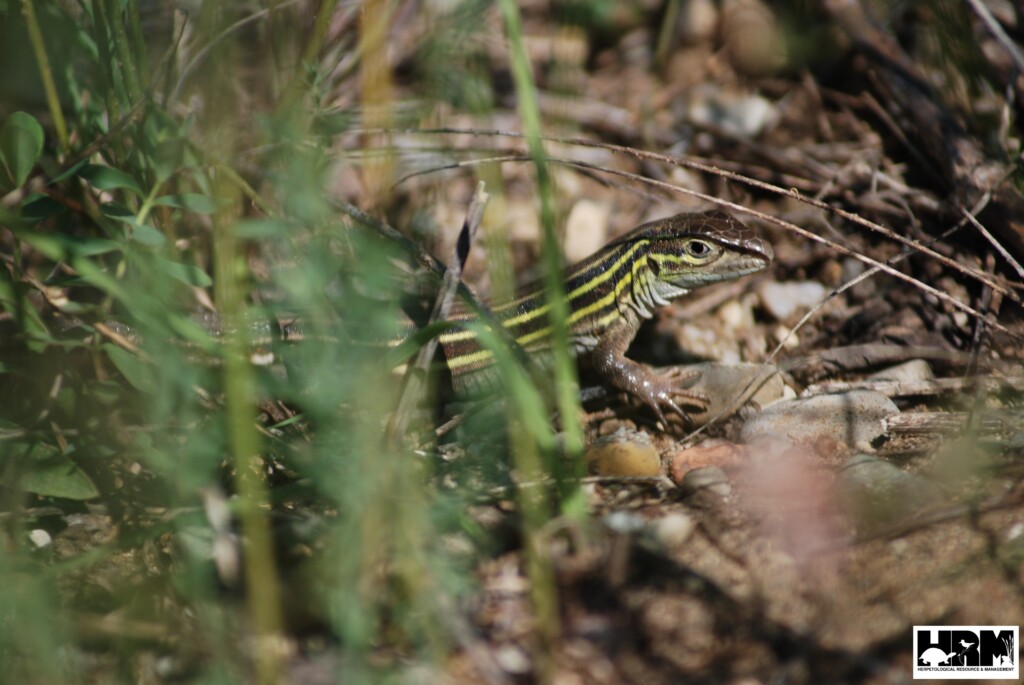
In Michigan, it is found in dry, fallow fields with adjacent dry forested habitat. In other parts of its range, it is found in habitats with sandy soils found in prairies, fallow fields, riverbanks and savannas.
Conservation:
The six-lined racerunner is only known to exist in one population in east-central Michigan. Although still in debate, it is likely that this isolated colony is a natural relic population that has persisted since the glacial retreat. Activities that cause an increase in shade and ground cover as well as the application of pesticides pose a serious threat to the already state threatened six-lined racerunner.
Best Management:
Identify and protect quality six-lined racerunner habitat containing extant populations. Ensure open, sparsely vegetated habitat is maintained by conducting tree harvest during late fall to early winter. Consider utilizing a technique that removes the canopy as well as understory to create large, open areas. Implement alternative strategies to prevent the need for pesticide application or consider utilizing alternative, low-toxicity substances and biocontrols. Mowing may be conducted to eliminate ground cover but should adhere to strict protocols to prevent incidental mortality. Mow infrequent and during the hottest times of the year and set the mower deck high (>6”). Create basking and cover structures by implementing woody debris, stones, logs, burrows, and leaf litter within these specific sites. Also provide nesting sites by including burrows as well as hibernacula consisting of logs and rocks. This species benefits from prescribed burns.
Adult Coloration:
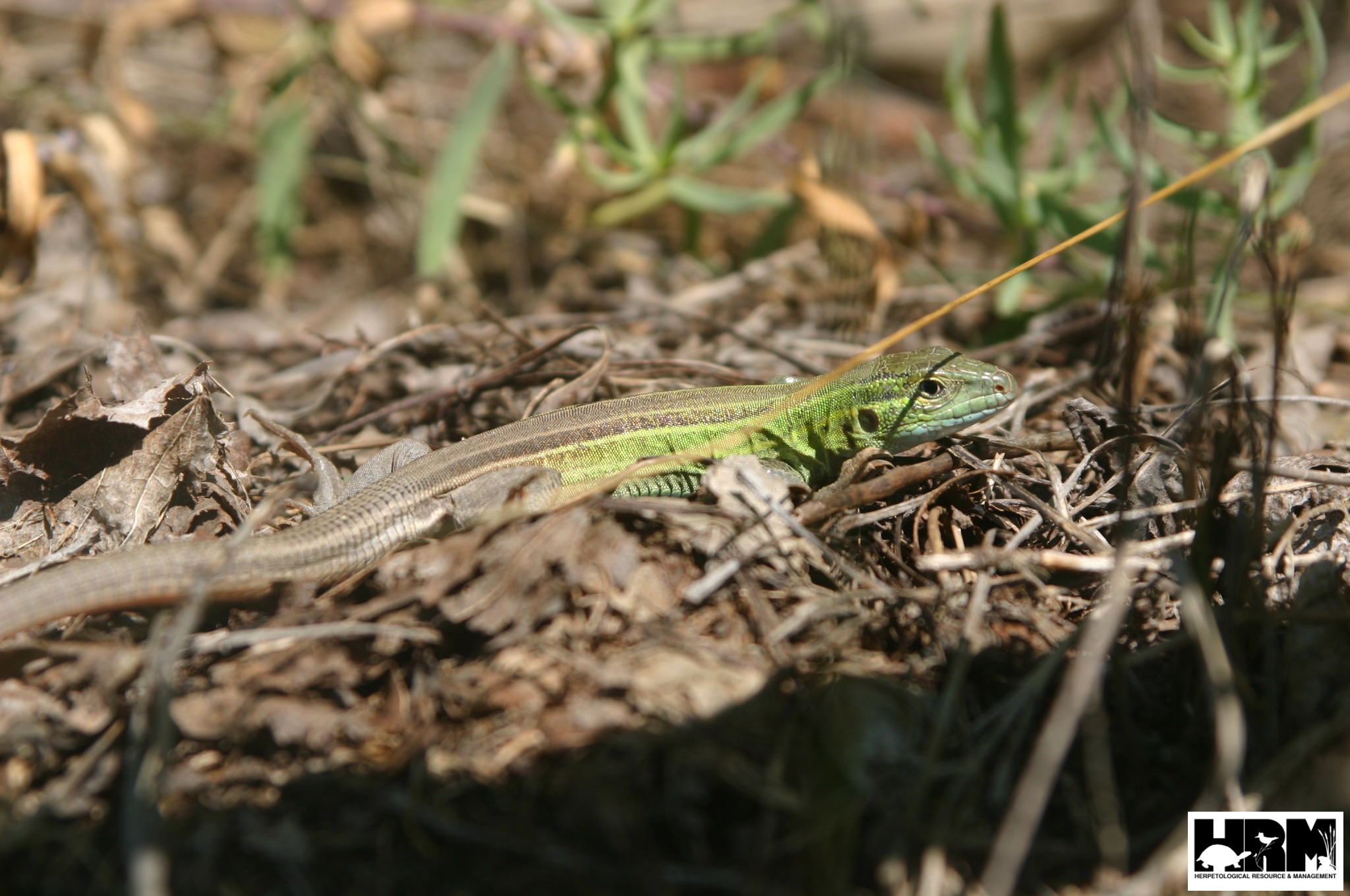
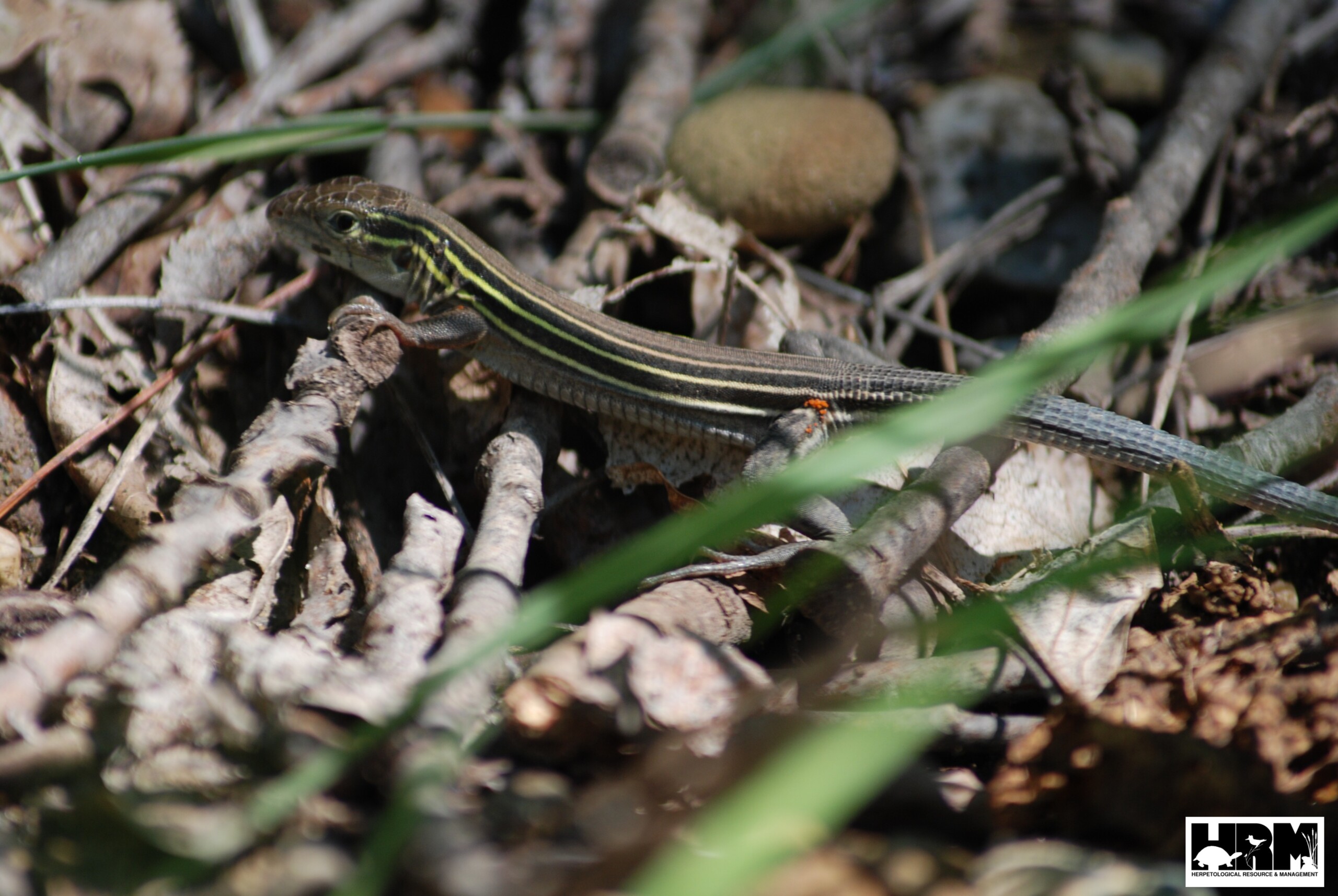
Its body is black, grey, brown, or olive in color with six yellowish-green, white, or grey stripes running down the back and sides with an indistinct brownish stripe down the middle of the back. In males the neck and front of the body may be green or bluish-green, older males the stripes are less distinct.
Adult Characteristics:
Slim bodied with a very long tail. The scales are granular on the body while the scales on the head are large and platelike, the belly scales are flat, rectangular, and arranged in straight rows. Males have a more robust head and a wider vent than females. The tail is encircled by rings of rough scales.
Typical lifespan in wild: 2-6 years
Breeding interval: twice annually
Breeding season: May- July
Range number of offspring: 1-8
Average number of offspring: 4
Range gestation period: 36-40 days
Average age at sexual/reproductive maturity (female): 1
Average age at sexual/reproductive maturity (male): 1
Diet: Grasshoppers, cicadas, beetle larvae, spiders, and ants
Predators: Fire Ants
Juvenile Characteristics:
Has distinct light stripes on the darkened body with bluish or bluish-green tails. 1.2” body length (snout to vent) at hatching.
Species Confused With:
All other lizards in the state have smooth, shiny, scales.
Photos:
References:
- Amphibians and Reptiles of the Great Lakes Region by Jim Harding
- Conant, R., and Collins, J. T. 1998. Reptiles and Amphibians: Eastern, Central North America. Houghton Mifflin Harcourt Press.
- Harding, J and D. Mifsud. 2017. Amphibians and Reptiles of the Great Lakes Region: Revised Edition. Ann Arbor: The University of Michigan Press.
- Harding, J.H. and J.A. Holman. 1990. Michigan Turtles and Lizards. MSU Cooperative Extension Service and MSU Museum. 96 pp.
- Holman, J. A. 2012. The Amphibians and Reptiles of Michigan: A Quaternary and Recent Faunal Adventure. Detroit, Mich., Wayne State University Press.
- Mifsud, David A., Sano, Melissa R., Seguchi, Kotaro J., 2026. Michigan Amphibian and Reptile Best Management Practices Third Edition. Herpetological Resource and Management Technical Publication 2026
- Ruthven, A. G., H. B. T. Gaige, et al. 1912. The herpetology of Michigan, by Alexander B. Ruthven. Crystal Thompson and Helen Thompson; Memoranda towards a bibliography of the archaeology of Michigan, by Harlan I. Smith; prepared under the direction of Alexander G. Ruthven. Lansing, Mich., Wynkoop Hallenbeck Crawford, State Printers.