
Eastern Massasauga Rattlesnake
Overview:
Scientific Name: Sistrurus catenatus
Size: 18.5 – 39.5” (adult total length)
Status: Historically abundant but have suffered large population declines leaving few scattered colonies throughout their original range
Michigan State Status: Threatened
Federal Status: Threatened
MDNR Wildlife Action Plan Status: Species of Greatest Conservation Need
Habitat:
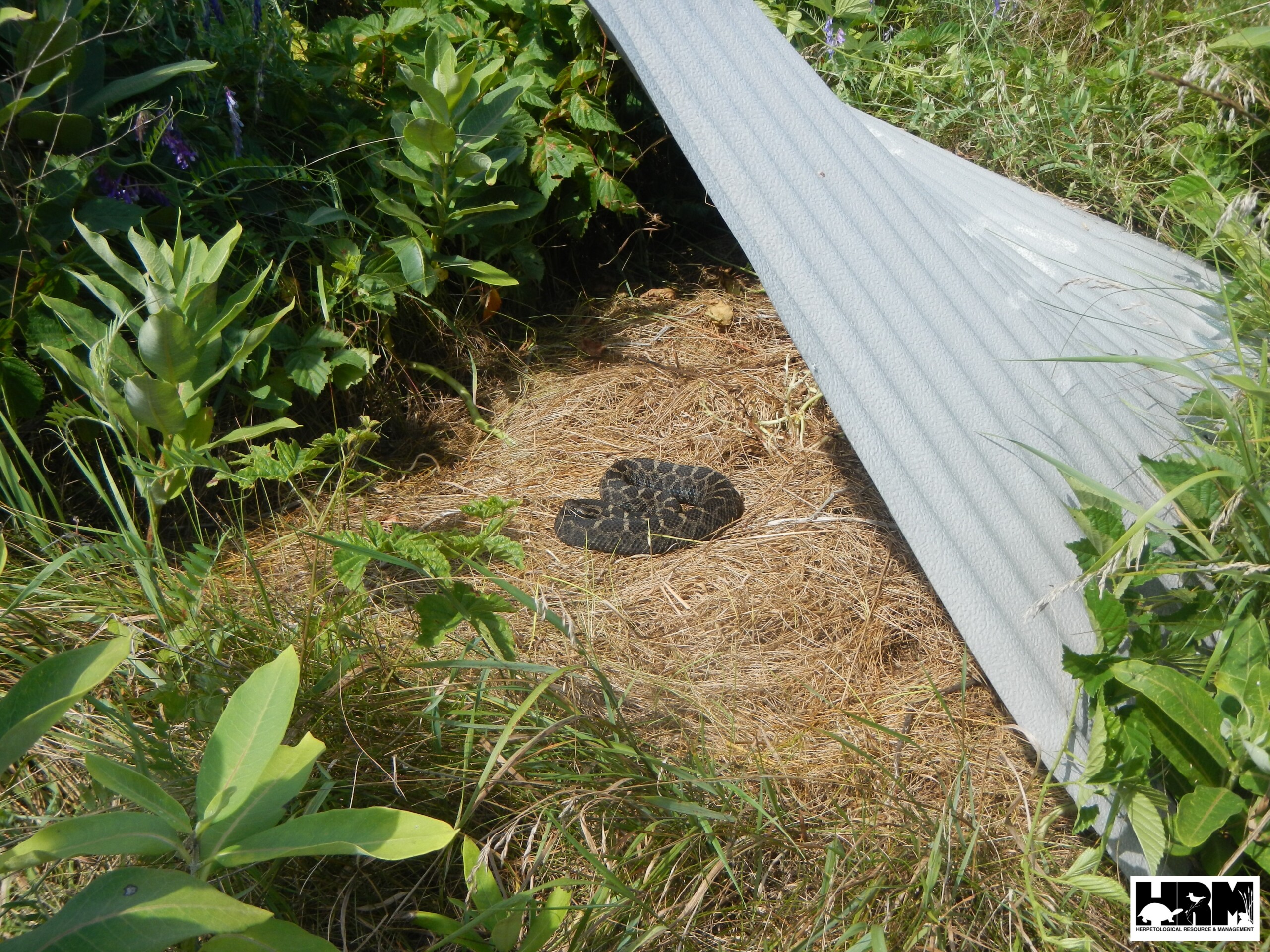
Inhabit damp lowland areas including river bottom woodlands, shrub swamps, bogs, fens, marsh edges, sedge meadows and moist prairies.
Conservation:
The eastern massasauga rattlesnake (EMR) inhabits an extremely small distribution that is limited to just a few Great Lakes states as well as portions of southern Ontario. This limited geographical range coupled with significant population declines puts the EMR at elevated risk of extirpation or even extinction. What was once historically a stronghold for EMR populations, continued persecution and habitat loss have forced the state of Michigan to recently re-elevate the EMR to the status of state threatened. Being Michigan’s only venomous snake and rattlesnake, EMRs serve an important ecological role in controlling rodent populations which further reinforces the notation to preserve this rare viper on our landscape.
Best Management:
Identify and protect quality EMR habitat containing extant populations. Ensure the presence of important habitat features such as sedge and grass hummocks, muskrat and beaver lodges, dikes and other embankments, as well as crayfish burrows. Maintain connectivity between suitable wetlands and adjacent upland habitats. Maintain a healthy wetland habitat by preventing the introduction of invasive species as well as intercepting chemical runoff and nutrient inputs from entering the aquatic system. If harvest is to be conducted in upland habitat, harvest during late fall to early winter utilizing various tree harvest methods coupled with an appropriately timed cut rotation. Provide nesting structures if naturally occurring features are not present. Provide supplemental snake hibernacula structures by excavating a pit to a depth of 8’ and fill the pit with objects such as rocks, logs, tubing, pipes, and rubble before covering it with soil. Ensure and entry and exit are available to and from the hibernacula. Provide snake basking areas by placing rocks or logs in piles in sunny areas while ensuring the material is arranged in a manner that allows for cracks and gaps to act as cover. If mowing is to be conducted, mow infrequently and during the hottest times of the year. Additionally, set mower decks high (>6”) to avoid ground-dwelling wildlife or alternatively set mower decks low (<2”) to discourage the movement of herpetofauna into the area. It’s important to note that wildlife clearance surveys must be conducted prior to any mowing operations in areas containing rare herpetofauna.
Adult Coloration:
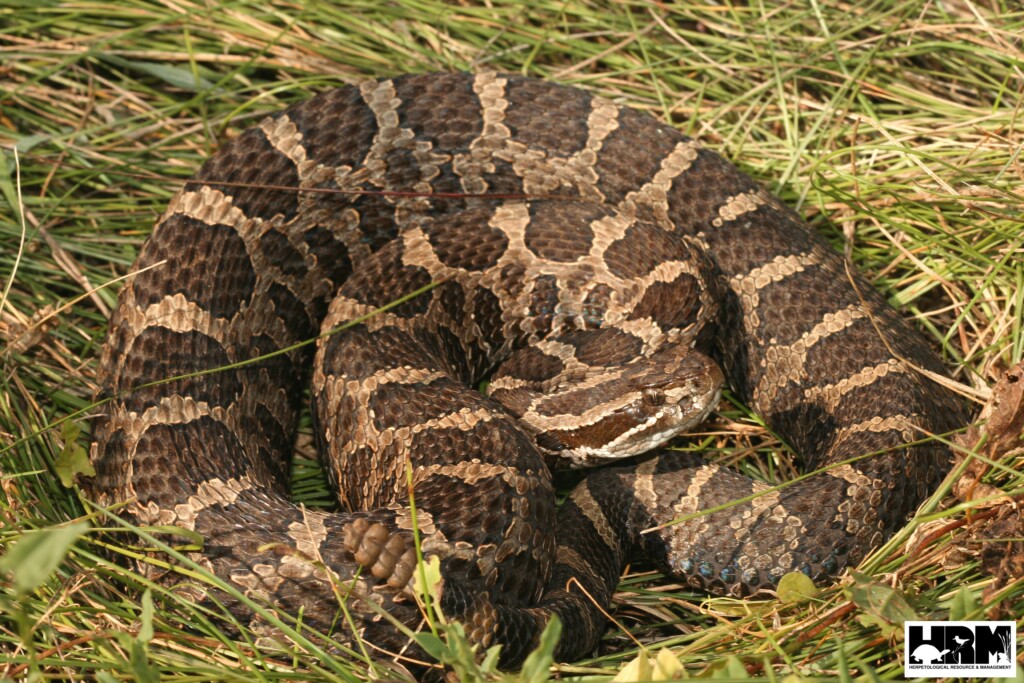
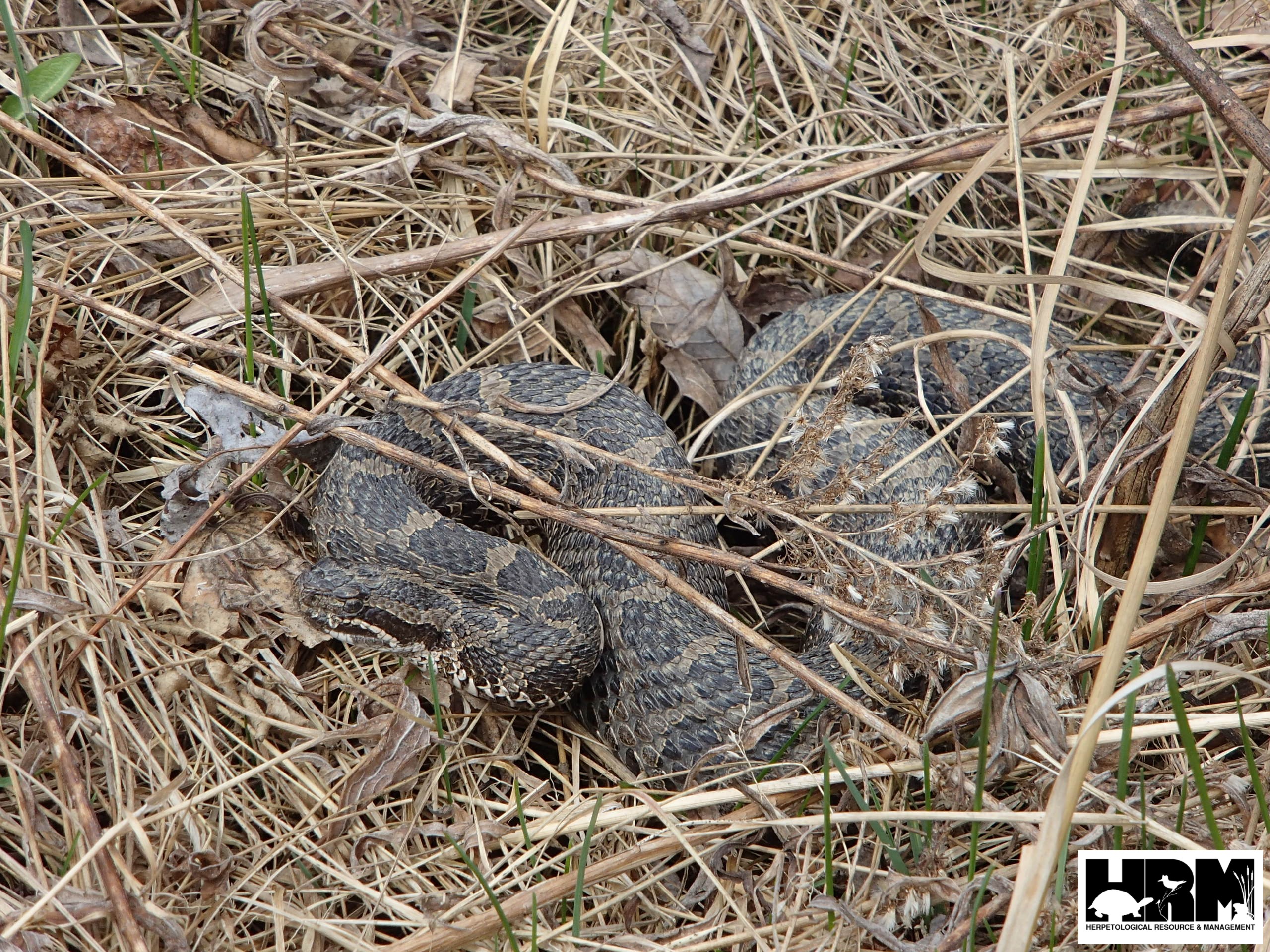
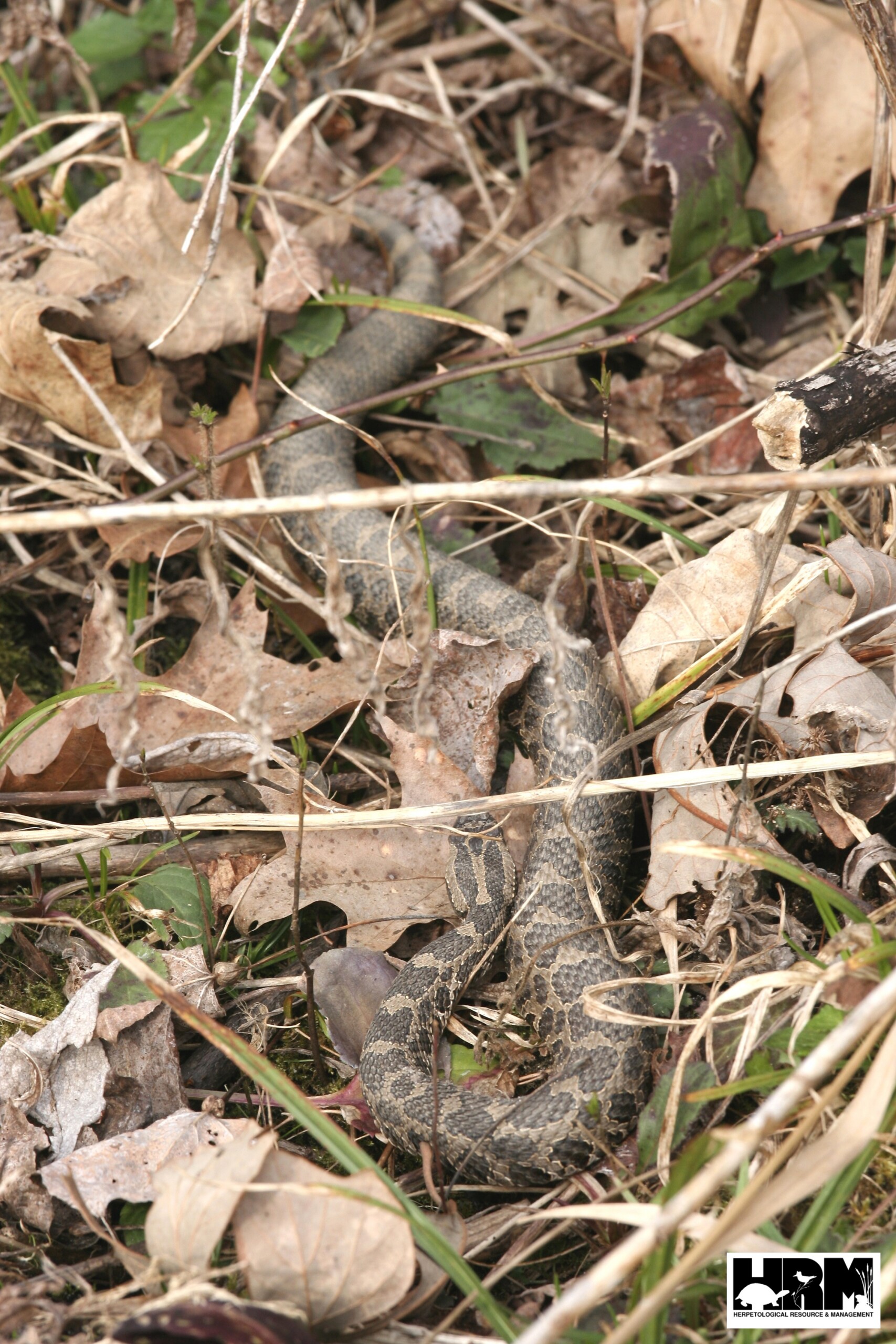
A grey, grey-brown, or brown body with a row of 21 to 40 large dark brown blotches edged in black down the back. Sometimes these blotches may be outlined in white or yellow. Two or three alternating rows of dark spots along the sides with the lowest row running onto the belly scales. A series of alternating dark and light bands wrap around the tail. A dark stripe extends from the back of the eye with a white lower border and two dark stripes on the back of the head extend onto the neck. The belly is black with grey, yellow, or white mottling. Occasionally some individuals are melanistic (solid black) with light markings on the chin, throat, and lip. Provide supplemental hibernacula structures by excavating a pit 8’ in depth and filling it with rocks, logs, tubing, pipes, rubble, and other objects before covering it with soil. Ensure multiple openings into the pit to act as entrances and exits. If mowing is necessary, mow infrequently and during the hottest times of year. Additionally, set the mower deck high (>6”) to protect ground dwelling wildlife or set the mower deck low (<2”) to discourage herpetofauna from moving through that area. Note that it’s vital that wildlife clearance surveys are conducted prior to mowing operations where the deck is set on low.
Adult Characteristics:
A medium sized, thick bodied snake with a rattle at the tail top, a pit between the eye and nostril, and elliptical pupils. The head is wider than the neck and distinct with nine enlarged scales on the top of the head. Males have longer tails than females.
Typical lifespan in wild: 20 years in captivity
Breeding interval: every other season
Breeding season: Spring and Fall (delayed fertilization)
Range number of offspring: 5 – 20
Average number of offspring: 12
Range gestation period: 3.5 months
Average age at sexual/reproductive maturity (female): 3 – 4 years
Average age at sexual/reproductive maturity (male): 3 – 4 years
Diet: voles, White-Footed Mice, Jumping Mice, shrews, snakes, frogs, birds, bird eggs, and insects.
Predators: Milk Snakes, hawks, herons, raccoons, Red Foxes, humans
Juvenile Characteristics:
Newborns range from 7 to 10” in length and similar to adults but with a lighter body color. Beneath the tail is yellowish and the rattle is a single “button.” The spotted pattern is present in the young, even in those who will be melanistic as adults. Fangs and venom glands and the ability to use them are present at birth.
Scale Count:
19 – 27 scales at midbody, usually 25.
Species Confused With:
All non-venomous snakes in the region have round pupils and no “pit” between the eye and nostril or rattles on the tail. Hog-nosed Snakes, Milk Snakes, and Water Snakes are often confused for them.
Photos:
References:
- Amphibians and Reptiles of the Great Lakes Region by Jim Harding
- Conant, R., and Collins, J. T. 1998. Reptiles and Amphibians: Eastern, Central North America. Houghton Mifflin Harcourt Press
- Harding, J and D. Mifsud. 2017. Amphibians and Reptiles of the Great Lakes Region: Revised Edition. Ann Arbor: The University of Michigan Press.
- Harding, J.H. and J.A. Holman. 2006. Michigan Snakes. MSU Extension Ext. Bulletin E-2000,74 pp. [revised].
- Holman, J. A. 2012. The Amphibians and Reptiles of Michigan: A Quaternary and Recent Faunal Adventure. Detroit, Mich., Wayne State University Press.
- Mifsud, David A., Sano, Melissa R., Seguchi, Kotaro J., 2026. Michigan Amphibian and Reptile Best Management Practices Third Edition. Herpetological Resource and Management Technical Publication 2026
- Ruthven, A. G., H. B. T. Gaige, et al. 1912. The herpetology of Michigan, by Alexander B. Ruthven. Crystal Thompson and Helen Thompson; Memoranda towards a bibliography of the archaeology of Michigan, by Harlan I. Smith; prepared under the direction of Alexander G. Ruthven. Lansing, Mich., Wynkoop Hallenbeck Crawford, State Printers.