Northern Ring-necked Snake
Overview:
Scientific Name: Diadophis punctatus edwardsii
Size: 10 – 27.7,” rarely exceeding 19.7” (total adult length)
Status: Exist in small, secretive colonies so they can be difficult to monitor but are believed to be locally present throughout their range
MDNR Wildlife Action Plan Status: Species of Greatest Conservation Need
Habitat:
Inhabits moist, shady woodlands but also open habitats near woodlands such as clear-cuts, old fields, grassy dunes, beaches and trash dumps.
Conservation:
Require moist woodland and woodland edges. As such, large scale clear-cutting or selective logging could be of detriment. The colonial nature of its distribution makes it vulnerable to rapid local extirpation when its habitat is disturbed. Recent declines may be due to habitat loss but widespread use of persistent pesticides during the mid-twentieth century may have played a role. Occasionally killed while crossing roadways at night.
Best Management:
Prescribed burnings should be infrequent allowing for long-term, unburned areas to exist longer. Pesticide applications should be mindful of where they are spraying and what types of pesticides and how long the chemical lifespan is. The creation of habitat structures that encourage basking opportunities and overwinter protections should be considered. Restore, maintain, or enhance nesting sites. If roads bisect suitable habitat areas, ensure that road crossings or protected culverts exist for the species.
Adult Coloration:
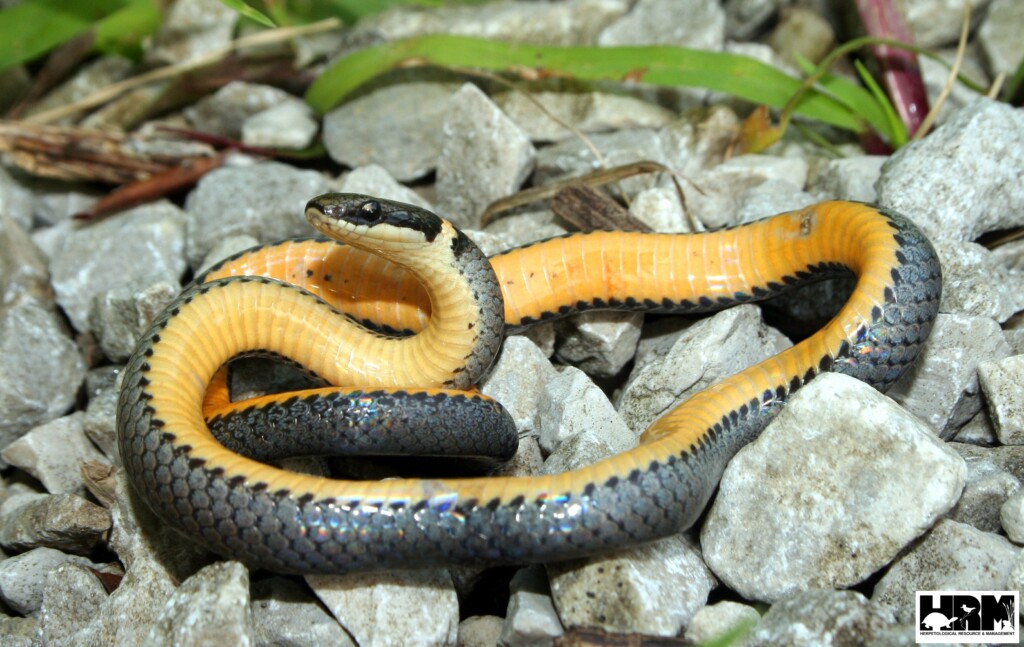
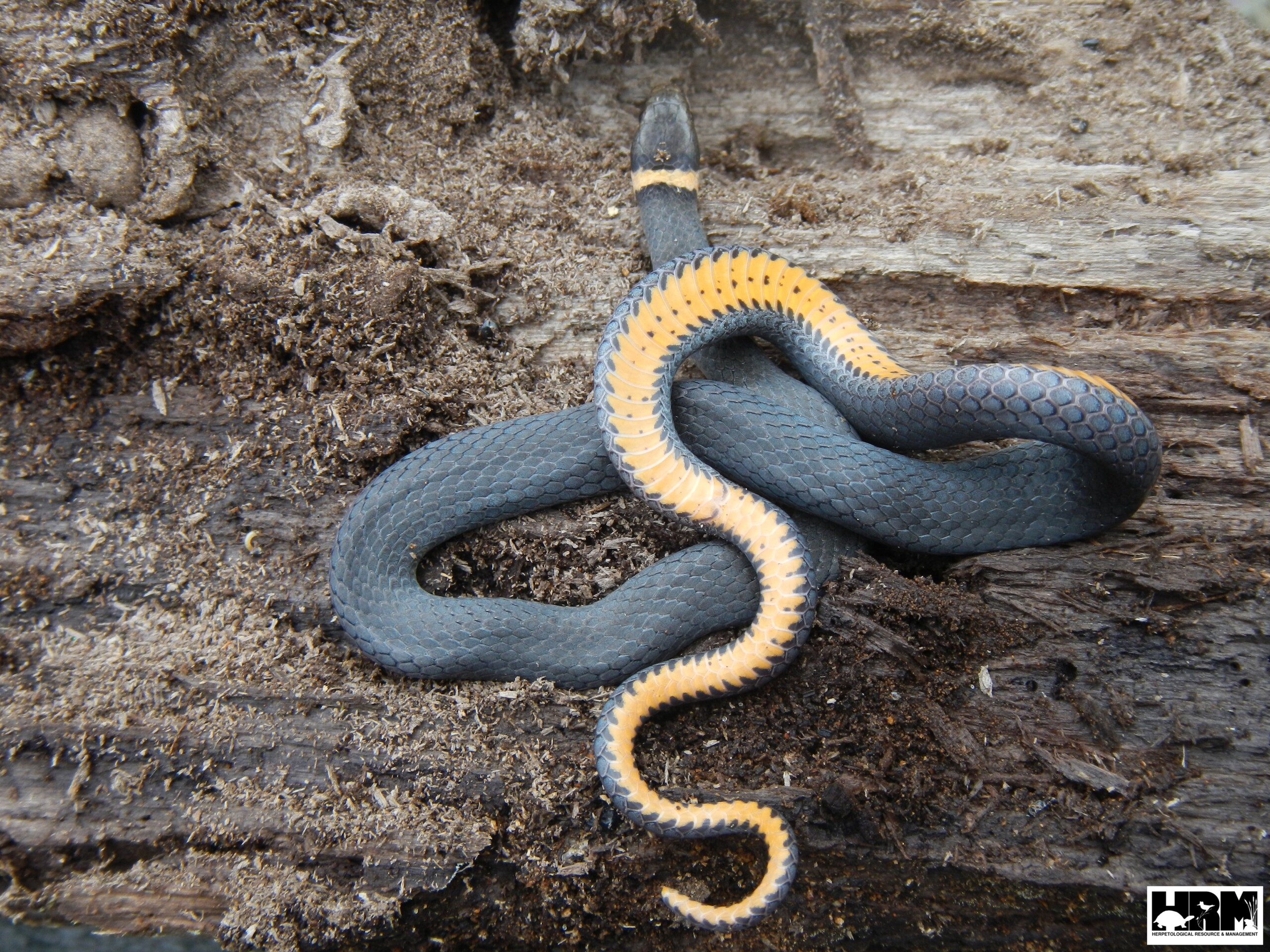
A solid bluish-black, grey, or brownish-grey body with a bright yellow or yellowish-orange ring around its neck. The head may be darker than the body. The belly is bright yellow or yellowish-orange with dark spots producing a jagged pattern on the edges with small black dots along the midline.
Adult Characteristics:
Small snake with shiny, unkeeled scales and a divided anal plate.
Juvenile Characteristics:
Hatchlings range from 3.5 to 5.5” in length with similar coloration as an adult but with a darker body and lighter belly.
Scale Count:
Usually 15 scale rows at midbody
Species Confused With:
Ring-necked Snakes can be confused with very young Brown Snakes and Northern Red-bellied Snakes but Brown Snakes have some spots on the back and the Red-bellied Snaked has a pink or red belly. Both of these species have keeled scales.
Photos:
References:
- Amphibians and Reptiles of the Great Lakes Region by Jim Harding
- Conant, R., and Collins, J. T. 1998. Reptiles and Amphibians: Eastern, Central North America. Houghton Mifflin Harcourt Press.
- Harding, J and D. Mifsud. 2017. Amphibians and Reptiles of the Great Lakes Region: Revised Edition. Ann Arbor: The University of Michigan Press.
- Harding, J.H. and J.A. Holman. 2006. Michigan Snakes. MSU Extension Ext. Bulletin E-2000,74 pp. [revised].
- Holman, J. A. 2012. The Amphibians and Reptiles of Michigan: A Quaternary and Recent Faunal Adventure. Detroit, Mich., Wayne State University Press.
- Mifsud, David A., Sano, Melissa R., Seguchi, Kotaro J., 2026. Michigan Amphibian and Reptile Best Management Practices Third Edition. Herpetological Resource and Management Technical Publication 2026
- Ruthven, A. G., H. B. T. Gaige, et al. 1912. The herpetology of Michigan, by Alexander B. Ruthven. Crystal Thompson and Helen Thompson; Memoranda towards a bibliography of the archaeology of Michigan, by Harlan I. Smith; prepared under the direction of Alexander G. Ruthven. Lansing, Mich., Wynkoop Hallenbeck Crawford, State Printers.