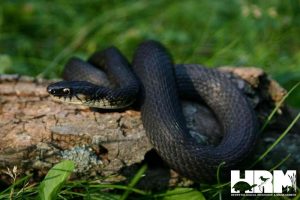
Black Rat Snake
Overview:
Scientific Name: Pantherophis obsoleta obsoleta
Size: 40 – 101” (adult total length) making this the largest snake in the Great Lakes region!
Status: Uncommon to rare, with many populations in southeastern Michigan suffering recent declines or extirpation.
Michigan State Status: Special Concern
MDNR Wildlife Action Plan Status: Species of Greatest Conservation Need
Habitat:
Inhabit woodlands or open areas adjacent to forests such as shrubby fields, pastures, hedgerows, and bog or marsh edges. Will occupy artificial cover objects near human dwellings and trash dumps.
Adult Coloration:
Mainly black or dark brown dorsally, with labial (lip) scales, chin, and throat white. Blotched juvenile pattern persists into adulthood but becomes faint, with a hint of white, yellow, or orange flecks, especially on skin between scales. Belly white or yellow with dark checkerboard pattern toward head, which becomes obscured with gray or brown pigment toward tail.
Adult Characteristics:
Very large snake, with head elongate and flattened, and broadest behind eyes. Body square in cross section. Upper body scales weakly keeled, anal plate divided.
Juvenile Characteristics:
Newborns have conspicuous patterning, with row of dark gray or brown bands along back alternating with smaller side markings on pale gray background. Black band in front of the eyes, and black stripe from eye to back of jaw. Range in length from 10.6 – 14.5.”
Scale Count:
23 – 27 scale rows at midbody
Species Confused With:
May be confused for Racers, but these have unkeeled scales and a rounded body. Juvenile racers do not have a stripe from the eye to the back of the jaw.
References:
- Amphibians and Reptiles of the Great Lakes Region by Jim Harding
- Harding, J.H. and J.A. Holman. 2006. Michigan Snakes. MSU Extension Ext. Bulletin E-2000,74 pp. [revised].
- Ruthven, A. G., H. B. T. Gaige, et al. 1912. The herpetology of Michigan, by Alexander B. Ruthven. Crystal Thompson and Helen Thompson; Memoranda towards a bibliography of the archaeology of Michigan, by Harlan I. Smith; prepared under the direction of Alexander G. Ruthven. Lansing, Mich., Wynkoop Hallenbeck Crawford, State Printers.
- Holman, J. A. 2012. The Amphibians and Reptiles of Michigan: A Quaternary and Recent Faunal Adventure. Detroit, Mich., Wayne State University Press.
- Conant, R., and Collins, J. T. 1998. Reptiles and Amphibians: Eastern, Central North America. Houghton Mifflin Harcourt Press.