
Unisexual Ambystoma Complex
Overview:
Scientific Name: Ambystoma spp.
Size: Variable but usually 4 – 8” in length.
Status: Can be locally abundant if high quality habitat is present ,although only recently recognized as a distinct complex, this lineage has been in existence for over 5,000 years.
Habitat:
Live in deciduous and coniferous forests from moist lowlands to drier upland forests. Most abundant in moist woodlands with sandy soils but can also be found in open fields and suburban backyards.
Conservation:
Wooded habitats adjacent to semi-permanent or permanent fishless ponds are required. Can be tolerant of selective logging and low-density residential development as long as critical habitat remains intact. Clear cuttings and roadways between breeding ponds and terrestrial habitat threaten the species and their local populations.
Best Management:
Consider the effects of altering or destroying vernal pools and other fish-free ponds. Do not impact the pool depression or core buffer area within 100 feet of the pools and aim to protect a wider buffer of 600 – 1000 feet around the pools. Try to maintain the forest canopy and any habitat corridors to other vernal pools and upland habitats, these landscape mosaics are important to the species. Crossing structures can help reduce the effects of habitat fragmentation by roadways.
Adult Coloration:
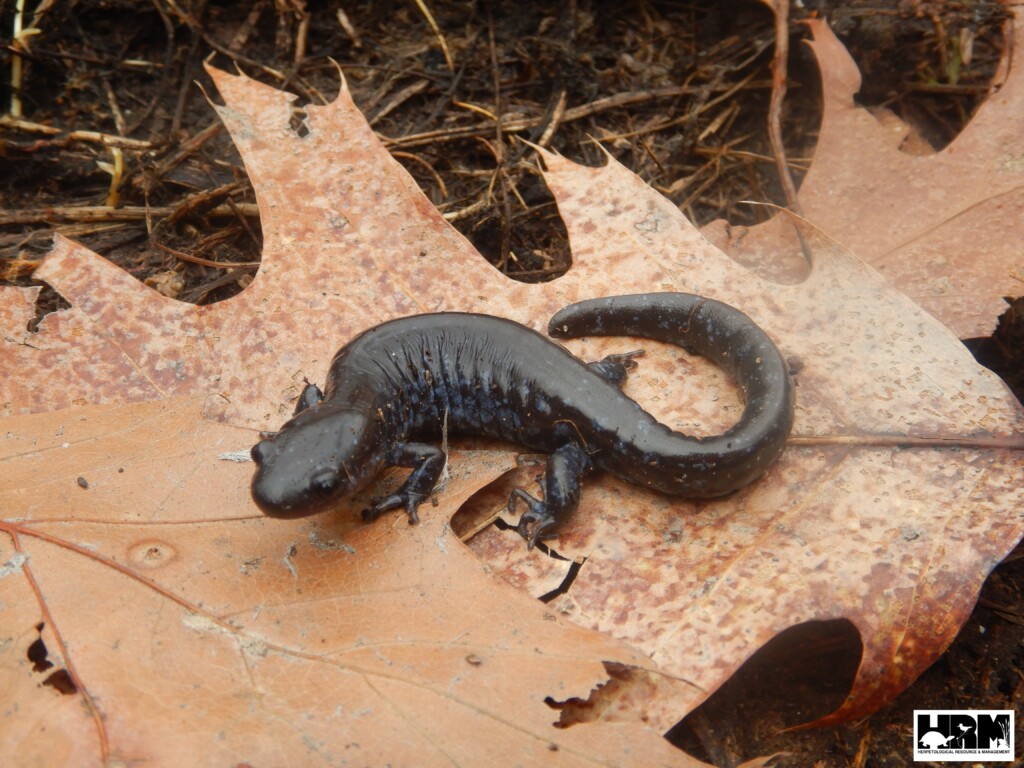
These hybrids are virtually all females (~99%) and show a blending of characteristics of parental species. They are often triploid, containing sets of chromosomes from one to three parental species including the Blue-spotted, Jefferson’s (A. jeffersonianum, does not occur in Michigan), Tiger, and Small-mouthed Salamanders. An individual will often look closest to the parental species for which it contains the most genetic material. These hybrids will often be much larger and stouter than a Blue-spotted Salamander despite an overall resemblance.
Juvenile Characteristics:
These hybrids are virtually all (~99%) female and show a blending of characteristics of parental species. They are often triploid, containing sets of chromosomes from one to three parental species, including the Blue-spotted, Jefferson’s (A. jeffersonianum, which itself does not occur in Michigan), Tiger, and Smallmouth Salamanders. An individual will often look closest to the parental species for which it contains the most genetic material. These hybrids will often be much larger and stouter than a Blue-spotted Salamander despite an overall resemblance.
Larvae Characteristics:
Older larvae (those with four legs present) may be dark brown, olive or grey on the back with dark mottling on tail fins. Sometimes with dull yellow blotches on the back and/or a yellow stripe down each side of the back. The belly is usually solid in color and lighter than the back.
Species Confused With:
Small-mouthed Salamanders have very short snouts with slightly protruding lower jaws and markings usually greyer than blue. Lead phase Red-backed Salamander has a considerably narrower body, very small legs, and small black and white spots in the belly. May look similar to the Blue-spotted Salamander but will generally be larger and with less distinct blue flecking. May have similar bulging eyes to the Tiger Salamander if genetic material from the species is present.
References:
- Amphibians and Reptiles of the Great Lakes Region by Jim Harding
- Conant, R., and Collins, J. T. 1998. Reptiles and Amphibians: Eastern, Central North America. Houghton Mifflin Harcourt Press
- Harding, J and D. Mifsud. 2017. Amphibians and Reptiles of the Great Lakes Region: Revised Edition. Ann Arbor: The University of Michigan Press.
- Harding, J.H. and J.A. Holman. 1992. Michigan Frogs, Toads, and Salamanders. MSU Cooperative Extension Service and MSU Museum. Extension Bull. E-2350, 144 pp.
- Holman, J. A. 2012. The Amphibians and Reptiles of Michigan: A Quaternary and Recent Faunal Adventure. Detroit, Mich., Wayne State University Press.
- Mifsud, David A., Sano, Melissa R., Seguchi, Kotaro J., 2026. Michigan Amphibian and Reptile Best Management Practices Third Edition. Herpetological Resource and Management Technical Publication 2026
- Ruthven, A. G., H. B. T. Gaige, et al. 1912. The herpetology of Michigan, by Alexander B. Ruthven. Crystal Thompson and Helen Thompson; Memoranda towards a bibliography of the archaeology of Michigan, by Harlan I. Smith; prepared under the direction of Alexander G. Ruthven. Lansing, Mich., Wynkoop Hallenbeck Crawford, State Printers.