
Western Lesser Siren
Overview:
Scientific Name: Siren intermedia nettingi
Size: 7 – 19.7” (adult size)
Status: Presumed to be exceptionally rare and potentially extirpated over much of the Great Lakes basin. Recently rediscovered in southwestern Michigan.
Michigan State Status: Endangered
MDNR Wildlife Action Plan Status: Species of Greatest Conservation Need
Habitat:
Inhabit ponds, ditches, backwater sloughs, sluggish streams, and shallow lake inlets. Prefer habitat with muddy bottoms and ample aquatic vegetation where they hide or beneath submerged debris.
Conservation:
Although relatively abundant throughout its distribution in the Southeast United States, the western lesser siren’s extent in Michigan is very limited to just Van Buren and Allegan counties in the Southwest region of the State. Not much is known about the western lesser siren in Michigan as it is a very reclusive species and may even exist in more areas of the lower lake Michigan basin than previously assumed. Besides a lack of information, the greatest threat to the western lesser siren in Michigan is the application of chemical controls such as lampricide or rotenone and habitat alteration. The western lesser siren is currently a species of special concern in Michigan.
Best Management:
Identify and protect quality western lesser siren habitat containing extant populations. Avoid the use of lampricide but, if necessary, consider alternatives or target areas with seasons with reduced amphibian presence or inactivity. Avoid the use of rotenone but, if necessary, apply late in the year and do not apply to areas containing rare herpetofauna. Avoid mechanical aquatic weed harvesting and prevent the introduction of exotics. Utilize vegetated buffer zones between areas of chemical application and aquatic system. Identify and intercept chemical runoff from entering the system. Ensure native aquatic plant communities are present and provide aquatic structure by placing logs or rocks in shallow water.
Adult Coloration:
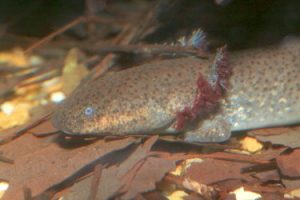
Dark grey, brown, or olive in color with dark spots or flecks scatter over the body with some appearing almost fully black. Occasionally have a light stripe on the upper lip. The belly is grey, usually with lighter spots.
Adult Characteristics:
Fully aquatic salamander with reddish, bushy external gills. Have elongated, eel-like bodies with vertically flattened tails. Front legs are tiny with four toes on each foot and no hind legs. The head is wider than the neck with a rounded snout and small eyes. Males can be larger than females in some areas.
Mass: 50 g
Typical lifespan in wild: unknown (6 years in captivity)
Breeding interval: once annually
Breeding season: November to May (geographic dependent)
Range number of offspring: 100-500
Average number of offspring: 200-300
Range time to hatchling: 35 days
Average age at sexual/reproductive maturity (female): 2 years
Average age at sexual/reproductive maturity (male): 2 years
Diet: amphibian larvae, adult salamanders, eggs, insects
Predators: snakes, fishes, wading birds
Larvae Characteristics:
Very young larvae have red, orange or yellow markings on head, neck, and feet, a yellowish stripe down each side of the body, and a dorsal tail fin. Sometimes dark and unmarked.
Species Confused With:
Mudpuppies also have external gills but are not eel-like and have four legs. Larval mole salamanders also have external gills but have four legs and are not eel-like.
References:
- Amphibians and Reptiles of the Great Lakes Region by Jim Harding
- Conant, R., and Collins, J. T. 1998. Reptiles and Amphibians: Eastern, Central North America. Houghton Mifflin Harcourt Press.
- Harding, J and D. Mifsud. 2017. Amphibians and Reptiles of the Great Lakes Region: Revised Edition. Ann Arbor: The University of Michigan Press.
- Harding, J.H. and J.A. Holman. 1992. Michigan Frogs, Toads, and Salamanders. MSU Cooperative Extension Service and MSU Museum. Extension Bull. E-2350, 144 pp.
- Holman, J. A. 2012. The Amphibians and Reptiles of Michigan: A Quaternary and Recent Faunal Adventure. Detroit, Mich., Wayne State University Press.
- Mifsud, David A., Sano, Melissa R., Seguchi, Kotaro J., 2026. Michigan Amphibian and Reptile Best Management Practices Third Edition. Herpetological Resource and Management Technical Publication 2026
- Ruthven, A. G., H. B. T. Gaige, et al. 1912. The herpetology of Michigan, by Alexander B. Ruthven. Crystal Thompson and Helen Thompson; Memoranda towards a bibliography of the archaeology of Michigan, by Harlan I. Smith; prepared under the direction of Alexander G. Ruthven. Lansing, Mich., Wynkoop Hallenbeck Crawford, State Printers.