Northern Leopard Frog
Overview:
Scientific Name: Rana (Lithobates) pipiens
Size: 2 – 4.4” (adult size)
Status: Historically abundant throughout the Great Lakes basin but suffered notable declines between 1960s to 1970s, can be locally abundant where suitable habitat is present
MDNR Wildlife Action Plan Status: Species of Greatest Conservation Need
Habitat:
Inhabit open habitats including marshes, bogs, lake and stream edges, fields, meadows, and suburban areas.
Conservation:
One of the most abundant anurans prior to the late 1960’s but since then have declined over much of its range. Explanations range from intensive harvesting for biological supply and fishing bait, fragmentation and loss of wetlands and adjacent upland habitats, to persistent pesticides used in the mid-twentieth century like DDT and other chlorinated hydrocarbons the species is more sensitive to. Largely intolerant of acidic waters. A pH of 4.8 suppresses egg development. Where habitat is suitable the reproductive potential of the species can offset declines rapidly. It is probable population numbers varied naturally year to year depending on several factors, most notably climatic. Diseases like “redleg” are a significant impactor on the species, likely related to physiological stress.
Best Management:
Pesticide application should occur in late summer and fall when larvae have metamorphosed, and hibernation begins. Aim to protect a wider buffer of 600 – 1000 feet around ponds and water sources. Try to maintain any habitat corridors to other vernal pools, ponds, water sources, and upland habitats.
Adult Coloration:
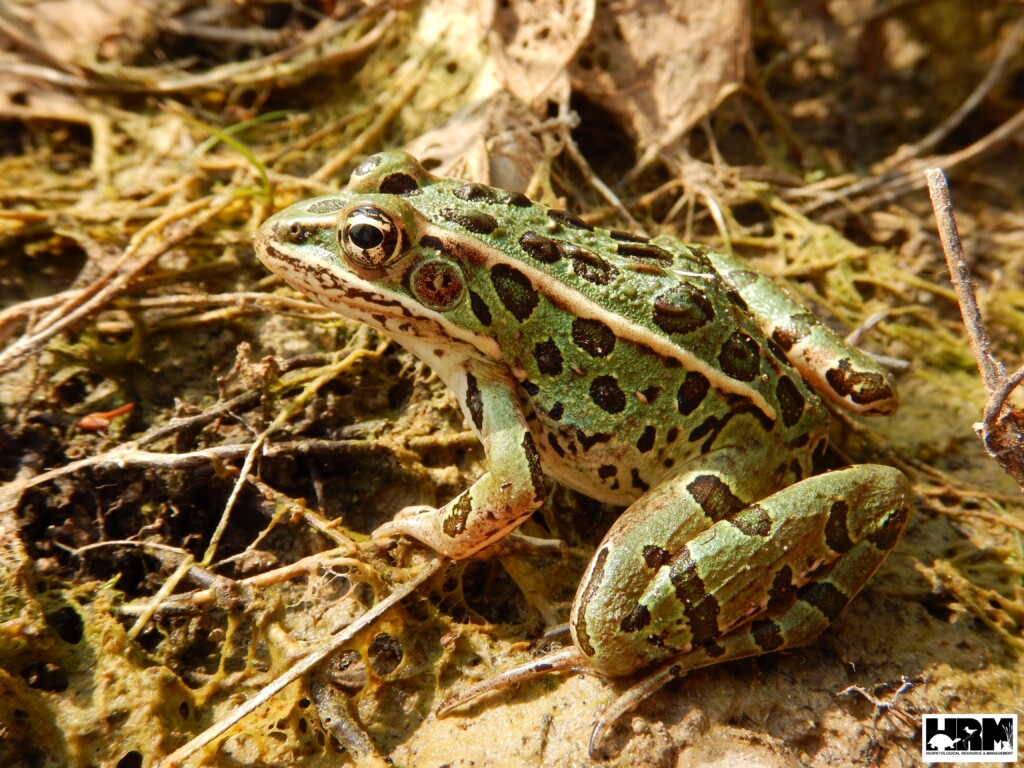
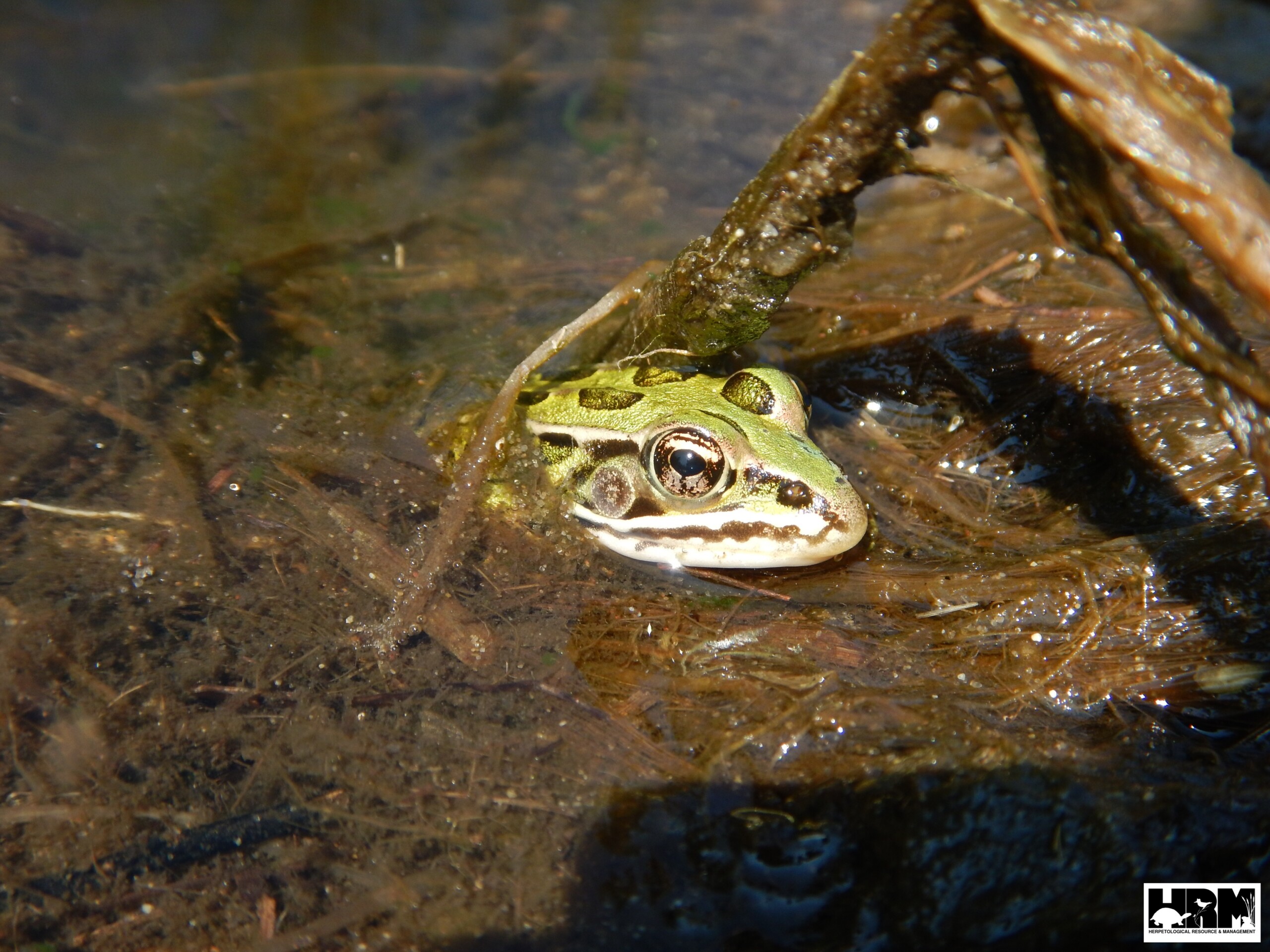
Green, greenish-brown, or brown with rounded spots scattered over the back and sides with the legs having similar spots or bars. Spots have a whitish or yellowish border to them. Usually has a dark spot over each eye and on the snout. A white line runs from the nose to the shoulder above the upper lip with light-colored dorsolateral folds (raised ridges running extending down each side of the back). The belly is white to pale green with a yellow tint in the groin.
Adult Characteristics:
Males have enlarged thumbs and are usually smaller than females. When calling, the males paired vocal sacs inflate over the shoulders. There is no difference in the size of the tympanum (circular “ear” structure on the side of the head) between sexes. Females may appear very fat when gravid (carrying eggs). The call is a low, rumbling snore with hoarse croaks. Both males and females can produce a vibrating “release call” when clasped by a male. Can produce a “scream” when seized by a hand or predator.
Larvae Characteristics:
Tadpoles reach a maximum length of 3.3”. Has a green, olive, or brown back often with yellow or brown speckling. The belly is iridescent white or cream with the intestines visible.
Species Confused With:
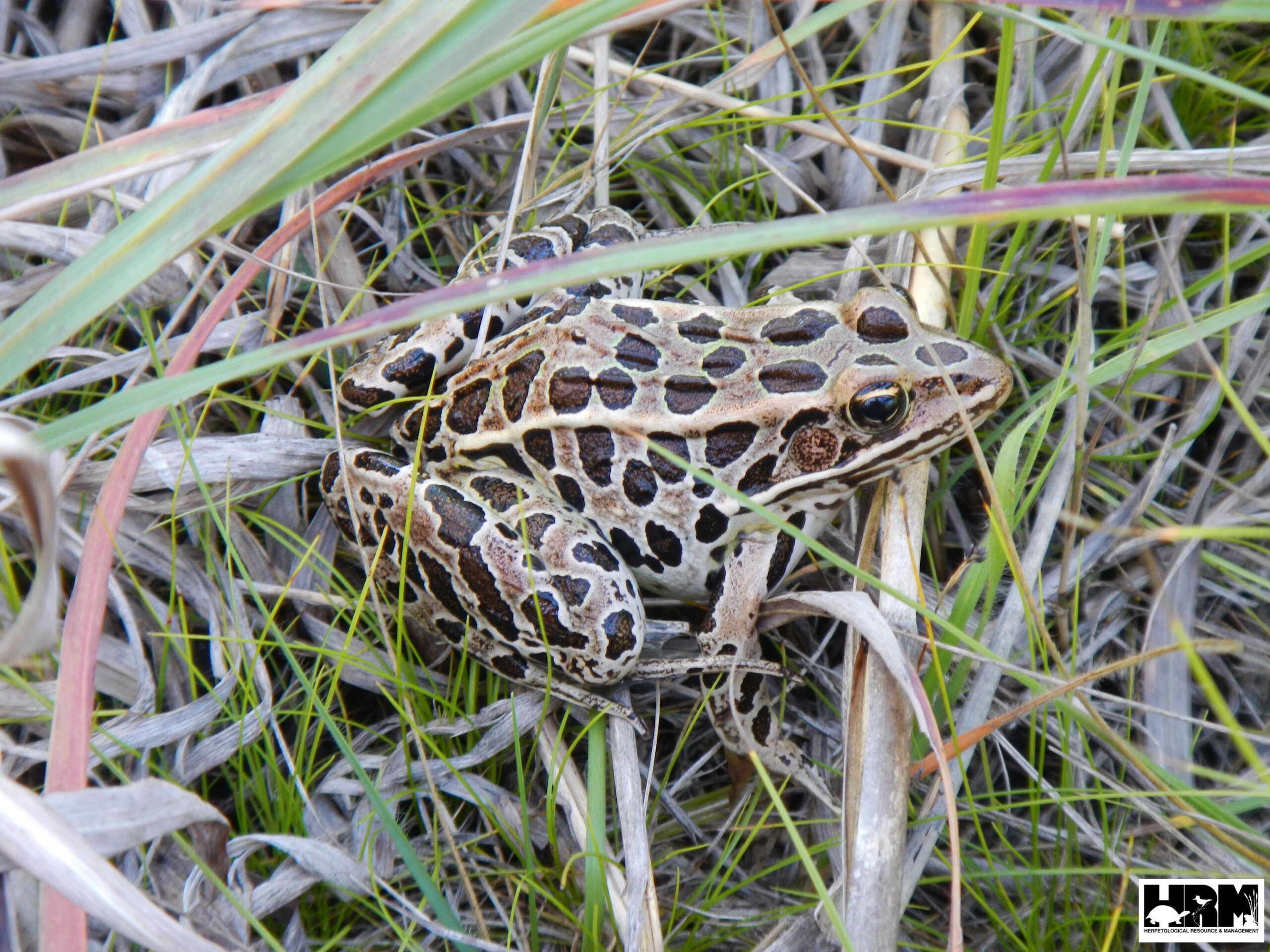
The Pickerel Frog has more angular spots that are paired in rows between the dorsolateral folds and a bright yellow or orange groin and inner thigh.
Photos:
References:
- Amphibians and Reptiles of the Great Lakes Region by Jim Harding
- Conant, R., and Collins, J. T. 1998. Reptiles and Amphibians: Eastern, Central North America. Houghton Mifflin Harcourt Press.
- Harding, J and D. Mifsud. 2017. Amphibians and Reptiles of the Great Lakes Region: Revised Edition. Ann Arbor: The University of Michigan Press.
- Harding, J.H. and J.A. Holman. 1992. Michigan Frogs, Toads, and Salamanders. MSU Cooperative Extension Service and MSU Museum. Extension Bull. E-2350, 144 pp.
- Holman, J. A. 2012. The Amphibians and Reptiles of Michigan: A Quaternary and Recent Faunal Adventure. Detroit, Mich., Wayne State University Press.
- Mifsud, David A., Sano, Melissa R., Seguchi, Kotaro J., 2026. Michigan Amphibian and Reptile Best Management Practices Third Edition. Herpetological Resource and Management Technical Publication 2026
- Ruthven, A. G., H. B. T. Gaige, et al. 1912. The herpetology of Michigan, by Alexander B. Ruthven. Crystal Thompson and Helen Thompson; Memoranda towards a bibliography of the archaeology of Michigan, by Harlan I. Smith; prepared under the direction of Alexander G. Ruthven. Lansing, Mich., Wynkoop Hallenbeck Crawford, State Printers.