
Eastern Musk Turtle
Overview:
Scientific Name: Sternotherus odoratus
Size: 3 – 5.4” (adult carapace length)
Status: Locally present in the lower Great Lakes area but some populations have declined or disappeared in recent years due to human development
Habitat:
Inhabits a wide variety of permanent waters including ponds, lakes, marshes, sloughs, and rivers. They are most common in clear lakes or ponds with marl, sand, or gravel bottoms and moderate aquatic plant growth.
Conservation:
Harmless to human interest with no harm to game fish populations though misconceptions exist they are damaging. Frequently caught by fisherman and occasionally killed for being a nuisance or the misconception on game fish harm. The development of residential shorelines is one of the most serious threats. The removal or poisoning of aquatic vegetation (most often for swimming and boating) and loss of terrestrial nesting sites are problematic to their populations.
Best Management:
Construction or preservation of breeding sites is important to consider. Be considerate of aquatic vegetation removal and pesticide applications. If aquatic vegetation is altered, restoration of the area is recommended. Protect waterways from contaminants.
Adult Coloration:
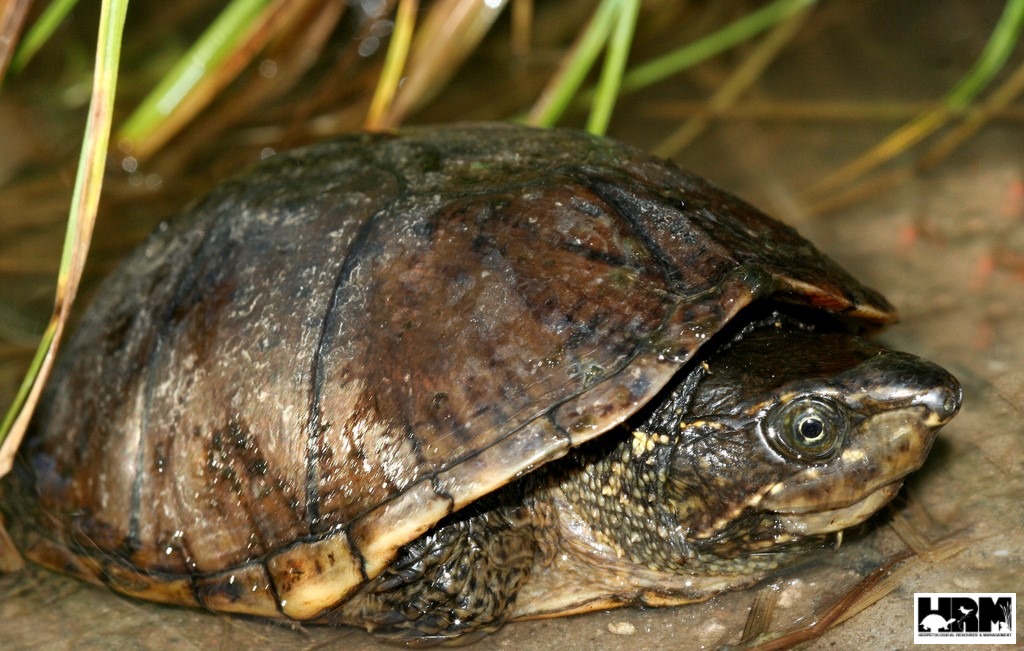
Brown, grey, or black carapace sometimes with dark streaks or spots. Yellowish or brownish plastron. Two yellow stripes extend from the nose above and below the eye and along the side of the head and neck but may fade with age.
Adult Characteristics:
Small with a narrow, domed carapace and a large head with a pointed snout. The carapace is smooth while the plastron is small and cross shaped exposing the soft parts around the legs. Usually there are areas of smooth skin between the plastral scutes especially toward the center. The front of the plastron is flexible and can move upward. Two or more pointed barbels on the chin and throat. Males have longer, thicker tails and a stiff blunt spine at the tip; females have less skin between the plastral scutes and a very short tail.
Juvenile Characteristics:
Hatchlings have a carapace length of 0.7 – 1” with the carapace being centrally keeled often with two lateral keels. The carapace is rough and black with white spots on the outer edge of the marginal scutes. Yellow head stripes are usually well defined.
Species Confused With:
May be mistaken for the larger Snapping Turtle due to its small plastron and willingness to bite.
References:
- Amphibians and Reptiles of the Great Lakes Region by Jim Harding
- Conant, R., and Collins, J. T. 1998. Reptiles and Amphibians: Eastern, Central North America. Houghton Mifflin Harcourt Press.
- Harding, J and D. Mifsud. 2017. Amphibians and Reptiles of the Great Lakes Region: Revised Edition. Ann Arbor: The University of Michigan Press.
- Harding, J.H. and J.A. Holman. 1990. Michigan Turtles and Lizards. MSU Cooperative Extension Service and MSU Museum. 96 pp.
- Holman, J. A. 2012. The Amphibians and Reptiles of Michigan: A Quaternary and Recent Faunal Adventure. Detroit, Mich., Wayne State University Press.
- Mifsud, David A., Sano, Melissa R., Seguchi, Kotaro J., 2026. Michigan Amphibian and Reptile Best Management Practices Third Edition. Herpetological Resource and Management Technical Publication 2026
- Ruthven, A. G., H. B. T. Gaige, et al. 1912. The herpetology of Michigan, by Alexander B. Ruthven. Crystal Thompson and Helen Thompson; Memoranda towards a bibliography of the archaeology of Michigan, by Harlan I. Smith; prepared under the direction of Alexander G. Ruthven. Lansing, Mich., Wynkoop Hallenbeck Crawford, State Printers.