
Red-eared Slider
Overview:
Scientific Name: Trachemys scripta elegans
Size: 5 – 11.4” (adult carapace length)
Status: Locally present throughout most of its range, but restricted to widely scattered and very localized populations across the Great Lakes region, historically found over a larger range
Habitat:
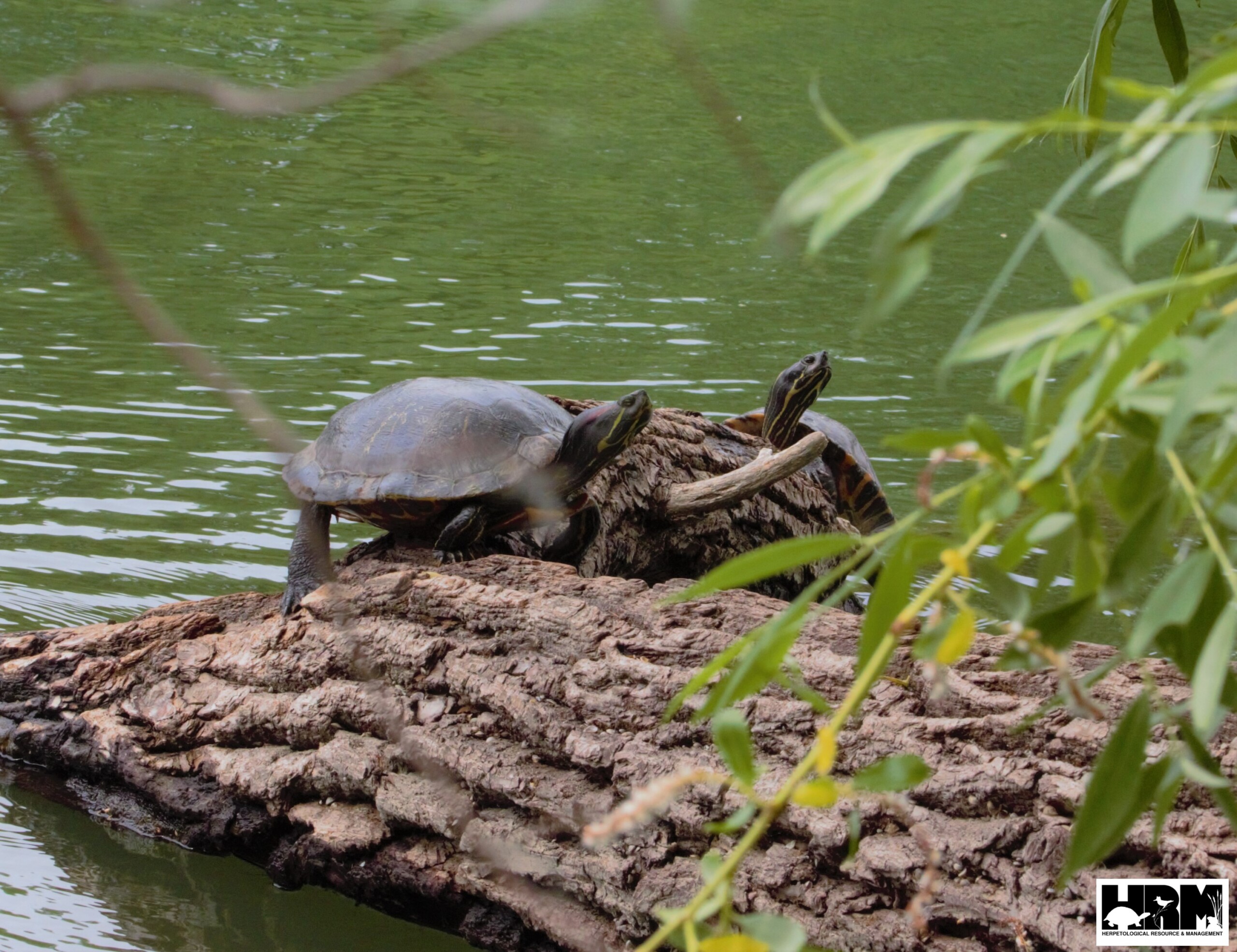
Inhabit ponds, lakes, reservoirs, ditches, sloughs, swamps and backwaters and slower sections of streams and rivers. Will occupy almost any permanent body of water with ample aquatic vegetation and basking sites. Are rarely far from water but will travel overland. Adults tend to prefer deep water than Painted Turtles in the same habitats though juveniles of both species remain in weedy shallows.
Conservation:
Do not normally eat game fish and pose no threats to human interests. Suffered from long standing human exploitation and destruction with many killed by automobiles or persecution from anglers. Many thousands were caught for the pet trade in the past which has now been replaced by breeding farms. Ironically, the international trade of the species has seen them become invasive in other parts of the country and world. Often used by vandals as target practice. Debate surrounds if the species is native or introduced in the Great Lakes region though no negative ecological problems have been noted by the species.
Best Management:
Maintain or restore nesting sites. Nest site protections like predator control and egg protective devices can help reduce large mortality events. Install basking structures in areas lacking them or in areas they are removed. Crossing structures can help reduce the effects of habitat fragmentation and mortality by roadways or railways.
Adult Coloration:
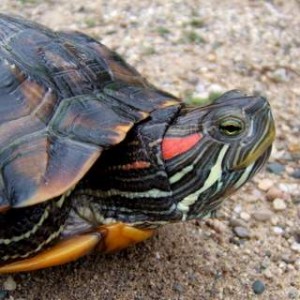
A Brownish or olive colored carapace with a variable pattern of yellow and black bands and stripes. The plastron is yellow with a dark spot or smudge in the center of each scute. The head and legs are green, olive, or brown with many narrow black and yellow stripes. A few broader yellow stripes slant down from the snout, mouth and lower corner of the eye with a broad red or orange stripe extending backwards from the center or top of each eye. In some individuals this stripe may be poorly developed or obscured. Large males often become very dark with black pigment obscuring the color and pattern on the shell and skin.
Adult Characteristics:
The carapace is smooth and may be unkeeled or with a low central keel with a flaring rear edge that is weakly serrated. Males are smaller than females and has greatly elongated claws on the front feet and a comparatively longer tail than females. Females have longer hind claws.
Juvenile Characteristics:
Range from 1.1 – 1.3” in carapace length. The carapace has a low keel with both the carapace and skin a bright green. Yellow stripes and other markings may be less defined by dark pigment than those of older individuals, but the black spots on the plastral scutes is usually prominent.
Species Confused With:
Painted Turtles have reddish markings on the marginal scutes and limbs and a centralized blotch or pattern on the plastron. Northern Map Turtles lack the red stripe behind the eye and have a mostly unmarked plastron.
Photos:
References:
- Amphibians and Reptiles of the Great Lakes Region by Jim Harding
- Conant, R., and Collins, J. T. 1998. Reptiles and Amphibians: Eastern, Central North America. Houghton Mifflin Harcourt Press.
- Harding, J and D. Mifsud. 2017. Amphibians and Reptiles of the Great Lakes Region: Revised Edition. Ann Arbor: The University of Michigan Press.
- Harding, J.H. and J.A. Holman. 1990. Michigan Turtles and Lizards. MSU Cooperative Extension Service and MSU Museum. 96 pp.
- Holman, J. A. 2012. The Amphibians and Reptiles of Michigan: A Quaternary and Recent Faunal Adventure. Detroit, Mich., Wayne State University Press.
- Mifsud, David A., Sano, Melissa R., Seguchi, Kotaro J., 2026. Michigan Amphibian and Reptile Best Management Practices Third Edition. Herpetological Resource and Management Technical Publication 2026
- Ruthven, A. G., H. B. T. Gaige, et al. 1912. The herpetology of Michigan, by Alexander B. Ruthven. Crystal Thompson and Helen Thompson; Memoranda towards a bibliography of the archaeology of Michigan, by Harlan I. Smith; prepared under the direction of Alexander G. Ruthven. Lansing, Mich., Wynkoop Hallenbeck Crawford, State Printers.