
Eastern Snapping Turtle
Overview:
Scientific Name: Chelydra serpentina
Size: 8 – 19” (adult carapace length)
Status: Locally abundant throughout the Great Lakes basin except when local populations have been depleted due to overharvesting
Habitat:
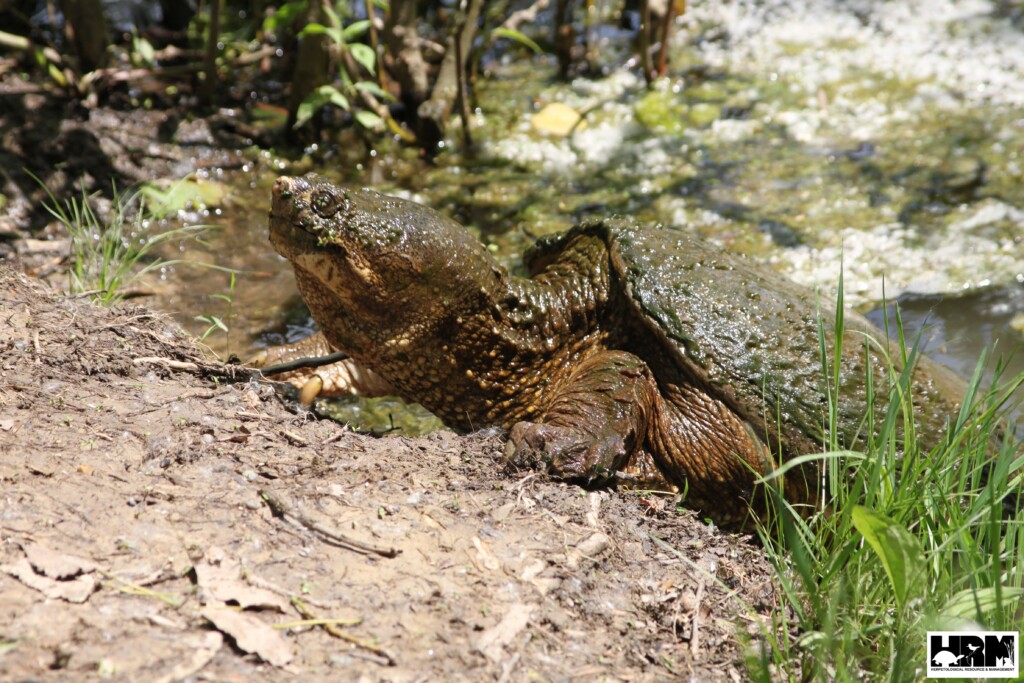
Inhabit permanent bodies especially quiet, mud-bottomed ponds, lakes, and slow streams with dense aquatic vegetation. The species appears to be relatively tolerant of polluted waters.
Conservation:
Snappers are blamed for reducing game fish and waterfowl populations which is not accurate but unfortunately leads to their persecution by some. An important lake and stream community member, they provide plenty of ecosystem services. Their eggs and young provide food resources for many predators while the adults are both predators and scavengers on the landscape. While some localities harvest the species for a food source, there is no sustainable harvest of the species leading to declines in these areas. The loss of mature turtles in such a way is hard for a species whose female annual adult survivorship range from 88 to 98%. Snapping Turtles can store environmental contaminants in their body fat, liver, muscle tissue and eggs such as organochlorine pollutants like polychlorinated biphenyls (PCBs).
Best Management:
Treatment of invasive species such as phragmites that block nesting areas is recommended, being mindful of when and where treatment activities occur. Consider the effects of altering or destroying vernal pools. Do not impact the pool depression or core buffer area within 100 feet of the pools and aim to protect a wider buffer of 600 – 1000 feet around the pools. Try to maintain the forest canopy and any habitat corridors to other vernal pools and upland habitats, these landscape mosaics are important to the species. Crossing structures can help reduce the effects of habitat fragmentation and mortality by roadways or railways.
Adult Coloration:
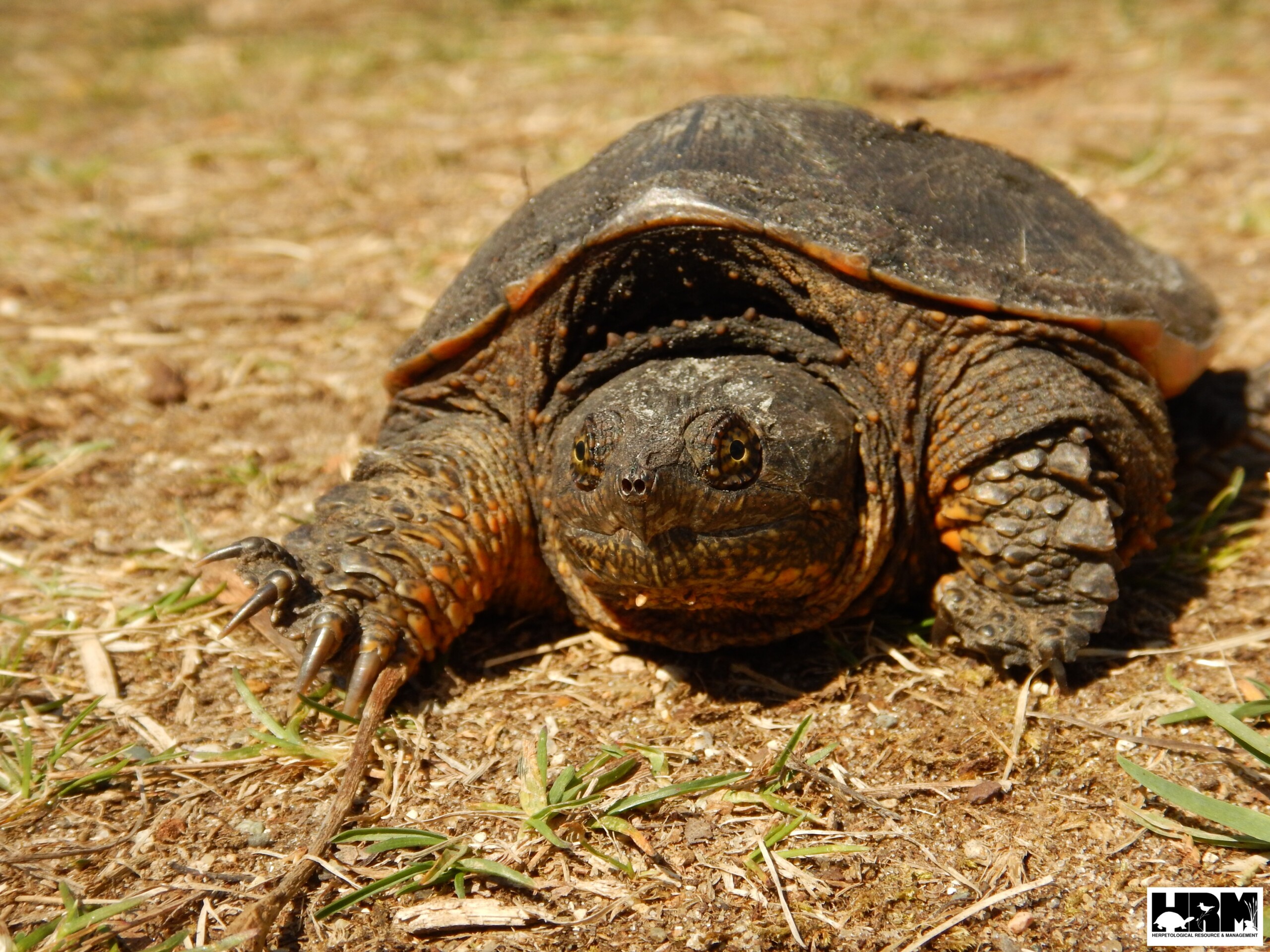
Brown, black, or olive carapace often obscured with mud or algae. The plastron can be yellow, tan or grey and is small and shaped in a cross leaving lots of exposed skin around the legs. The skin color on the top of the head, neck and legs is generally dark brown, grey, or olive blending into lighter shades of a dull yellow below. Sometimes has one or two yellow stripes behind the eyes and yellow spots on the neck or legs.
Adult Characteristics:
A broad carapace with a serrated rear edge with the four most rear marginal scutes sharply pointed. Shells may be ridged or nearly smooth. The feet are webbed with heavy, curved claws. The head is large with a short, pointed snout and sharp jaws with a hooked upper beak. There are two barbels on the chin and skin on the neck is warty and covered with blunt tubercles. Three rows of triangular scales run down the long, thick tail with the middle row being larger and more conspicuous. In males, the precloacal tail is longer than females.
Juvenile Characteristics:
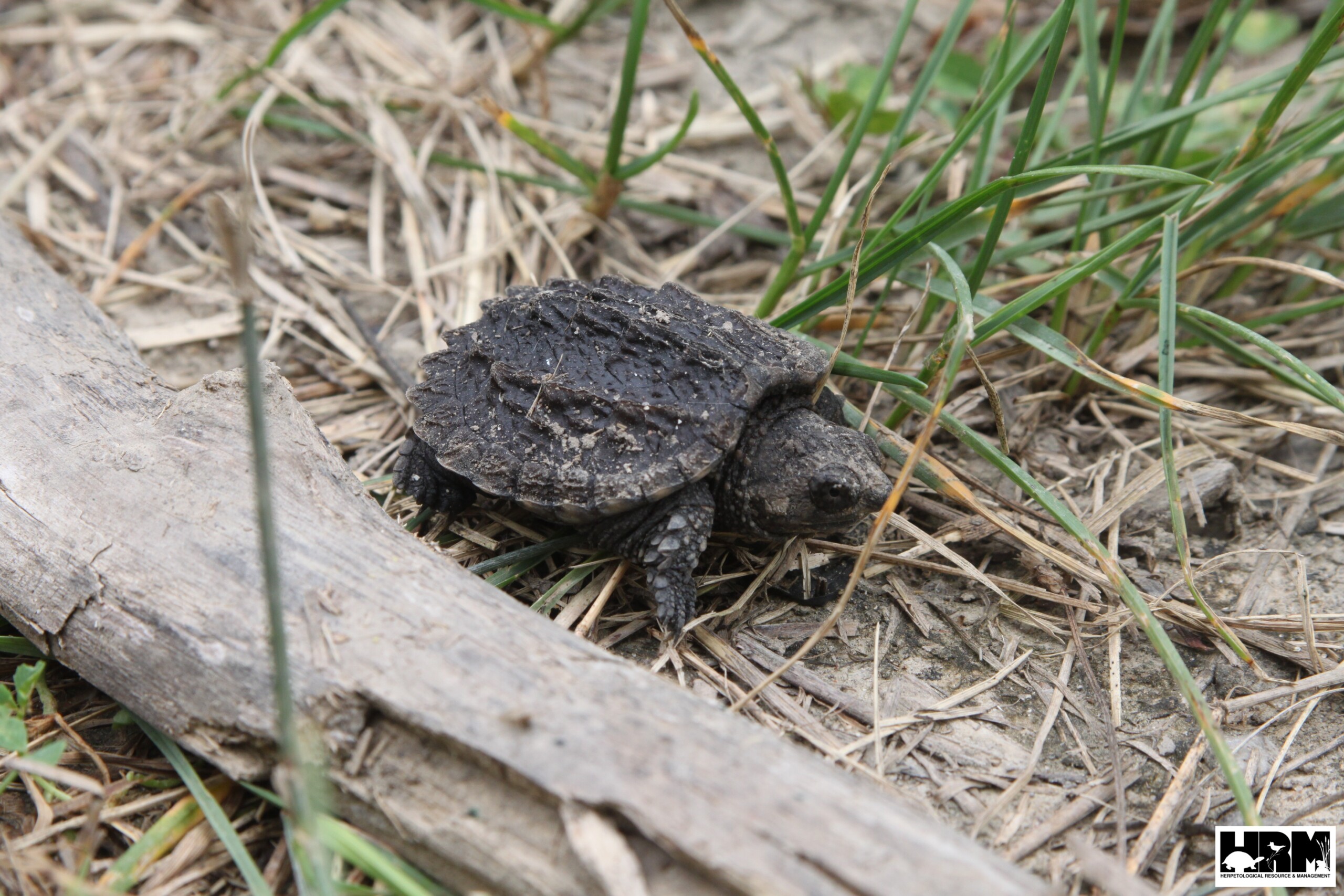
Same as above but with three lengthwise keels on the carapace. Their tails are usually longer than their shells. Often there are white spots below the edge of the carapace and on the plastron with a carapace length of 1 – 1.5”.
Species Confused With:
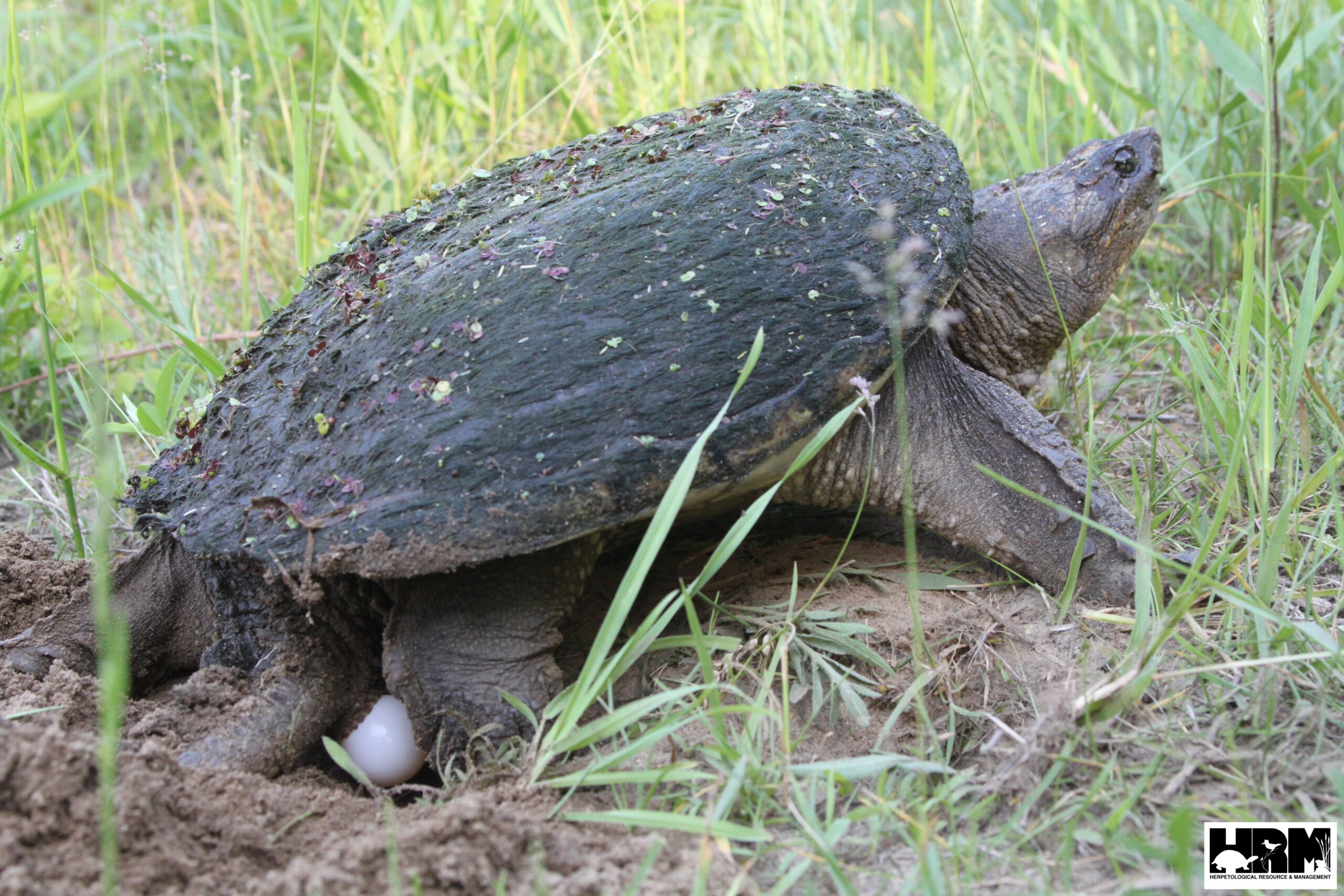
The Eastern Musk Turtle has a similarly small plastron and feisty behavior but is much smaller than a Snapping Turtle with a short tail and highly domed carapace. Snapping Turtle eggs are spherical like Softshell Turtle eggs but are larger and have more rigid shells.
Photos:
References:
- Amphibians and Reptiles of the Great Lakes Region by Jim Harding
- Conant, R., and Collins, J. T. 1998. Reptiles and Amphibians: Eastern, Central North America. Houghton Mifflin Harcourt Press.
- Harding, J and D. Mifsud. 2017. Amphibians and Reptiles of the Great Lakes Region: Revised Edition. Ann Arbor: The University of Michigan Press.
- Harding, J.H. and J.A. Holman. 1990. Michigan Turtles and Lizards. MSU Cooperative Extension Service and MSU Museum. 96 pp.
- Holman, J. A. 2012. The Amphibians and Reptiles of Michigan: A Quaternary and Recent Faunal Adventure. Detroit, Mich., Wayne State University Press.
- MI DNR
- Mifsud, David A., Sano, Melissa R., Seguchi, Kotaro J., 2026. Michigan Amphibian and Reptile Best Management Practices Third Edition. Herpetological Resource and Management Technical Publication 2026
- Ruthven, A. G., H. B. T. Gaige, et al. 1912. The herpetology of Michigan, by Alexander B. Ruthven. Crystal Thompson and Helen Thompson; Memoranda towards a bibliography of the archaeology of Michigan, by Harlan I. Smith; prepared under the direction of Alexander G. Ruthven. Lansing, Mich., Wynkoop Hallenbeck Crawford, State Printers.