
Wood Turtle
Overview:
Scientific Name: Glyptemys insculpta
Size: 6.3 – 9.8” (adult carapace length)
Status: Generally uncommon to rate across Great Lakes range. Many local populations have experienced great reductions or extirpation due to human activities. Species can be locally common where habitat intact and disturbance is low.
Michigan State Status: Threatened
Federal Status: Candidate Under Review
MDNR Wildlife Action Plan Status: Species of Greatest Conservation Need
Habitat:
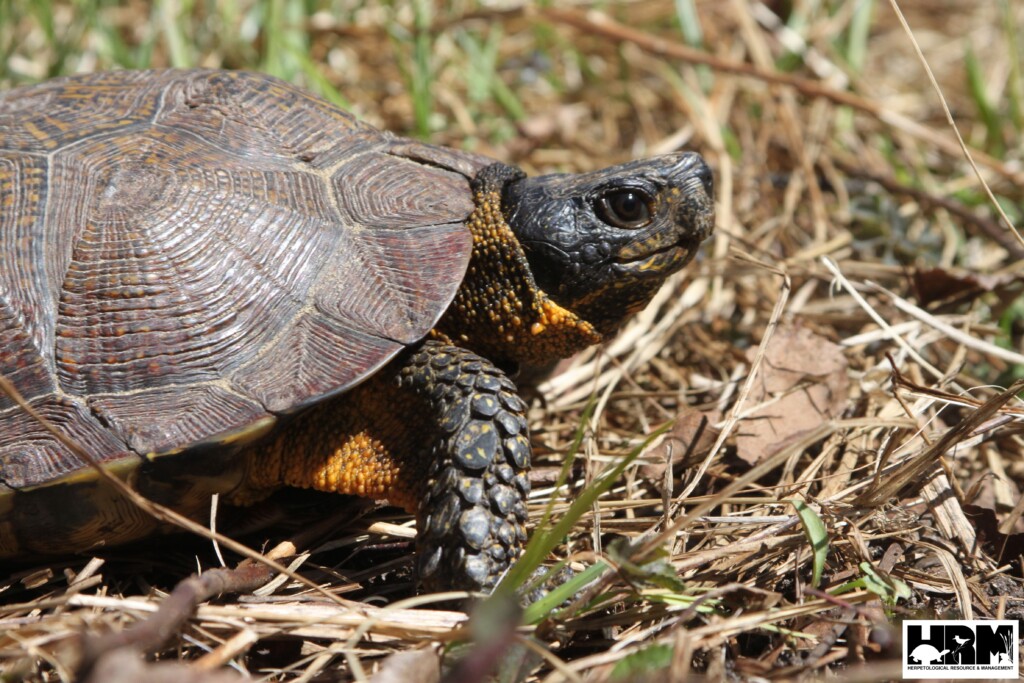
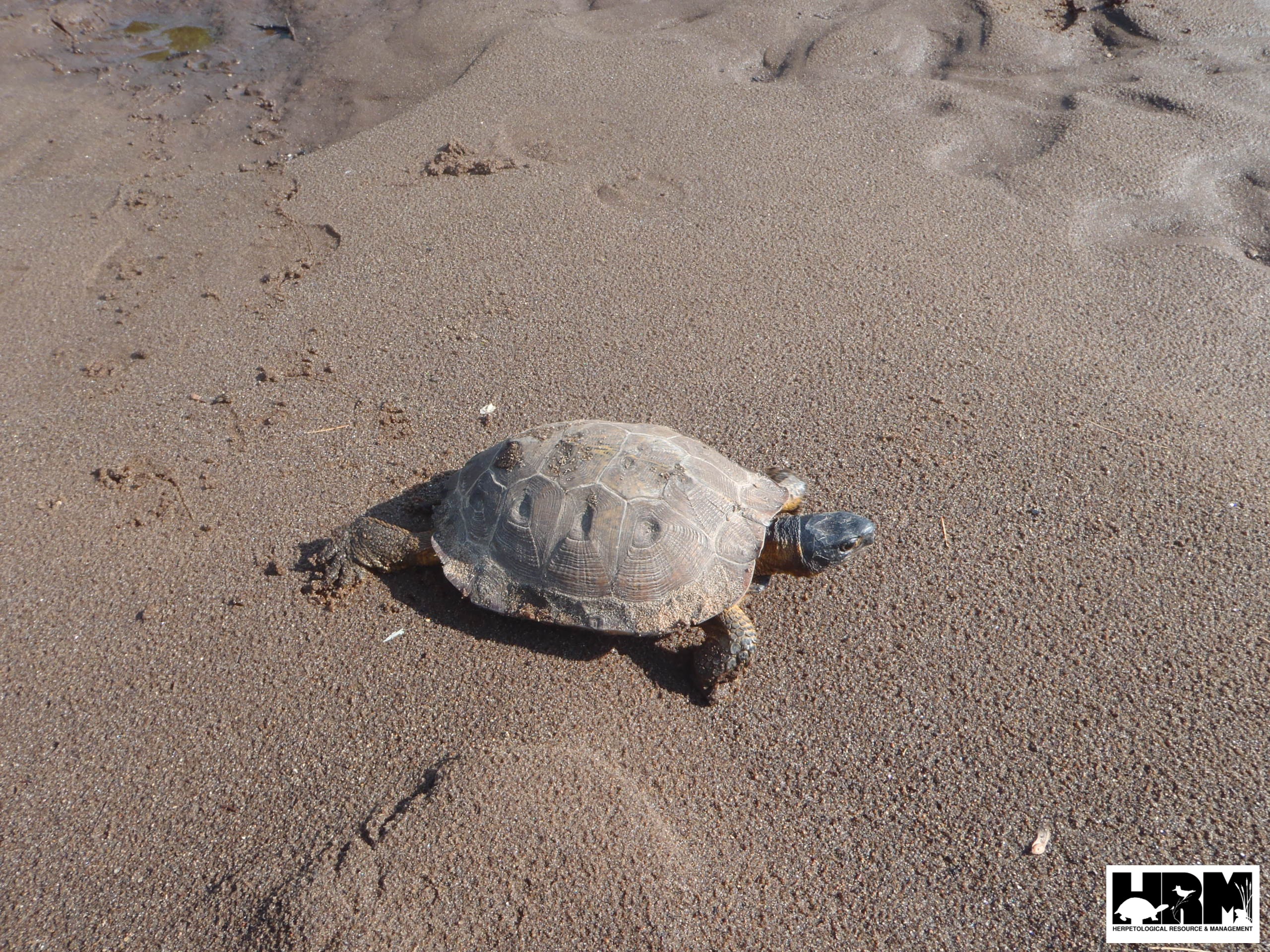
Most commonly inhabit in or near sandy-bottomed streams or rivers but also in streams with partially rocky or silty beds. Largely aquatic during most of the year but are often terrestrial during summer and can be found walking through woodlands, alder thickets, swamps, wet meadows, and fields within or near floodplains.
Conservation:
Inhabiting riparian habitat throughout the Northern Great Lakes region as well as across New England and Southern Canada, the wood turtle faces increasing risks of extirpation. Habitat destruction and alteration of riparian zones from activities such as channelization, bank stabilization, dredging, as well as the instillation of culverts and impoundments can have serious implications for the longevity of this species’ survival on the landscape. Life history traits such as low clutch sizes and delayed sexual maturity also make wood turtles increasingly vulnerable to disturbances within their habitat. These traits, which are usually balanced out by historic high adult survivorship, can make it very difficult for wood turtles to maintain stable populations when adults or older juveniles are removed from the system. Either because of over-predation or collection for the illegal wildlife trade, the loss of wood turtles from older age classes can be detrimental to a population’s persistence. Similarly to the Blanding’s turtle, wood turtles are immensely popular in the illegal wildlife trade and are one of the most commonly trafficked turtles on the market.
Best Management:
Identify and protect suitable habitats that contain extant populations of wood turtles. Suitable habitat for wood turtles consists of forested streamside/riparian zones situated near slow-moving, sandy-bottomed streams or rivers. However, it has also been documented that female wood turtles utilize adjacent woodlands during the summer months while males typically stay close to water year-round. Wood turtles would greatly benefit from riparian management practices such as creating a variety of habitat structures like sand and gravel bars for nesting, natural cutbanks to provide cover, and adding woody debris. Culverts can be added to improve stream connectivity and should be slightly wider than the bankfull width and placed on straight parts of the stream or river. Ensure water velocity is not disturbed by the culvert and try to maintain natural water flow. Incorporate floodplain shelves to dissipate excess energy during flood events to decrease erosion while improving the adjacent floodplain habitat. Restore riffles, runs, and pool sequences that naturally occur in streams to provide deeper pools to act as potential overwinter sites and create increased bank habitat. Utilize vegetation placed in strategic locations to stabilize slopes as well as to protect exposed sandy areas that serve as critical breeding sites. Known wood turtle nesting sites should be monitored and protected from predation. Basking structures can be created by placing fallen trees or logs as well as large rocks or boulders partially in the water. Captive rearing head-start programs can be an effective tool in stabilizing populations in decline. Introduce predator controls to eliminate over-predation and increase the success of nests. Maintain adequate water quality by using vegetated buffer zones between areas of chemical application and aquatic system. Identify and prevent non-point nutrient and chemical runoff from entering the system. Prevent the introduction of invasive species. Minimize road mortality by installing wildlife barrier fencing or crossing structures to redirect wood turtle movements during peak active season. Monitor sites consistently to prevent the collection of wood turtles for the illegal wildlife trade and report suspicious activities to wildlife law enforcement.
Adult Coloration:
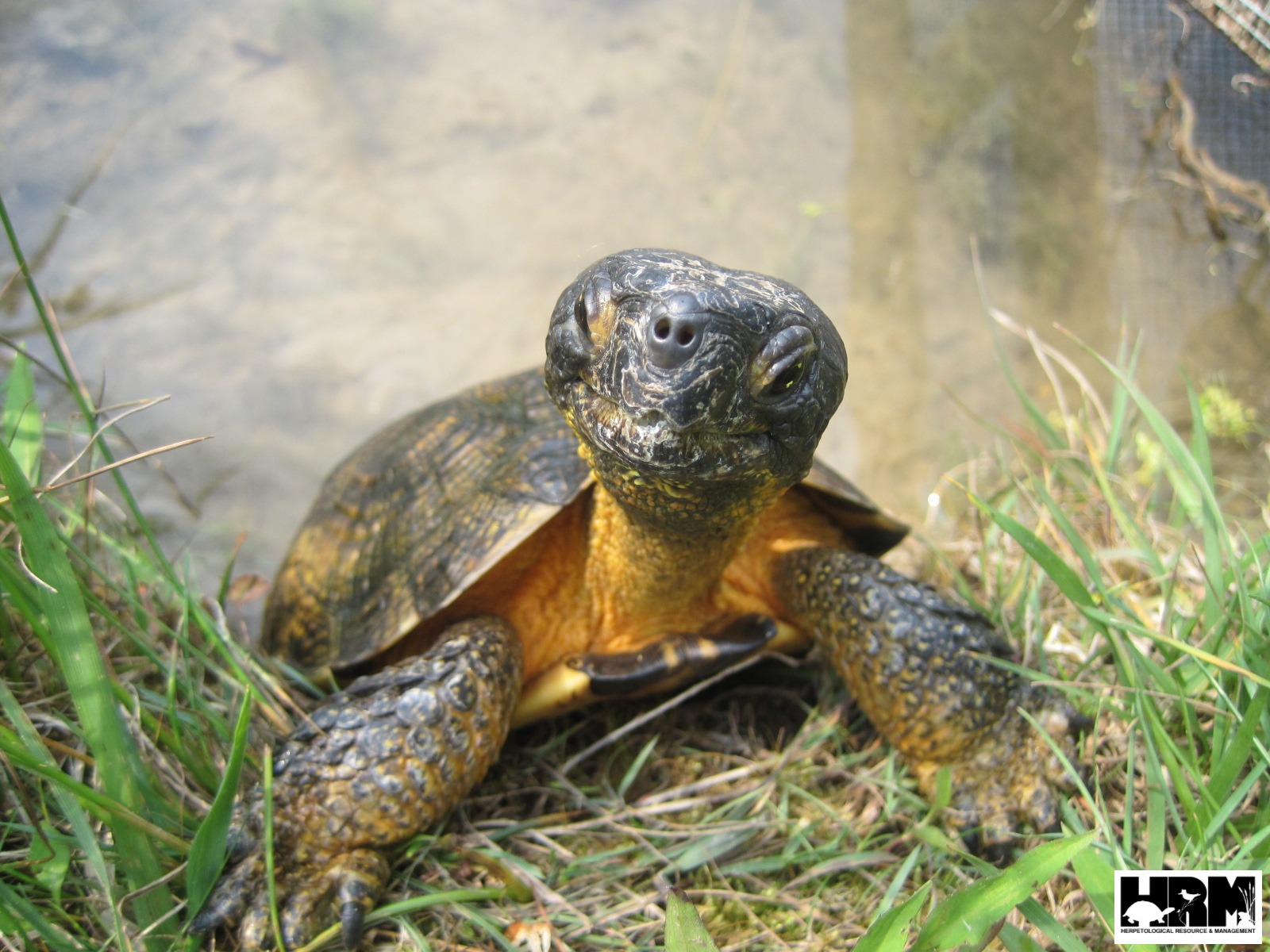
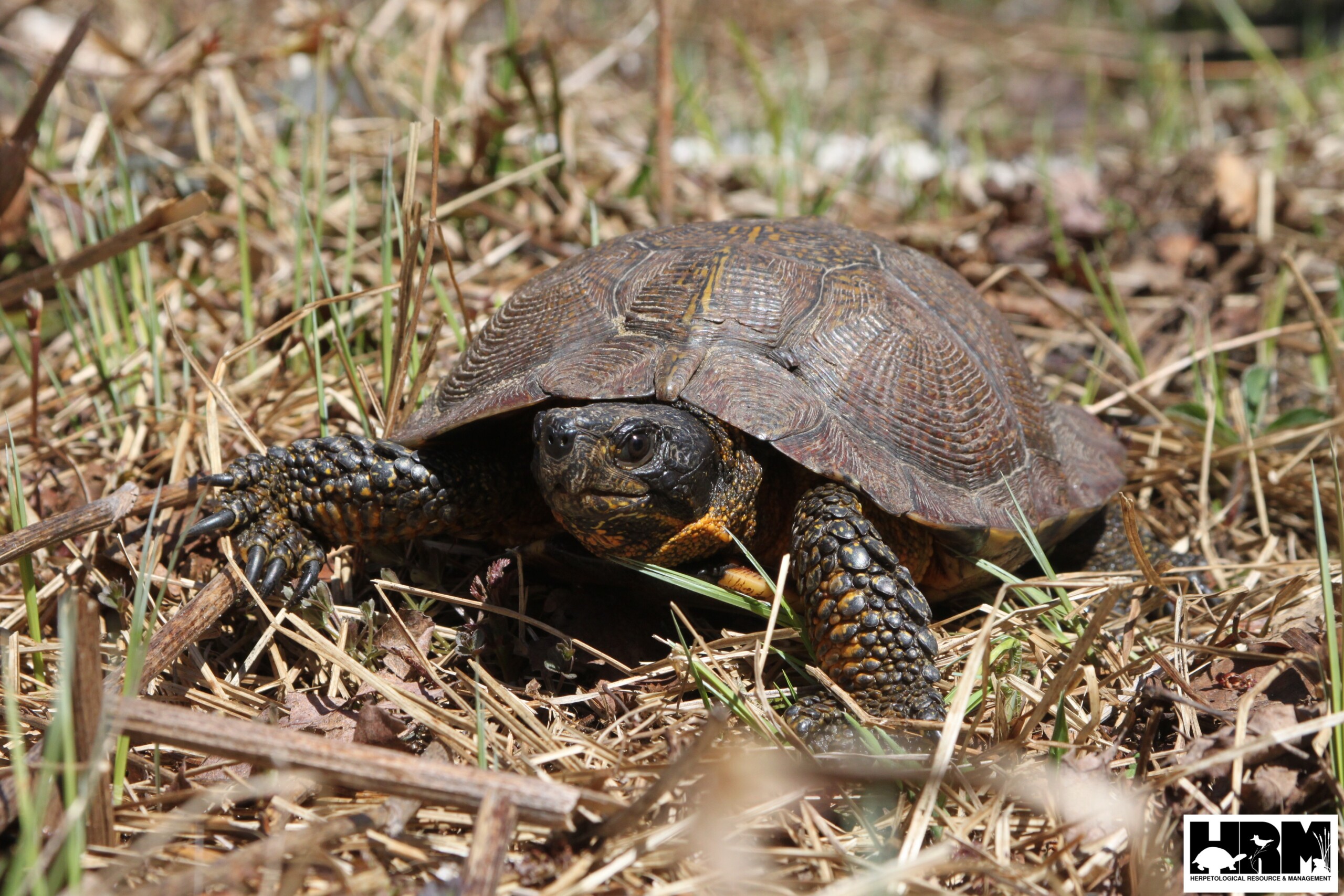
The carapace may be brown or greyish-brown sometimes with a pattern radiating yellow and black lines on the vertebral and pleural scutes. The plastron is yellow with a dark blotch at the read outer corner of each scute. The head and the upper parts of the neck, legs and tail is black. The lower parts of the neck, legs, tail and other soft parts vary from yellow to yellowish-orange. The large outer scales of the front legs are black or brown that are sometimes edged and speckled with yellow.
Adult Characteristics:
The carapace has a low central keel and well-defined growth rings (known as annuli) that crossed by ray-like ridges on the scutes. A V-shaped notch is on the plastron at the tail. Males have higher, narrower shells with larger, wider heads and more robust limbs and feet with thick claws. The tail is also longer and thicker in males than females. Males have a concave plastron. Females have broader, less domed carapaces with rear marginal scutes that are outwardly flared. Females have a flat or slightly convex plastron. The legs are less thick, and claws are thinner. Immature males may be mistaken for females when the carapace length is less than 6.3” in length
Length: 16-25 cm
Typical lifespan in wild: unknown: estimated to 58 years
Breeding interval: once annually, may skip a year
Breeding season: May-June
Range number of offspring: 3-18
Average number of offspring: 5-13
Range gestation period: 47-69 days
Average age at sexual/reproductive maturity (female): 12-20 years
Average age at sexual/reproductive maturity (male): 12-20 years
Diet: violets, strawberry leaves, dandelions, willows, strawberries, raspberries, blackberries, algae, fungi, insects, slugs, snails, earthworms, recent deceased organisms
Predators: Raccoons, skunks, minks, otters, foxes, coyotes, ravens, feral cats and dogs, large fish, and frogs.
Juvenile Characteristics:
Hatchlings are uniform grey, tan, or brown in color with nearly circular carapaces and long, thin tails. They range from 1.1 – 1.5” in carapace length. Typical adult color pattern is usually acquired during the first full year of growth.
Species Confused With:
Blanding’s Turtles are also yellow under the neck and legs and have a similar plastral pattern, but they have a hinged plastron and an unkeeled, domed carapace.
Photos:
References:
- Amphibians and Reptiles of the Great Lakes Region by Jim Harding
- Conant, R., and Collins, J. T. 1998. Reptiles and Amphibians: Eastern, Central North America. Houghton Mifflin Harcourt Press.
- Harding, J and D. Mifsud. 2017. Amphibians and Reptiles of the Great Lakes Region: Revised Edition. Ann Arbor: The University of Michigan Press.
- Harding, J.H. and J.A. Holman. 1990. Michigan Turtles and Lizards. MSU Cooperative Extension Service and MSU Museum. 96 pp.
- Holman, J. A. 2012. The Amphibians and Reptiles of Michigan: A Quaternary and Recent Faunal Adventure. Detroit, Mich., Wayne State University Press.
- Mifsud, David A., Sano, Melissa R., Seguchi, Kotaro J., 2026. Michigan Amphibian and Reptile Best Management Practices Third Edition. Herpetological Resource and Management Technical Publication 2026
- Ruthven, A. G., H. B. T. Gaige, et al. 1912. The herpetology of Michigan, by Alexander B. Ruthven. Crystal Thompson and Helen Thompson; Memoranda towards a bibliography of the archaeology of Michigan, by Harlan I. Smith; prepared under the direction of Alexander G. Ruthven. Lansing, Mich., Wynkoop Hallenbeck Crawford, State Printers.