
Bullfrog
Overview:
Scientific Name: Rana (Lithobates) catesbeianus
Size: 3.7 – 8” (adult size), largest frog in North America
Status: Less common in the north and absent from northern Lake Superior basin. Can be locally common, though recent declines have occurred in areas where they were previously abundant.

Habitat:
Will inhabit almost any still, permanent body of water, especially areas with abundant submerged and emergent aquatic vegetation. Temporary ponds may be used by dispersing juveniles.
Conservation:
Local declines have been attributed to habitat degradation and loss, water pollution, pesticide contamination, and overharvesting. Lakeside developments that remove shoreline and submergent vegetation and heavy recreational use disrupt breeding activities. Restaurant and biological supply trades heavily collect the species and while the species is listed as a game animal with seasons and bag limits, there is no sustainable harvest of the species given their developmental rate and slow population replacement rates.
Best Management:
Pesticide application should occur in late summer and fall when larvae have metamorphosed and hibernation begins, care should be taken as tadpoles are still present for this species. Maintaining inundation during drawdowns will allow tadpoles to overwinter.
Adult Coloration:
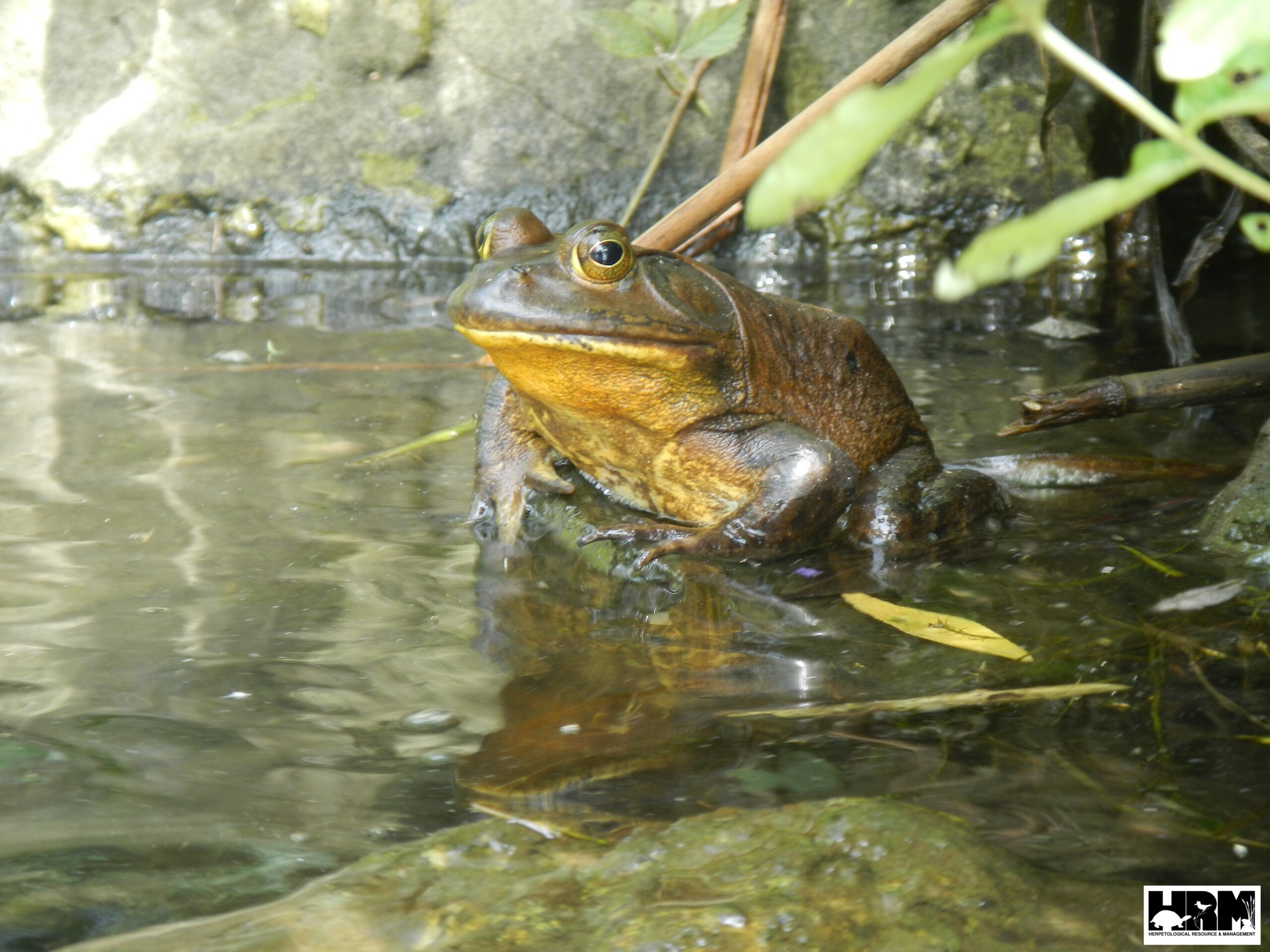
Can be green, yellow-green, olive or brown with brown spotting or blotches on the back and dark bands on the upper legs. The belly is white or cream colored often with grey mottling.
Adult Characteristics:
No dorsolateral folds (raised ridges running extending down each side of the back) but a ridge of skin is present from the eye to the shoulder. The skin of young Bullfrogs is smooth but becomes bumpier with age. The toes of the hind feet are fully webbed except for the tip of the longest toe, the fourth toe. The tympanum (circular “ear” structure on the side of the head) is much larger than the eye in males and about the same size as the eye in females. Males have a yellow throat while females have a white throat. Males are usually more uniform in coloration and smaller than females. Their call is a low pitched, resonating “brr-rr–rrum” while
Larvae Characteristics:
Tadpoles are green, olive, or brownish-black with dark spots that can extend to the upper tail fin. The belly is white or yellowish. Can reach over 6” in length during extended larval period that can last upwards of two years.
Species Confused With:
Green Frog tadpoles are similar but often have dark spots on both the upper and lower tail fins. Adult Green Frogs also may resemble Bullfrogs, but they have distinct dorsolateral folds extending at least part way down the back and they have a smaller adult size. The Mink Frog is also smaller, but it may be mistaken for Bullfrogs due to the lack of dorsolateral folds. The Mink Frog may be distinguished by the presence of rounded spots or lengthwise blotches on the top of the legs or by the musky odor it releases when handled.
Photos:


References:
- Amphibians and Reptiles of the Great Lakes Region by Jim Harding
- Conant, R., and Collins, J. T. 1998. Reptiles and Amphibians: Eastern, Central North America. Houghton Mifflin Harcourt Press.
- Harding, J.H. and J.A. Holman. 1992. Michigan Frogs, Toads, and Salamanders. MSU Cooperative Extension Service and MSU Museum. Extension Bull. E-2350, 144 pp.
- Harding, J and D. Mifsud. 2017. Amphibians and Reptiles of the Great Lakes Region: Revised Edition. Ann Arbor: The University of Michigan Press.
- Holman, J. A. 2012. The Amphibians and Reptiles of Michigan: A Quaternary and Recent Faunal Adventure. Detroit, Mich., Wayne State University Press.
- Mifsud, David A., Sano, Melissa R., Seguchi, Kotaro J., 2026. Michigan Amphibian and Reptile Best Management Practices Third Edition. Herpetological Resource and Management Technical Publication 2026.
- Ruthven, A. G., H. B. T. Gaige, et al. 1912. The herpetology of Michigan, by Alexander B. Ruthven. Crystal Thompson and Helen Thompson; Memoranda towards a bibliography of the archaeology of Michigan, by Harlan I. Smith; prepared under the direction of Alexander G. Ruthven. Lansing, Mich., Wynkoop Hallenbeck Crawford, State Printers.