
Mink Frog
Overview:
Scientific Name: Rana (Lithobates) septentrionalis
Size: 1.8 – 3” (adult size)
Status: Locally abundant in suitable areas.
Michigan State Status: Special Concern
MDNR Wildlife Action Plan Status: Species of Greatest Conservation Need
Habitat:
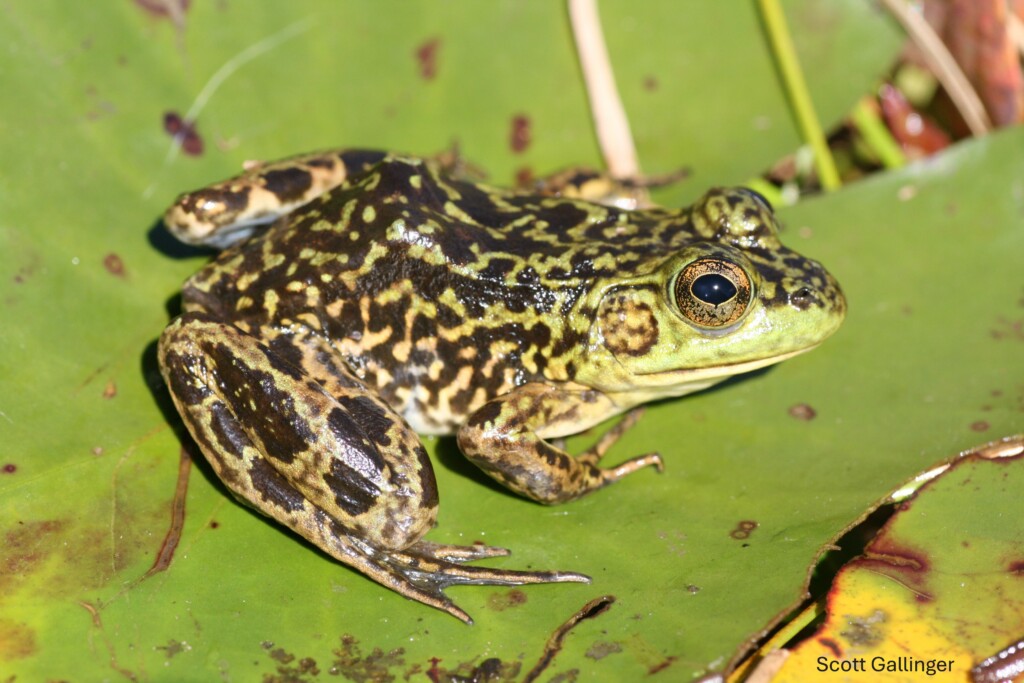
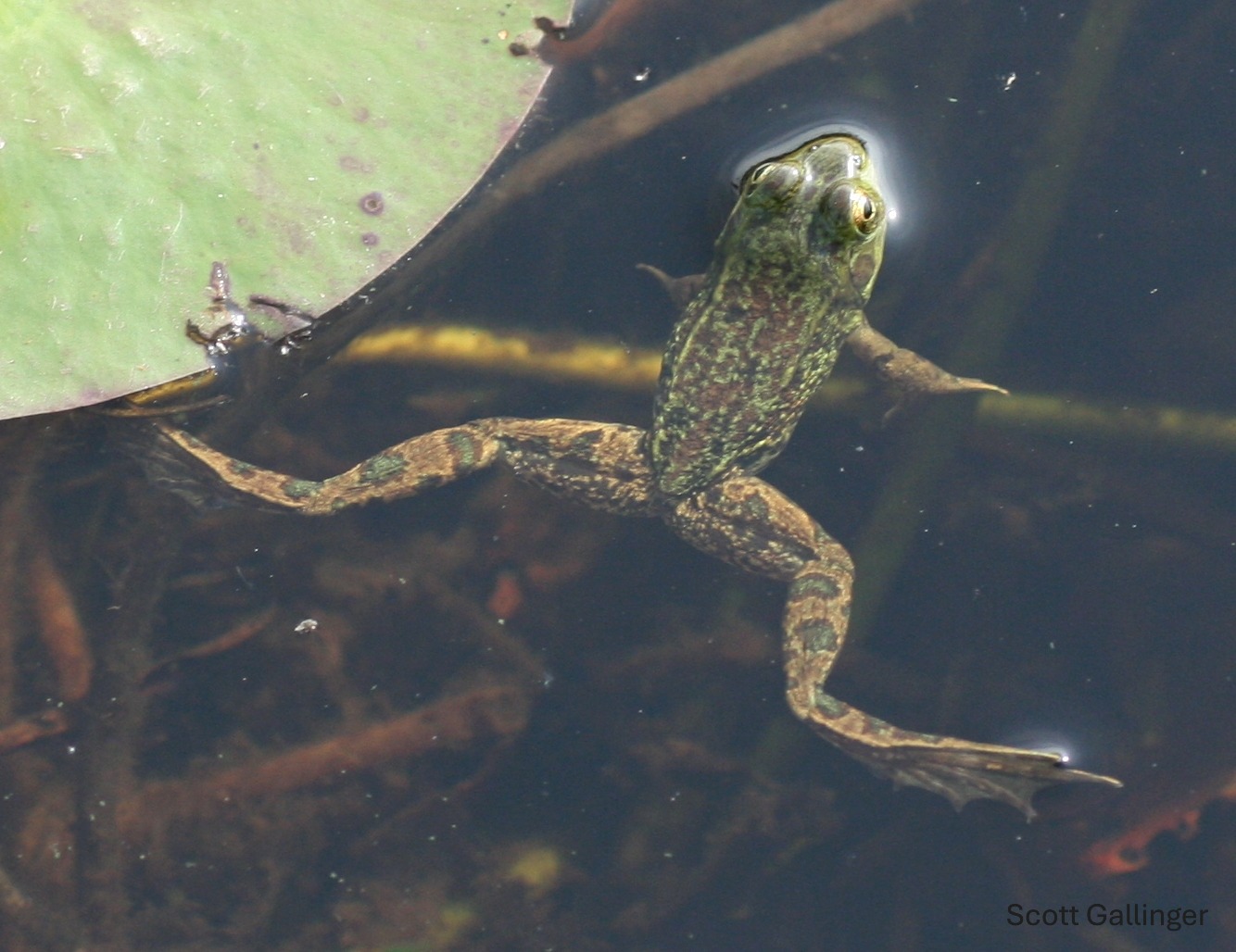
Inhabit cool, permanent waters with abundant emergent and floating vegetation. Favors slow streams, boggy lake inlets, natural impoundments, and spring-fed ponds where lily pads or other floating weedy vegetation is present.
Conservation:
Listed as a species of special concern in Michigan, the greatest threat facing the Mink Frog is the transmission of amphibious diseases. Aeromonas is a bacterium that causes red-leg syndrome, which damages internal organs and leads to rapid death. Ranaviruses like frog erythrocytes virus (FEV) and frog virus 3 (FV3) have also decimated mink frogs at the local scale. Besides diseases, chemical contaminates have the ability to disrupt the progression of mink frog development and inhibit successful metamorphism.
Best Management:
Identify and protect quality Mink frog habitat containing extant populations. Adhere to strict decontamination protocol regarding equipment and clothing when working in suitable mink frog habitat. Utilize vegetated buffer zones between areas of chemical application and aquatic systems as well as intercept chemical runoff before entering the system. Apply chemicals during late summer and early fall if necessary. Avoid mechanical aquatic weed harvesting and prevent introduction of invasive aquatic species. Avoid disturbing riparian and adjacent terrestrial area. If riparian harvest is necessary, maintain the understory and install erosion control measures. The management of beavers will also directly benefit mink frogs because the vegetative communities created by beaver impoundments in turn create ideal mink frog habitat. Provide egg laying structure by submerging finely brushed trees and ensure the presence of native aquatic plant communities. Create basking structures by partially or fully submerging logs and other objects.
Adult Coloration:
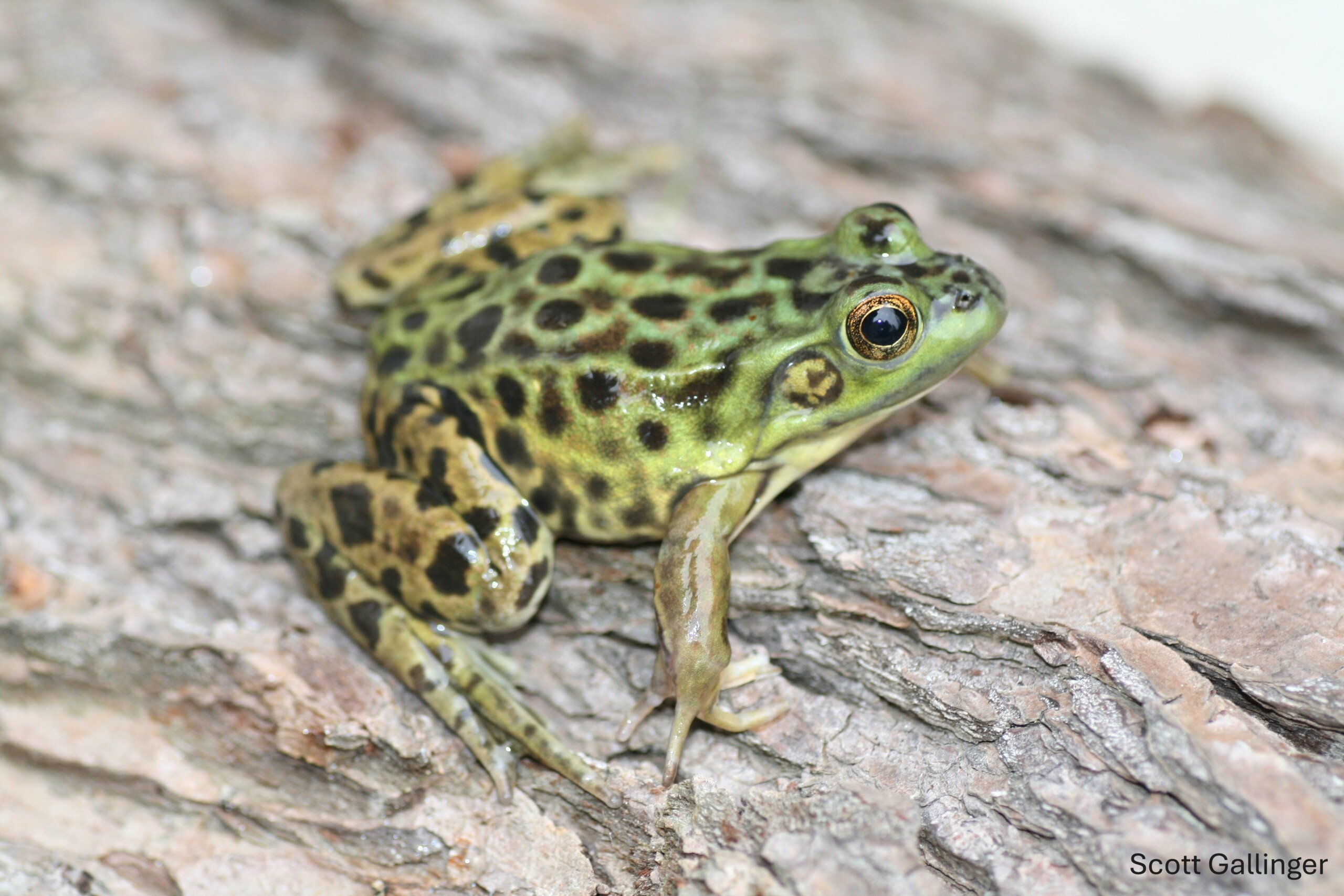
The back and sides are green, olive, or brown and are pattered moderately to heavily with dark spots and blotches. The top of the hind legs has rounded spots lengthwise stripes. The upper lip is green. The belly is white often blending to light yellow on the sides and chin. Occasionally the underside is entirely yellow.
Adult Characteristics:
The skin produces a musky odor when handled similar to rotting onions. Dorsolateral folds are poorly developed or absent but occasionally are present. In males, the tympanum (circular “ear” structures on the side of the head) is larger than the eye and the throat may be bright yellow. In females, the tympanum is smaller or equal to the eye and the throat is white or pale yellow. The call is a series or soft, low-pitched croaks “tok… tok, tok, tok, tok, tok” that is likened to distant hammering.
Typical lifespan in wild: 1 – 4 years
Breeding interval: multiple times annually
Breeding season: June – August
Range number of offspring: 500 – 4,0000
Average number of offspring: 2,000
Range time to hatchling: 3 – 6 days (metamorphosis: 1 year)
Average age at sexual/reproductive age (female): 1 – 3 years
Average age at sexual/reproductive age (male): 1 – 2 years
Diet: small fish, millipedes, insects, small frogs, leeches, snails, spiders; Tadpoles prey on algae though they have been observed consuming carrion.
Predators: American Bullfrog, raccoon, Great Blue Herons, Wood Ducks, Spruce Grouse, Eastern Newts, Green Frogs, Eastern Tiger Salamanders, Eastern Garter Snakes, Five-spined Stickleback, Giant Water Bug, North American Leech
Larvae Characteristics:
Tadpoles may reach 4” in length before they metamorphose. The back is green, olive, or brown with small dark spots or heavy mottling that can extend onto the tail. The tail is long with a pointed tip and fins may be edged with pinkish spots. The belly is yellowish and opaque.
Species Confused With:
Young Bullfrogs can be similar but are usually green and have sparse spotting. Green Frogs often have heavy marking where their ranges overlap but the two can be distinguished by the Mink Frog’s odor and rounded spots or lengthwise bars on the hindlegs compared to the Green Frogs darker crossbands.
Photos:
References:
- Amphibians and Reptiles of the Great Lakes Region by Jim Harding
- Conant, R., and Collins, J. T. 1998. Reptiles and Amphibians: Eastern, Central North America. Houghton Mifflin Harcourt Press.
- Harding, J and D. Mifsud. 2017. Amphibians and Reptiles of the Great Lakes Region: Revised Edition. Ann Arbor: The University of Michigan Press.
- Harding, J.H. and J.A. Holman. 1992. Michigan Frogs, Toads, and Salamanders. MSU Cooperative Extension Service and MSU Museum. Extension Bull. E-2350, 144 pp.
- Holman, J. A. 2012. The Amphibians and Reptiles of Michigan: A Quaternary and Recent Faunal Adventure. Detroit, Mich., Wayne State University Press.
- Mifsud, David A., Sano, Melissa R., Seguchi, Kotaro J., 2026. Michigan Amphibian and Reptile Best Management Practices Third Edition. Herpetological Resource and Management Technical Publication 2026
- Ruthven, A. G., H. B. T. Gaige, et al. 1912. The herpetology of Michigan, by Alexander B. Ruthven. Crystal Thompson and Helen Thompson; Memoranda towards a bibliography of the archaeology of Michigan, by Harlan I. Smith; prepared under the direction of Alexander G. Ruthven. Lansing, Mich., Wynkoop Hallenbeck Crawford, State Printers.