
Marbled Salamander
Overview:
Scientific Name: Ambystoma opacum
Size: 3.4 – 5” (adult size)
Status: Generally rare across the region, recently rediscovered in southwestern Michigan.
Michigan State Status: Threatened
MDNR Wildlife Action Plan Status: Species of Greatest Conservation Need
Habitat:
Prefer moist lowland forests but also occur in drier wooded ridges and rocky hillsides. Spend a majority of time beneath cover like logs, rocks and leaf litter.
Conservation:
Although stable and even locally common throughout much of its range, the marbled salamander is listed as endangered in the State of Michigan and is experiencing population declines around the Great Lakes region. Habitat loss, particularly the destruction of bottomland forests and their associated vernal pools, are having detrimental impacts to this species. The loss of connectivity as a result of habitat fragmentation between different breeding sites and adjacent habitats is also contributing to the marbled salamander’s decline in Michigan.
Best Management:
Identify and protect marbled salamander habitat containing extant populations. To manage forested habitat containing vernal pools, do not impact the pool depression or core buffer area within a minimum of 100 feet and also aim to protect a wider buffer of 600-1000 feet. It is critical to maintain a forest canopy (>50%) as well as connectivity between breeding sites and adjacent habitat. If desired, additional vernal pools may be constructed or restored. If tree harvest is to be conducted near known marbled salamander populations, ensure harvest is carried out during late fall to early winter. Consider utilizing various tree harvesting techniques conjoined with a cutting rotation to prevent large, forested tracts from being clearcut. Ensure course woody debris is scattered and that the litter layer and understory vegetation are maintained to provide appropriate microclimates. Provide egg laying structures by submerging finely brushed trees or bushes and ensure native plant communities are present. Additional aquatic structures may be placed in shallow water.
Adult Coloration:
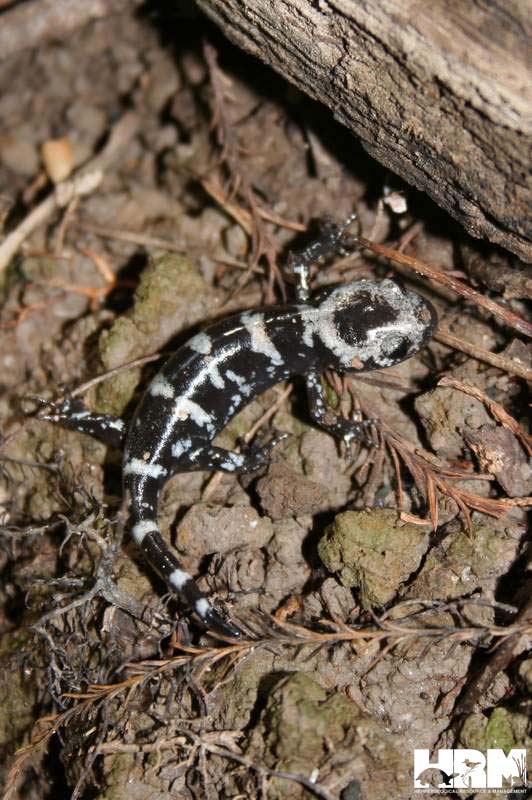
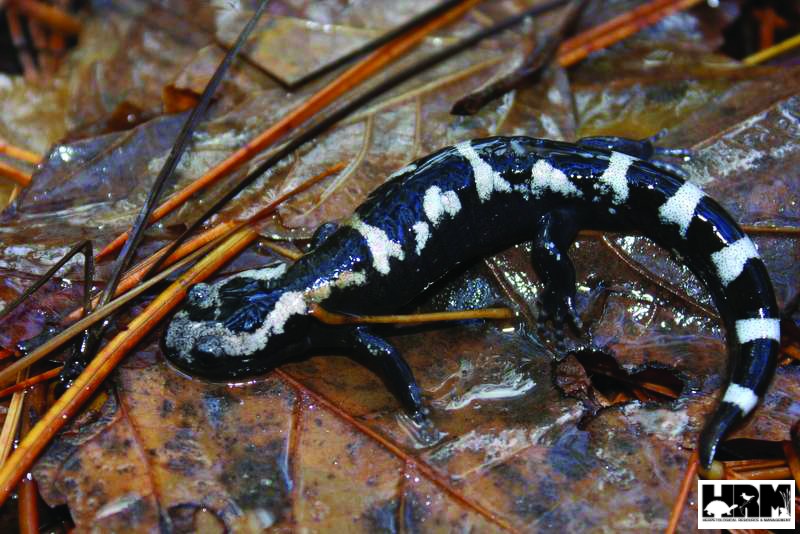
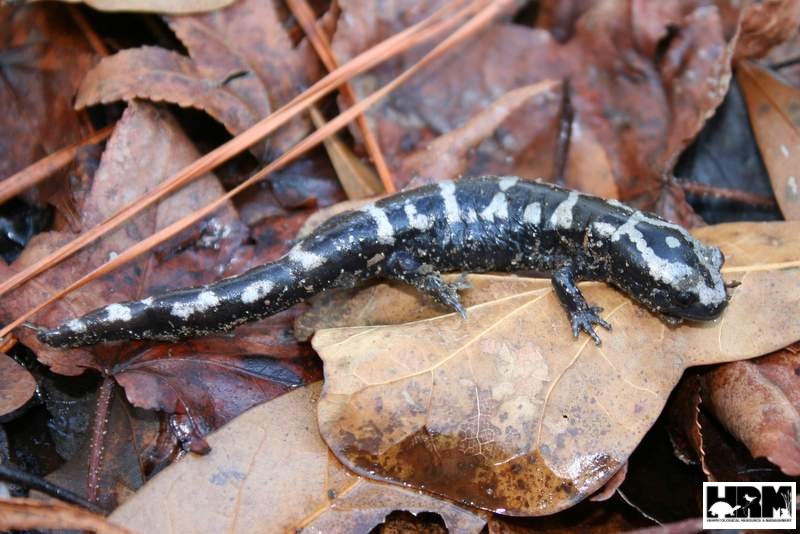
The body is marked with conspicuous white or grey markings on a black to dark-brown-black body. Markings occur as bands across the head and back which sometimes marge into an irregular stripe down each side of the back. The tail is banded black and white, the belly can be black or brownish-black with light speckling.
Adult Characteristics:
11-13 costal grooves (grooves between rib-like ridges that run down the sides of the body). Body is stocky. In males the light markings on the body are pure white while females are more grey (more prominent in breeding season). Males have swollen vents during breeding season. Breeding season occurs in the fall.
Typical Lifespan in Wild: Unknown (3.5 – 4 years in captivity)
Breeding Interval: Once annually
Breeding Season: September- October
Range number of offspring: 50 – 100
Average number of offspring: 75
Range time to hatchling: climate dependent (metamorphosis: 8 – 9 months depending on geographic location
Average age at sexual/reproductive maturity (female): 2 – 4 years
Average age at sexual/reproductive maturity (male): 2 – 4 years
Diet: Larvae will prey on zooplankton (copepods and cladocerans, isopods, fairy shrimp, aquatic insects. Snails, oligochaete worms, and caterpillars. Adults will prey on small worms, larger insects, slugs, and snails.
Predators: snakes, owls, raccoons, skunks, shrews, weasels
Juvenile Characteristics:
Metamorphs are brown or black with scattered light markings that are denser on the head compared to the back and tail. Markings may begin as yellow and become blue to silvery or white in color the first few days out of the water. Adult coloration and pattern develop over a period of several weeks to months.
Larvae Characteristics:
Larvae are brown or grey-brown with light spots or blotches on the sides and tail fins. The species fall reproduction can result in high larval mortality as ponds and pools often freeze through in the winter months.
Species Confused With:
Small-mouthed Salamanders are slimmer with light markings scattered along the sides and not in crossbands. Spotted Salamanders have yellow spots that do not merge into stripes down the sides. Tiger Salamanders are considerably larger and have irregular yellow or brownish spots and blotches.
Photos:
References:
- Amphibians and Reptiles of the Great Lakes Region by Jim Harding
- Conant, R., and Collins, J. T. 1998. Reptiles and Amphibians: Eastern, Central North America. Houghton Mifflin Harcourt Press.
- Harding, J and D. Mifsud. 2017. Amphibians and Reptiles of the Great Lakes Region: Revised Edition. Ann Arbor: The University of Michigan Press.
- Harding, J.H. and J.A. Holman. 1992. Michigan Frogs, Toads, and Salamanders. MSU Cooperative Extension Service and MSU Museum. Extension Bull. E-2350, 144 pp.
- Holman, J. A. 2012. The Amphibians and Reptiles of Michigan: A Quaternary and Recent Faunal Adventure. Detroit, Mich., Wayne State University Press.
- Mifsud, David A., Sano, Melissa R., Seguchi, Kotaro J., 2026. Michigan Amphibian and Reptile Best Management Practices Third Edition. Herpetological Resource and Management Technical Publication 2026
- Ruthven, A. G., H. B. T. Gaige, et al. 1912. The herpetology of Michigan, by Alexander B. Ruthven. Crystal Thompson and Helen Thompson; Memoranda towards a bibliography of the archaeology of Michigan, by Harlan I. Smith; prepared under the direction of Alexander G. Ruthven. Lansing, Mich., Wynkoop Hallenbeck Crawford, State Printers.