
Blue Racer
Overview:
Scientific Name: Coluber constrictor foxii
Size: 35 – 75” (total adult length)
Status: Generally common, though populations in Southern Michigan have experienced declines while some in Northern Michigan have experienced range expansions.
MDNR Wildlife Action Plan Status: Species of Greatest Conservation Need
Habitat:
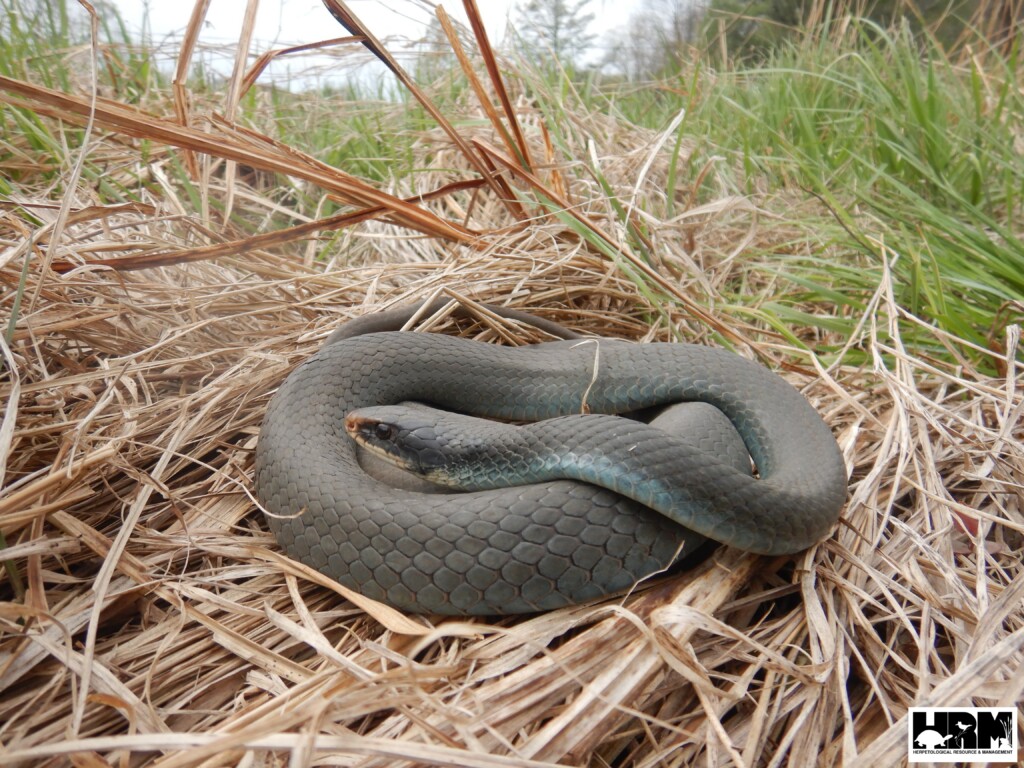
Inhabits dry, sunny areas with access to cover including old fields, hedgerows, shrubby fence lines, thickets, open forests, and woodland edges. Moister sites such as grassy lake edges, fens, and marshes are occasionally occupied.
Conservation:
The species require relatively large areas of habitat, and their populations will decline in areas of intensive agriculture or suburban/urban development. Pesticides pose a danger to the insectivorous young Racers. Road mortality and persecution by humans often results in their mortality. Racers tend to converge in numbers at preferred overwintering dens making them vulnerable to mass mortality.
Best Management:
Assess habitat connectivity and space requirements to preserve large, contiguous tracts if possible. The creation of habitat structures that encourage basking opportunities and overwinter protections should be considered. Restore, maintain, or enhance nesting sites. If roads bisect suitable habitat areas, ensure that road crossings or protected culverts exist for the species. Maintain cover objects both natural and/or artificial on the landscape to provide cover.
Adult Coloration:
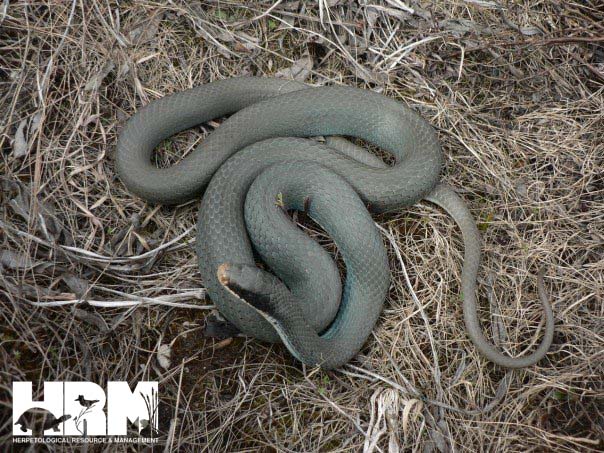
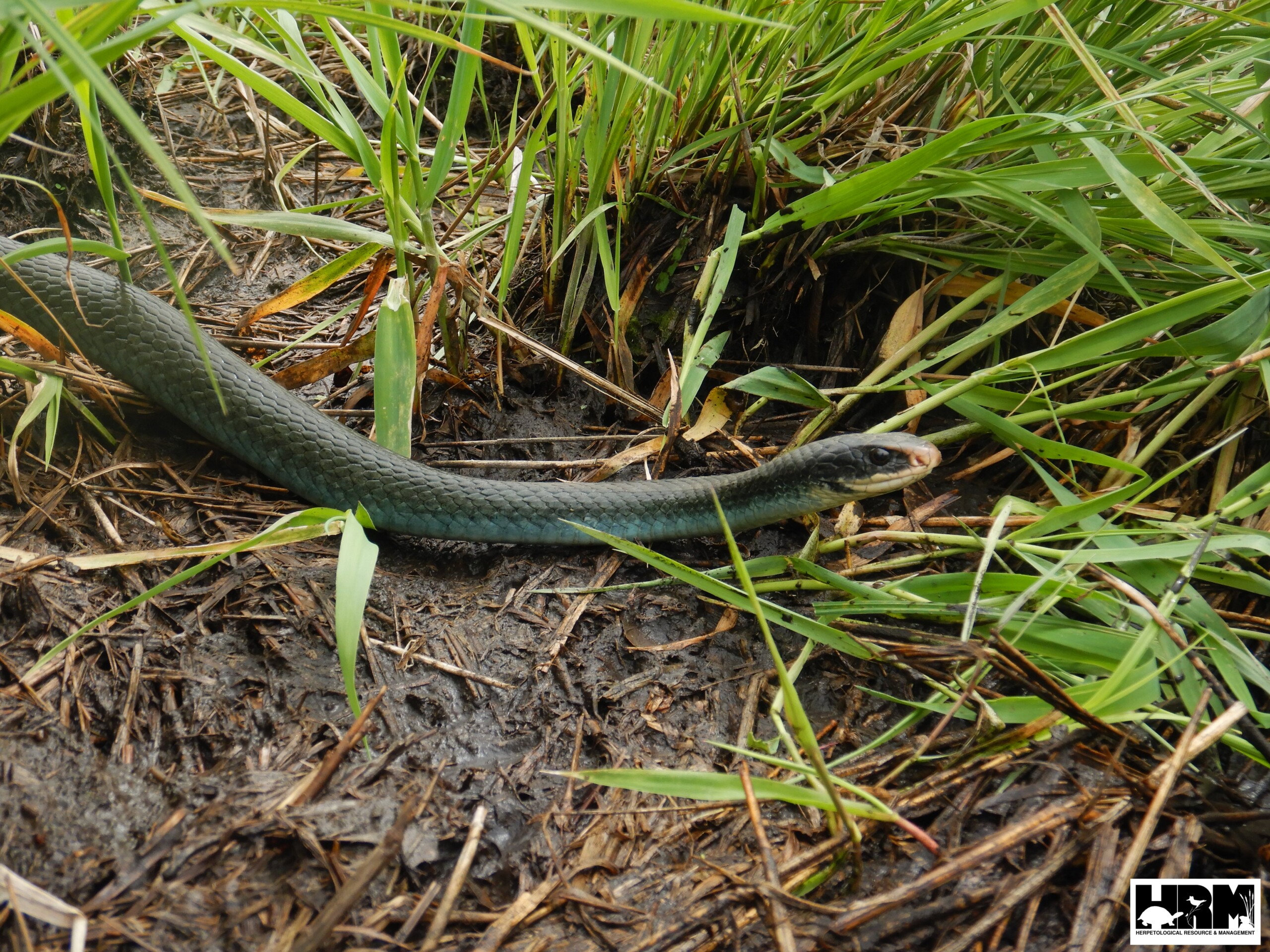
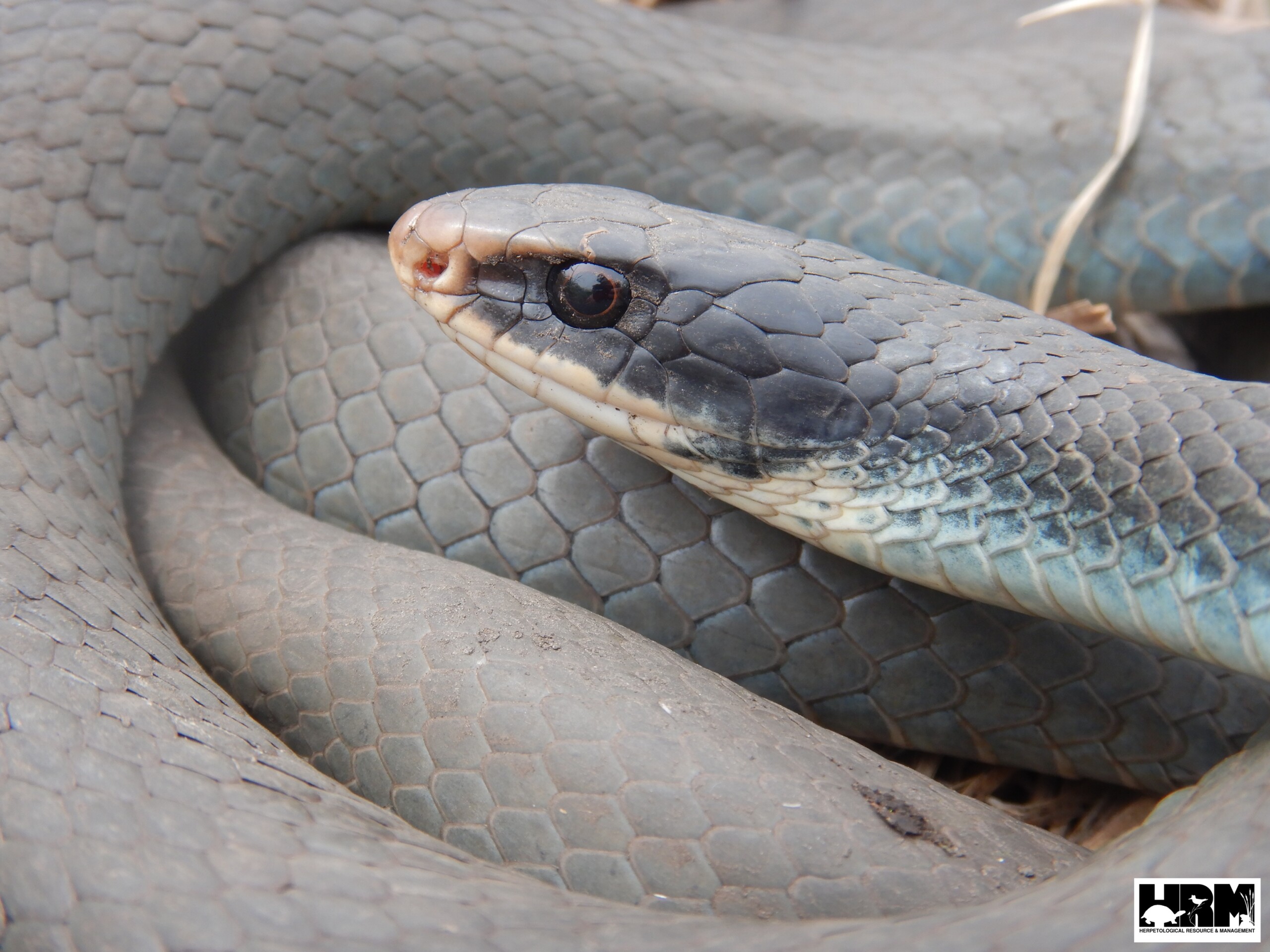
May be a uniform blue, grey, bluish-grey, turquoise, olive, or brown, with a slightly darker head and a black “mask” behind the eye. The belly is bluish, white, or cream. The upper labial scales (those along the mouth) are whitish or yellowish similar to the chin and throat.
Adult Characteristics:
Large, active snakes with unkeeled and shiny scales. The eyes are large with a distinct brow ridge. The anal plate is divided. Males have slightly longer tails that bulge near the vent due to the hemipenes (reproductive structures).
Juvenile Characteristics:
Newly hatched Racers range from 7.5 to 14” in length and have a pattern of grey, brown, or maroon dorsal blotches with black borders with grey or brown body colors. The head, belly, and sides have many dark spots. This pattern fades with age and is usually replaced by adult coloration when the snake is around 27.5 to 35” in length around the age of 2 or 3 years old.
Scale Count:
17 scale rows at midbody
Species Confused With:
Black Rat Snakes and Fox Snakes both have weakly keeled scales and a nearly square cross section body shape, while the Blue Racer has smooth scales and a nearly round body. Young Black Rat Snakes have a black stripe from the eye to the back edge of the jaw. Melanistic Eastern Garter Snakes have heavily keeled scales and an undivided anal plate.
Photos:
References:
- Amphibians and Reptiles of the Great Lakes Region by Jim Harding
- Conant, R., and Collins, J. T. 1998. Reptiles and Amphibians: Eastern, Central North America. Houghton Mifflin Harcourt Press.
- Harding, J and D. Mifsud. 2017. Amphibians and Reptiles of the Great Lakes Region: Revised Edition. Ann Arbor: The University of Michigan Press.
- Harding, J.H. and J.A. Holman. 2006. Michigan Snakes. MSU Extension Ext. Bulletin E-2000,74 pp. [revised].
- Holman, J. A. 2012. The Amphibians and Reptiles of Michigan: A Quaternary and Recent Faunal Adventure. Detroit, Mich., Wayne State University Press.
- Mifsud, David A., Sano, Melissa R., Seguchi, Kotaro J., 2026. Michigan Amphibian and Reptile Best Management Practices Third Edition. Herpetological Resource and Management Technical Publication 2026
- Ruthven, A. G., H. B. T. Gaige, et al. 1912. The herpetology of Michigan, by Alexander B. Ruthven. Crystal Thompson and Helen Thompson; Memoranda towards a bibliography of the archaeology of Michigan, by Harlan I. Smith; prepared under the direction of Alexander G. Ruthven. Lansing, Mich., Wynkoop Hallenbeck Crawford, State Printers.