Copper-bellied Water Snake
Overview:
Scientific Name: Nerodia erythrogaster neglecta
Size: 26.4 – 56” (total adult length)
Status: Present in few areas that contain ideal habitat, many colonies have been recently extirpated and the remaining colonies are in decline throughout the range
Michigan State Status: Endangered
Federal Status: Endangered
MDNR Wildlife Action Plan Status: Species of Greatest Conservation Need
Habitat:
Inhabits shrub swamps, ponds, lakes, oxbow sloughs, fens, and slow-moving streams usually near mature woodlands or more open areas. In spring will move into open edges of shallow ponds and can be found basking on the shoreline.
Conservation:
Thought to have been relatively common on the landscape prior to human settlement, the copper-bellied water snake has now been extirpated from much of its historic distribution within the Great Lakes region. Land-use changes such as deforestation and conversion of wetlands to agricultural fields have forced copper-bellied water snakes into scattered, isolated populations. Listed as endangered in Michigan, Ohio, and Indiana, the copper-bellied water snake is at risk of extinction as human persecution and habitat fragmentation continue to threaten this incredibly imperiled species. If management efforts are not quickly introduced, it is likely the copper-bellied water snake will no longer persist in the Great Lakes region.
Best Management:
Identify and protect suitable habitat containing extant populations of copper-bellied water snakes. Suitable habitat consists of large tracts of wetland complexes containing a mixture of different wetland types, riparian zones, and adjacent upland areas. Unlike other water snake species, the protection of upland habitat is critical to copper-bellied water snakes because they serve as important corridors between ephemeral wetland habitat in the early summer to more permanent water later in the season as temperatures rise. Maintain and protect the landscapes natural wetland hydrology to ensure appropriate hibernacula conditions. Implement vegetated buffer zones between areas of chemical application and aquatic systems. Furthermore, identify and prevent non-point nutrient input and chemical runoff from entering the aquatic system. If crayfish are absent or exist in small populations, provide supplemental snake hibernacula structures by excavating a pit to a depth of 8’ and fill the pit with objects such as rocks, logs, tubing, pipes, and rubble before covering it with soil. Ensure access and exit points are available into and out of the hibernacula. Provide snake basking areas by placing rocks or logs in piles in sunny areas while ensuring the material is arranged in a manner that allows for cracks and gaps to act as cover. Provide nesting structures if naturally occurring features are not present.
Adult Coloration:
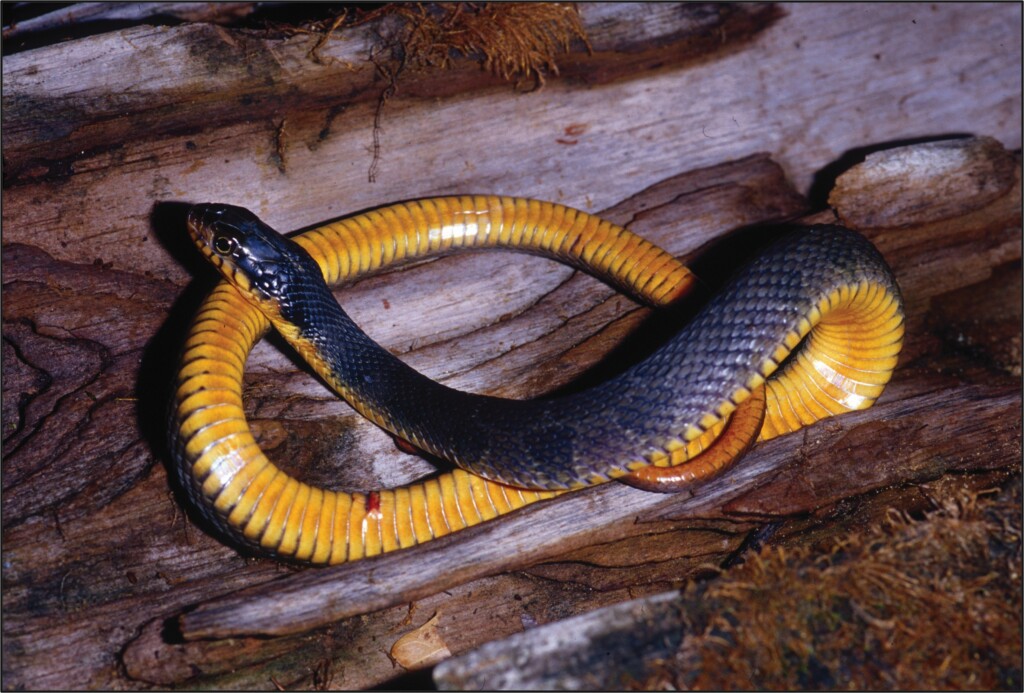
A uniform black, grey or dark brown when mature occasionally with a faint blotched pattern. Labial scales (those along the mouth) are orangish or reddish edged with darker pigment, the throat may be whitish to orange. The belly is solid and ranges from pale orange, red, or coppery-red. Ventral (belly) scales often have a dark border than is more pronounced near the tail.
Adult Characteristics:
Large water snake with keeled scales (each scale has a small central ridge) and a divided anal plate (about 10% have a complete anal plate). Males are smaller than females and have longer tails.
Mass: male: 286g, female: 516 g
Length: 67-141.5 cm
Typical lifespan in wild: unknown, captive: 8-15 years
Breeding interval: once per year
Breeding season: April-May
Range number of offspring: 5-37
Average number of offspring: 17
Range gestation period: 4-7 months
Averge age at sexual/reproductive maturity (female): 3-4 years
Average age at sexual/reproductive maturity (male): 3-4 years
Diet: frogs, salamanders and larvae, crayfish, and fish
Predators: Large fish, snapping turtles, herons, hawks, opossums, raccoons, foxes, otters, minks, skunks, opossums, humans, domestic cat, bobcats, coyotes
Juvenile Characteristics:
Newborns range from 8.3 – 10.6” in length. Newborn and juveniles have dark blotches on a reddish-brown or greyish-brown body. Larger blotches on the back alternate with smaller ones on the sides and may fuse into crossbands near the head. In juveniles the belly color is often paler than an adult varying from light yellow or orange to pinkish-red.
Scale Count:
19-23 scale rows at midbody
Species Confused With:
Northern Water Snakes have rows of half-moons on the belly with a blotched pattern on the back and sides. Kirtland’s Snakes and Queen Snakes also have markings on the belly (row of spots or stripes, respectively). The Northern Red-bellied Snake is considerably smaller (rarely longer than 12”) and only has 15 scale rows at midbody.
References:
- Amphibians and Reptiles of the Great Lakes Region by Jim Harding
- Conant, R., and Collins, J. T. 1998. Reptiles and Amphibians: Eastern, Central North America. Houghton Mifflin Harcourt Press.
- Harding, J and D. Mifsud. 2017. Amphibians and Reptiles of the Great Lakes Region: Revised Edition. Ann Arbor: The University of Michigan Press.
- Harding, J.H. and J.A. Holman. 2006. Michigan Snakes. MSU Extension Ext. Bulletin E-2000,74 pp. [revised].
- Mifsud, David A., Sano, Melissa R., Seguchi, Kotaro J., 2026. Michigan Amphibian and Reptile Best Management Practices Third Edition. Herpetological Resource and Management Technical Publication 2026
- Ruthven, A. G., H. B. T. Gaige, et al. 1912. The herpetology of Michigan, by Alexander B. Ruthven. Crystal Thompson and Helen Thompson; Memoranda towards a bibliography of the archaeology of Michigan, by Harlan I. Smith; prepared under the direction of Alexander G. Ruthven. Lansing, Mich., Wynkoop Hallenbeck Crawford, State Printers.