
Eastern Hog-nosed Snake
Overview:
Scientific Name: Heterodon platirhinos
Size: 20 – 45.5” (total adult length)
Status: Can be locally present where suitable habitat exists but has experienced decline over the past several decades
MDNR Wildlife Action Plan Status: Species of Greatest Conservation Need
Habitat:
Inhabits many terrestrial habitats from open pine and deciduous woodlands to old fields, meadows, and pastures.
Conservation:
Harmless to humans but their defensive bluffing behaviors, occasional spotted coloration, and local names (puff adder, blow snake, Michigan cobra, etc.) have led to fatal confrontations with humans. Often killed on roadways and by farming equipment.
Best Management:
The creation of habitat structures that encourage basking opportunities and overwinter protections should be considered. Restore, maintain, or enhance nesting sites. If roads bisect suitable habitat areas, ensure that road crossings or protected culverts exist for the species. Restoration efforts targeting preferred upland, dry habitats are recommended.
Adult Coloration:
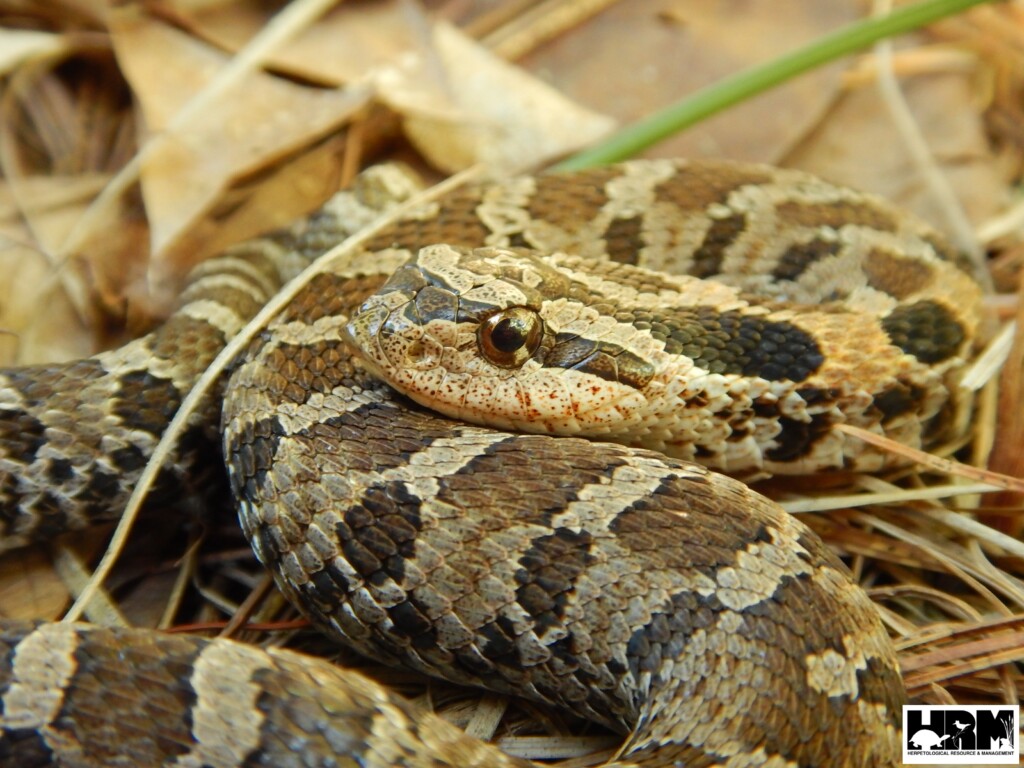
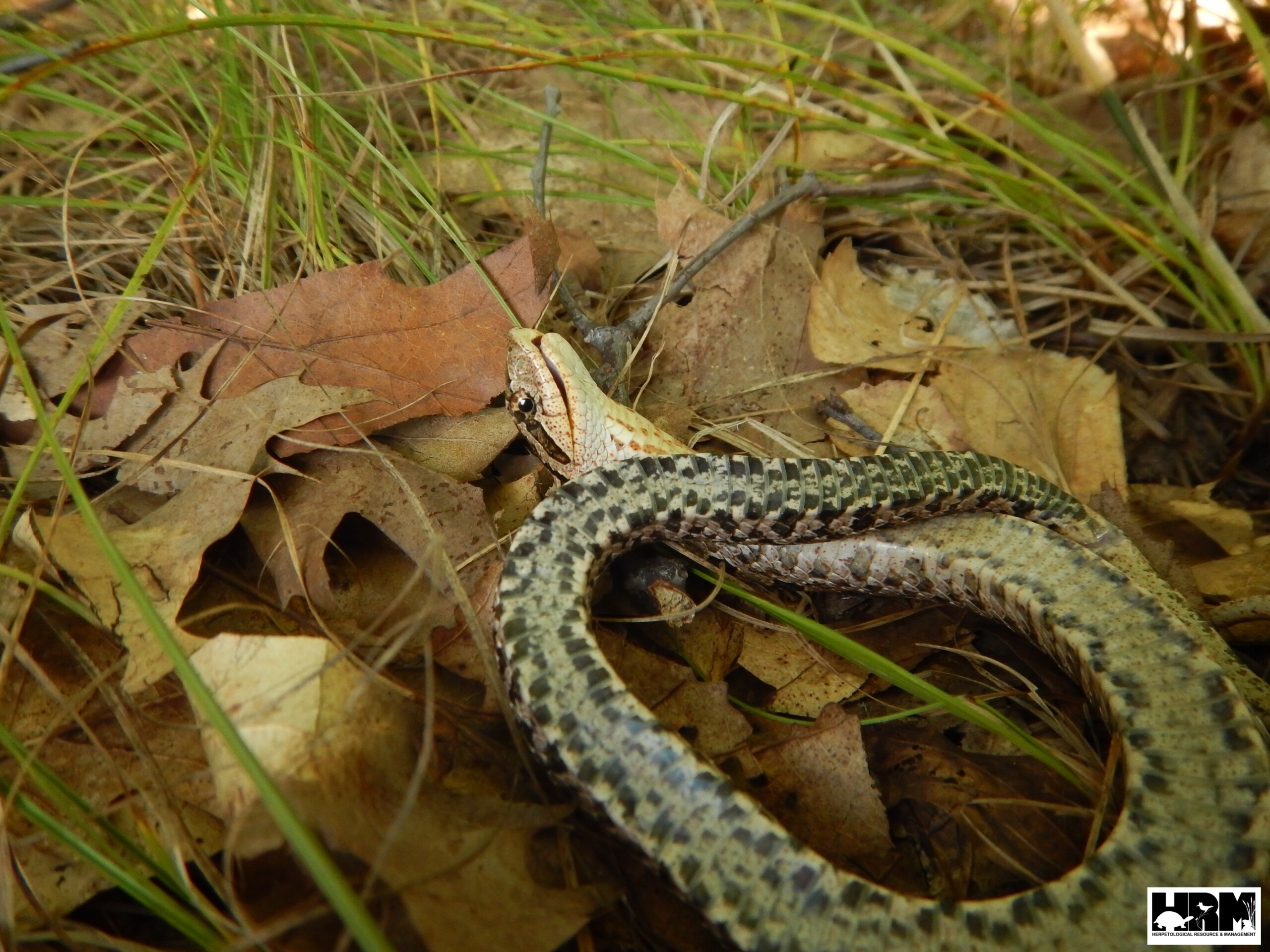
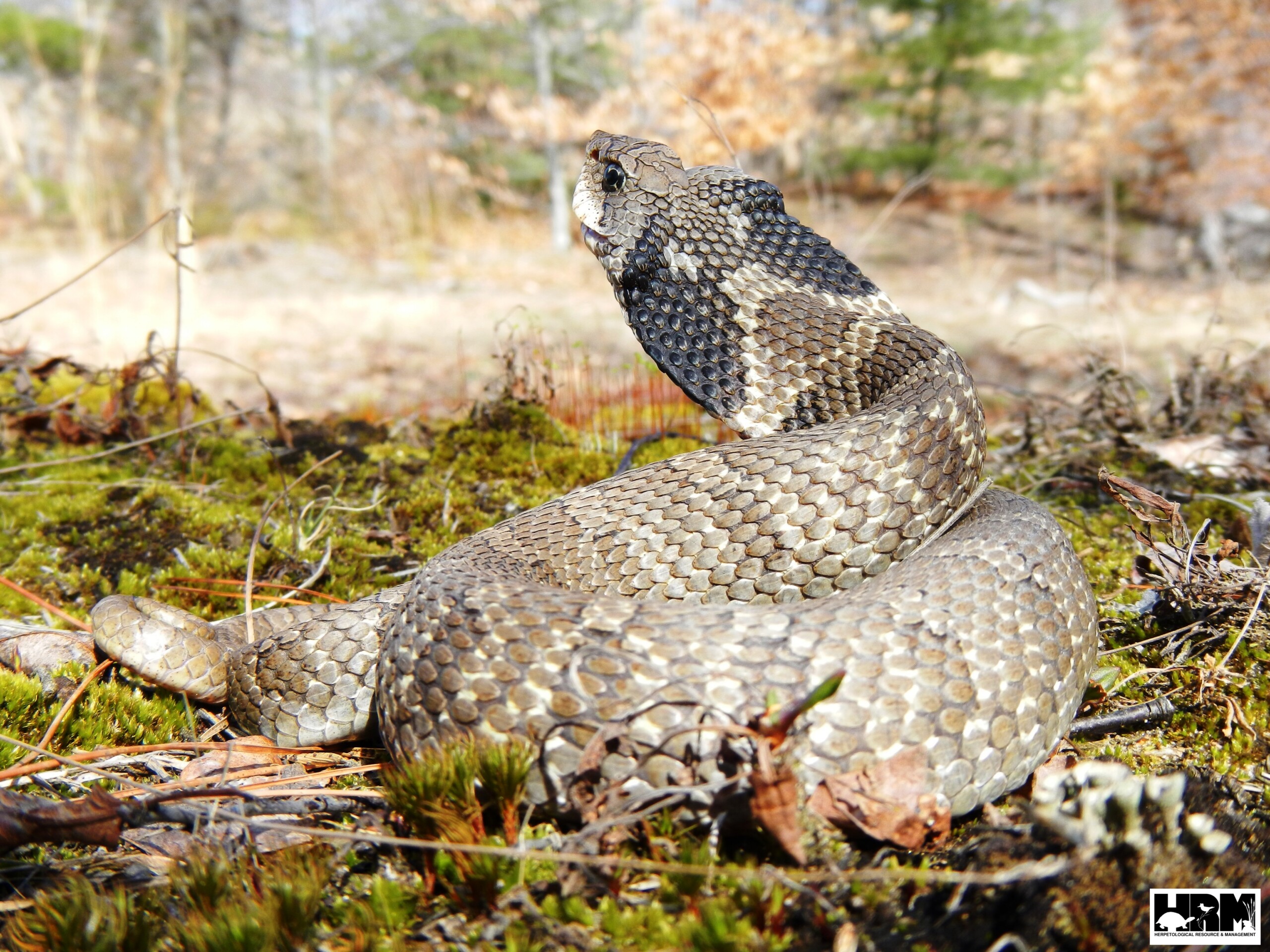
The coloration of the species is variable with mottled grey, brown, tan, olive, orange, yellow, or pinkish body colorations with a pattern of irregular dark blotches down the back that alternate with dark spots on the sides. Some may be uniformly grey, brown, olive, or melanistic (solid black). Many are an intermediate of these colors with faded blotches. Long, dark blotches on the neck are found in all but the darkest individuals. A dark band between the eyes and another from the eye to the back of the jaw is found in some with distinct patterning. The belly is yellowish, cream, grey, or pinkish with dark mottling. The chin, throat and scales under the tail are usually lighter than the belly.
Adult Characteristics:
A medium sized snake with a thick body, short tail, and flattened, upturned snout. The head is wide and triangular in shape and distinct from the neck unless flattened in a defensive display. The scales are keeled (each scale has a small central ridge) with a divided anal plate. Males are smaller and less robust than a female.
Juvenile Characteristics:
Hatchlings range from 5 to 10” in length with a light grey, brown, or pinkish body with dark blotches on their back and spots on their sides. The belly is dark grey or black while the throat and scales under the tail are white or yellowish.
Species Confused With:
The Eastern Massasauga Rattlesnake has a rattle, elliptical pupils, and facial pits (opening between the eye and nostril) and lacks an upturned and keeled snout.
Photos:

References:
- Amphibians and Reptiles of the Great Lakes Region by Jim Harding
- Conant, R., and Collins, J. T. 1998. Reptiles and Amphibians: Eastern, Central North America. Houghton Mifflin Harcourt Press
- Harding, J and D. Mifsud. 2017. Amphibians and Reptiles of the Great Lakes Region: Revised Edition. Ann Arbor: The University of Michigan Press.
- Harding, J.H. and J.A. Holman. 2006. Michigan Snakes. MSU Extension Ext. Bulletin E-2000,74 pp. [revised].
- Holman, J. A. 2012. The Amphibians and Reptiles of Michigan: A Quaternary and Recent Faunal Adventure. Detroit, Mich., Wayne State University Press.
- Mifsud, David A., Sano, Melissa R., Seguchi, Kotaro J., 2026. Michigan Amphibian and Reptile Best Management Practices Third Edition. Herpetological Resource and Management Technical Publication 2026
- Ruthven, A. G., H. B. T. Gaige, et al. 1912. The herpetology of Michigan, by Alexander B. Ruthven. Crystal Thompson and Helen Thompson; Memoranda towards a bibliography of the archaeology of Michigan, by Harlan I. Smith; prepared under the direction of Alexander G. Ruthven. Lansing, Mich., Wynkoop Hallenbeck Crawford, State Printers.