
Northern Red-bellied Snake
Overview:
Scientific Name: Storeria occipitomaculata occipitomaculata
Size: 8 – 16” (adult total length)
Status: Locally common.
Habitat:
Inhabit deciduous or mixed forests, adjacent fields, pastures, marshes, and bogs. Prefer moist soils but can occupy drier sites. Can be found in urban and suburban areas under natural and artificial cover objects.
Conservation:
Most often found turning over artificial cover objects and can be abundant in these unnatural areas. It is unclear if the artificial cover leads to higher populations or if it makes them easier to find. Human activities that create open edges in and around woodlands probably benefit the species. If roads separate wintering sites from summer feeding areas large numbers may be killed in migrations.
Best Management:
Habitat connectivity across roads is vital. Seasonal road closures, crossing structures and barrier fencing can prevent road mortality. Take care to remove any artificial cover and natural cover before burning.
Adult Coloration:
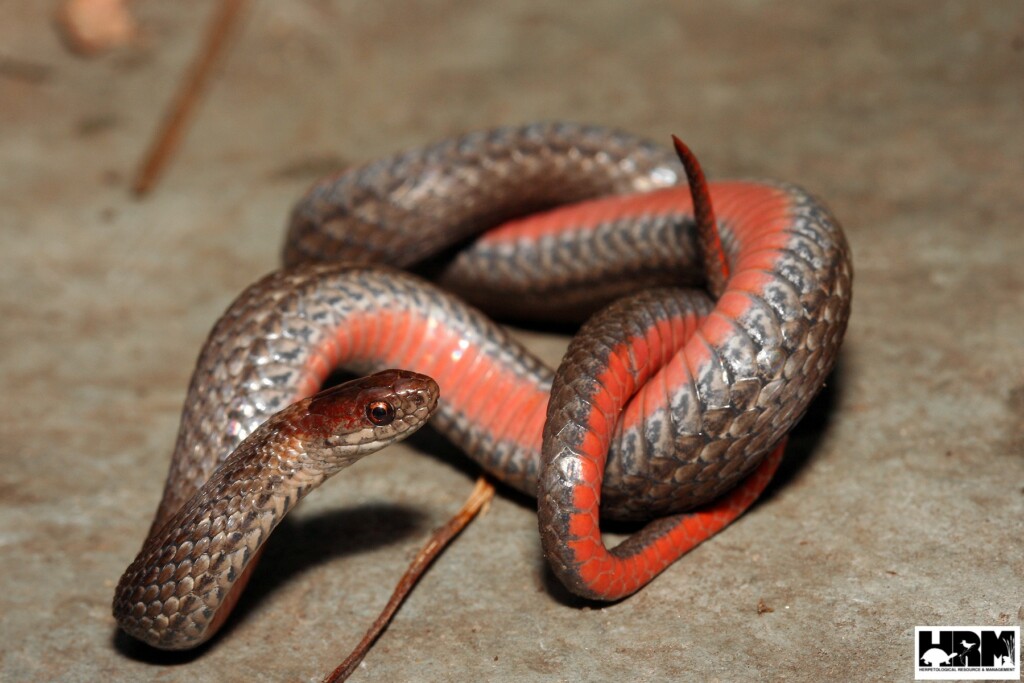
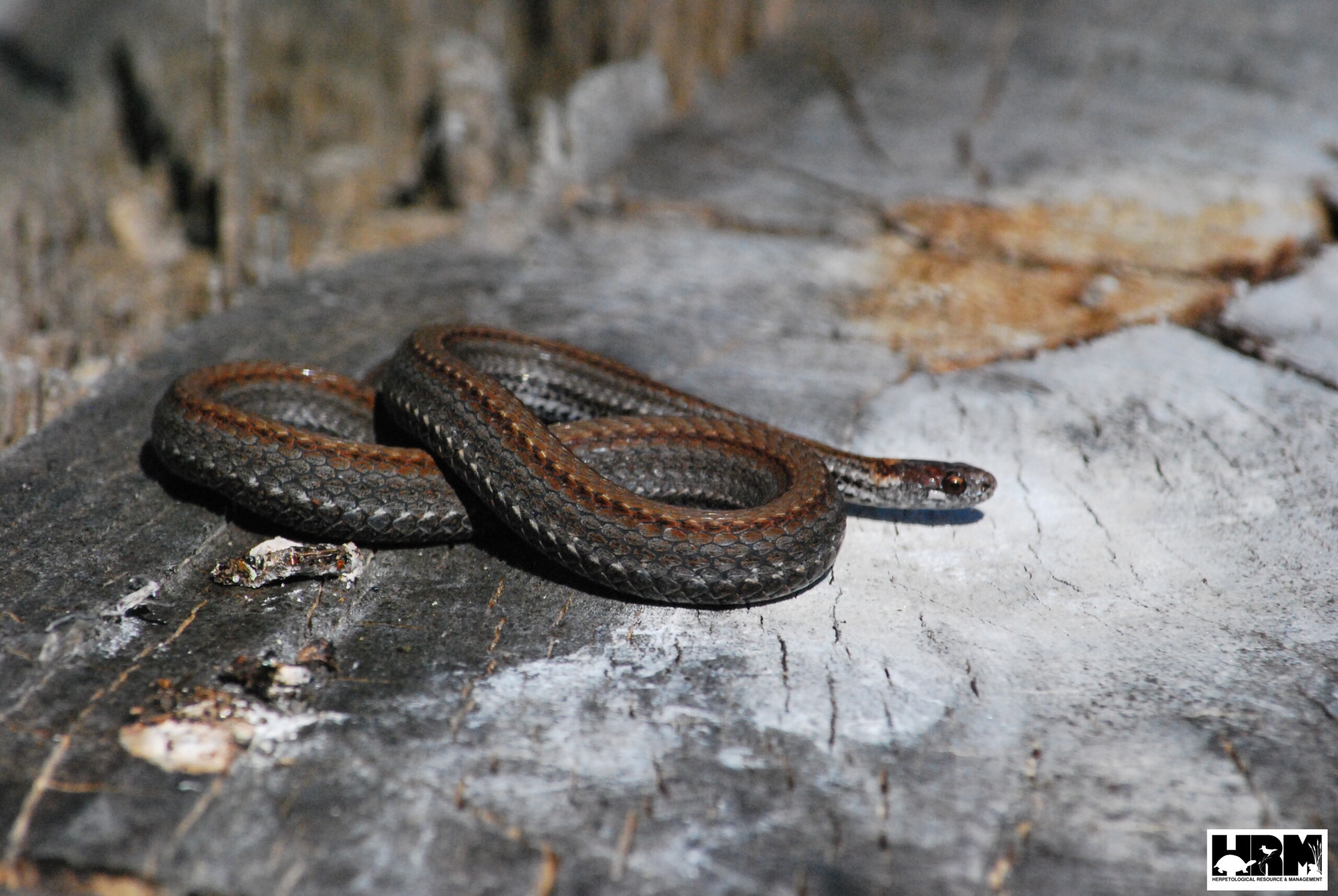
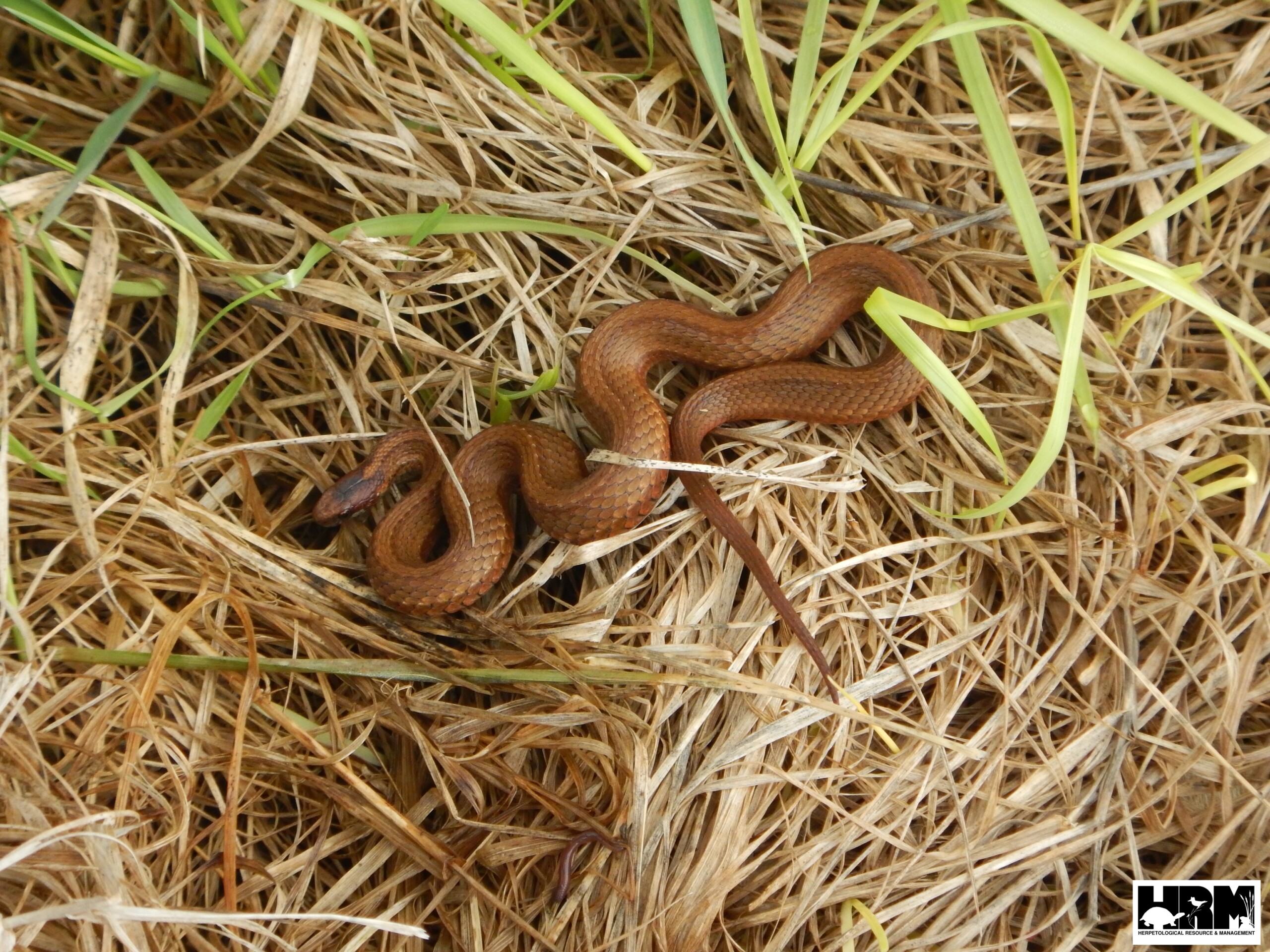
Brown, reddish-brown, or grey and two or four thin dark stripes on the back and/or sides. The top of the head is dark brown or reddish-brown while the chin and throat are white. A light spot can usually be found behind and below the eye and three light tan or yellow spots on the neck which may for a light collar. The belly is bright red but can range from pink, orange, light yellow, or rarely, grey or black.
Adult Characteristics:
A small snake with a narrow head and small head, keeled scales (each scale has a small central ridge), and a divided anal plate. Males have slightly longer tails but are similar and hard to distinguish except when females are gravid.
Juvenile Characteristics:
Newborns range from 2.8 – 4.3” in length and tend to be dark on their backs and paler on the bellies than adults and have a prominent light spot or collar on the neck.
Scale Count:
15 scale rows at midbody
Species Confused With:
Northern Brown Snakes are about the same size but have paler bellies and 17 scale rows at midbody. Kirtland’s Snakes have two rows of black spots down the belly. Garter and Ribbon Snakes have paler bellies and single anal plates. Northern Ring-necked Snakes are also small but have unkeeled scales.
Photos:
References:
- Amphibians and Reptiles of the Great Lakes Region by Jim Harding
- Conant, R., and Collins, J. T. 1998. Reptiles and Amphibians: Eastern, Central North America. Houghton Mifflin Harcourt Press.
- Harding, J and D. Mifsud. 2017. Amphibians and Reptiles of the Great Lakes Region: Revised Edition. Ann Arbor: The University of Michigan Press.
- Harding, J.H. and J.A. Holman. 2006. Michigan Snakes. MSU Extension Ext. Bulletin E-2000,74 pp. [revised].
- Holman, J. A. 2012. The Amphibians and Reptiles of Michigan: A Quaternary and Recent Faunal Adventure. Detroit, Mich., Wayne State University Press.
- Mifsud, David A., Sano, Melissa R., Seguchi, Kotaro J., 2026. Michigan Amphibian and Reptile Best Management Practices Third Edition. Herpetological Resource and Management Technical Publication 2026
- Ruthven, A. G., H. B. T. Gaige, et al. 1912. The herpetology of Michigan, by Alexander B. Ruthven. Crystal Thompson and Helen Thompson; Memoranda towards a bibliography of the archaeology of Michigan, by Harlan I. Smith; prepared under the direction of Alexander G. Ruthven. Lansing, Mich., Wynkoop Hallenbeck Crawford, State Printers.