
Northern Ribbon Snake
Overview:
Scientific Name: Thamnophis sauritus septentrionalis
Size: 18-34″ (total adult length)
Status: Can be abundant in the appropriate habitats but are less abundant towards the edges of their range
MDNR Wildlife Action Plan Status: Species of Greatest Conservation Need
Habitat:
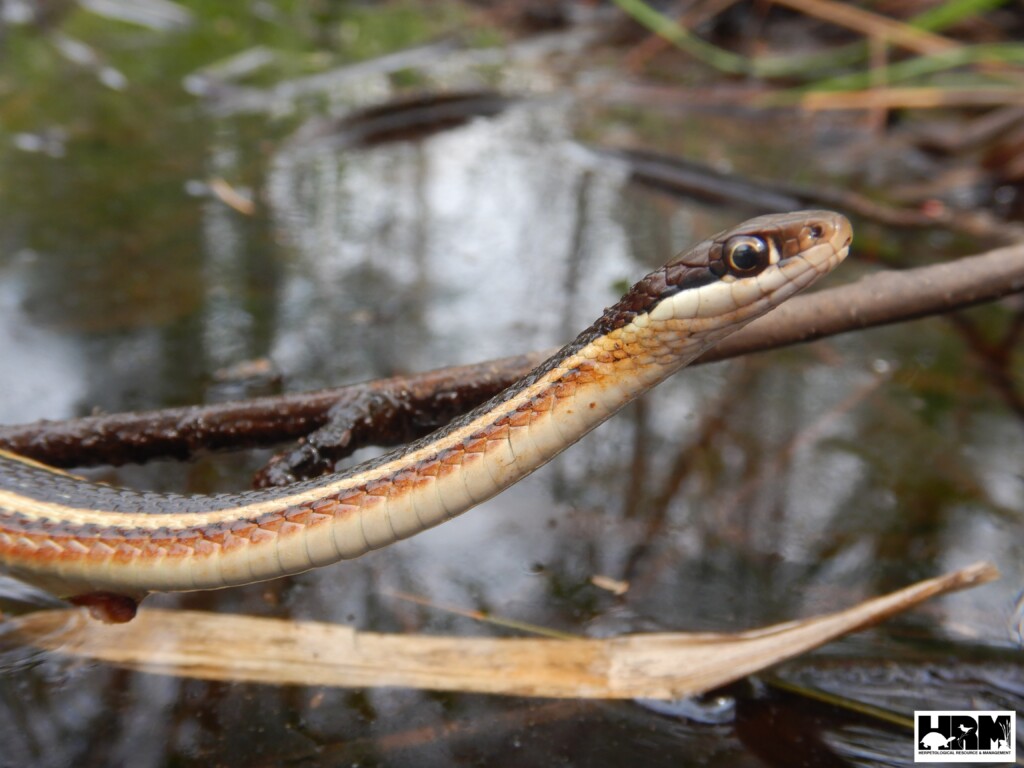
Inhabit the edges of lakes, ponds, bogs, streams, and marshes especially where there is low vegetation. Prefers sunny sites. Will occasionally be found in open swamps or near wetland ponds.
Conservation:
The availability and health of wetland and littoral habitats and number of amphibian prey is important to the species fate. Populations will decline where frequent human activity results in the degradation of shoreline vegetation and thus the loss of cover and food. Persecution and road mortality are further threats.
Best Management:
The creation of snake basking and cover structures including rocks and woody debris are important additions. Consider the effects of altering or destroying vernal pools and ponds. Do not impact the pool depression or core buffer area within 100 feet of the pools and aim to protect a wider buffer of 600 – 1000 feet around the pools. Try to maintain any habitat corridors to other vernal pools and upland habitats.
Adult Coloration:
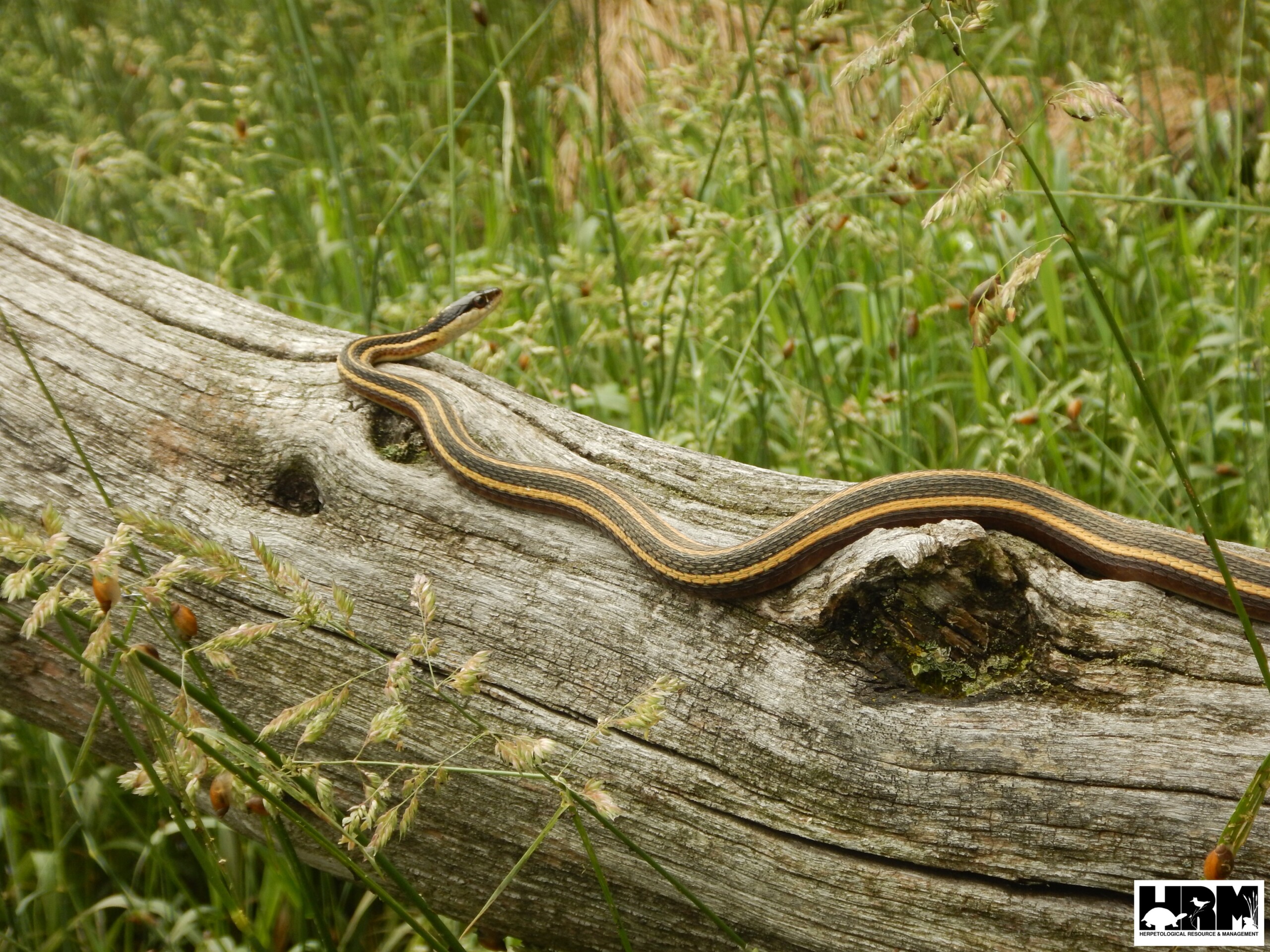
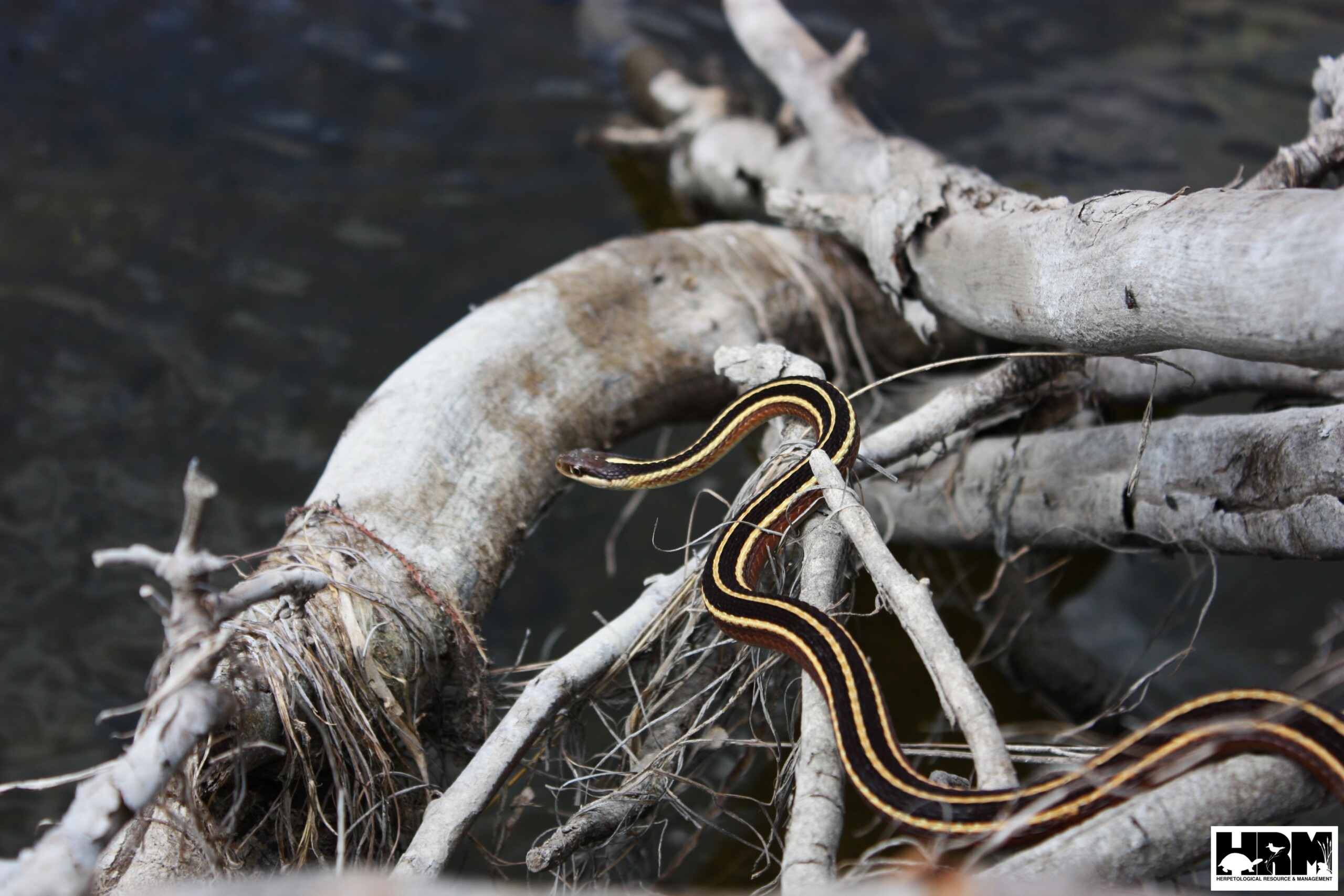
A dark brown or black body with three yellow, greenish-yellow, or white stripes. The stripe down its back may be brown or tan. The stripes down the sides are on scale rows 3 and 4 and a brown stripe below this on scale rows 1 and 2. A light bar is in front of the eye and the labial scales (along the mouth) are bright white or pale yellow. There may be two light spots on the large scales at the back of the head. The belly is a solid pale green, yellow, or white.
Adult Characteristics:
A long, slender snake with a very long tail that is at least a quarter to one-third the total length of the snake. The head is wider than the neck with large eyes. The scales are keeled (each scale has a small central ridge) and has an undivided anal plate.
Juvenile Characteristics:
Newborns range from 6.3 – 9.4” in length with similar coloration as adults.
Scale Count:
19 scale at midbody
Species Confused With:
This species is much thinner with a much longer tail than similarly striped Garter Snakes with Eastern Garter Snakes having side stripes of scale rows 2 and 3 and Butler’s Garter Snakes having stripes on scale rows 2 through 4.
Photos:
References:
- Amphibians and Reptiles of the Great Lakes Region by Jim Harding
- Conant, R., and Collins, J. T. 1998. Reptiles and Amphibians: Eastern, Central North America. Houghton Mifflin Harcourt Press.
- Harding, J and D. Mifsud. 2017. Amphibians and Reptiles of the Great Lakes Region: Revised Edition. Ann Arbor: The University of Michigan Press.
- Harding, J.H. and J.A. Holman. 2006. Michigan Snakes. MSU Extension Ext. Bulletin E-2000,74 pp. [revised].
- Holman, J. A. 2012. The Amphibians and Reptiles of Michigan: A Quaternary and Recent Faunal Adventure. Detroit, Mich., Wayne State University Press.
- Mifsud, David A., Sano, Melissa R., Seguchi, Kotaro J., 2026. Michigan Amphibian and Reptile Best Management Practices Third Edition. Herpetological Resource and Management Technical Publication 2026
- Ruthven, A. G., H. B. T. Gaige, et al. 1912. The herpetology of Michigan, by Alexander B. Ruthven. Crystal Thompson and Helen Thompson; Memoranda towards a bibliography of the archaeology of Michigan, by Harlan I. Smith; prepared under the direction of Alexander G. Ruthven. Lansing, Mich., Wynkoop Hallenbeck Crawford, State Printers.