
Spotted Turtle
Overview:
Scientific Name: Clemmys guttata
Size: 3.5 – 5.4” (adult carapace length)
Status: Uncommon to rare throughout Great Lakes range; tend to occur in isolated populations surrounded by unoccupied or unsuitable habitat
Michigan State Status: Threatened
Federal Status: Candidate Under Review
MDNR Wildlife Action Plan Status: Species of Greatest Conservation Need
Habitat:
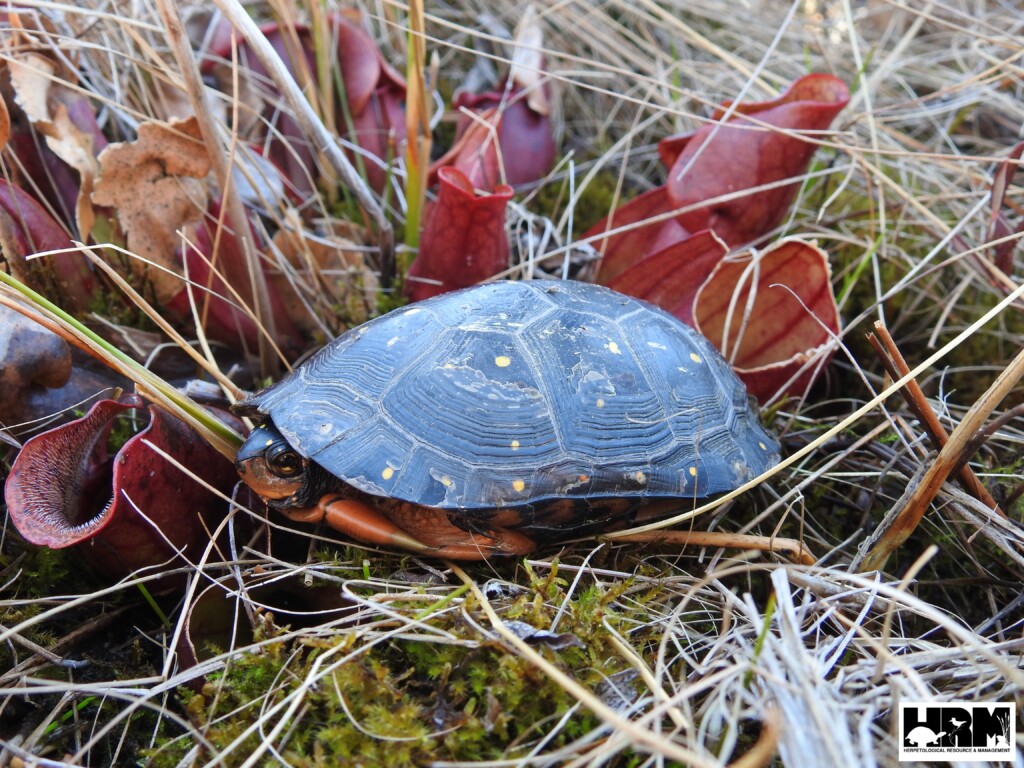
Inhabit shallow ponds, wet ponds, tamarack swamps, bogs, fens, marsh channels, sphagnum seepages, and slow streams. Most commonly found in clear, shallow water with mud or muck bottom and ample aquatic and emergent vegetation.
Conservation:
Confined to small, isolated colonies, spotted turtles in the Great Lakes region are at immense threat of increased extirpation and even extinction. Listed as a threatened species in Michigan, habitat loss due to the draining and conversion of wetlands for human development is causing devastating implications for this species. Unique life history characteristics such as delayed sexual maturity, high egg mortality, and low reproductive outputs make the spotted turtle particularly vulnerable to habitat degradation. The demand for spotted turtles in the illegal pet trade has also contributed to their extirpation, as the aesthetically pleasing patterns on their shells have significantly increased their popularity on the market.
Best Management:
Identify and protect quality spotted turtle habitat containing extant populations. Suitable habitat consists of small, non-contiguous wetlands with adjacent open uplands for nesting. Maintain habitat connectivity between wetland and upland habitat. Minimize habitat fragmentation and establish buffer zones around development in close proximity to spotted turtle habitat. Ensure mature adults and older juveniles remain on the landscape to maintain population stability. Captive rearing head-start programs can be an effective tool in stabilizing populations in decline. Introduce predator controls to eliminate over-predation and increase the success of nests. Maintain adequate water quality by using vegetated buffer zones between areas of chemical application and aquatic system. Identify and prevent non-point nutrient and chemical runoff from entering the system. Prevent the introduction of invasive species. Avoid mechanically harvesting aquatic vegetation. Consider creating or restoring vernal pools. Do not impact the pool depression or core buffer area within a minimum of 100 feet and aim to protect a wider buffer of 600-1000 feet. Maintain a forest canopy of at least >50% and use coarse woody material to create simple habitat structures. Avoid altering water levels and consider adding hibernacula structures by creating hollowed-out areas under the banks, ensuring they are submerged or at a constant water level from early fall to early spring. Implement turtle basking structures by felling trees or utilizing existing logs and partially submerging them in a sunny location to provide basking habitat. Minimize road mortality by preventing habitat fragmentation and installing wildlife barrier fencing or crossing structures. Monitor sites consistently to prevent the collection of spotted turtles for the illegal wildlife trade and report suspicious activities to wildlife law enforcement.
Adult Coloration:
The carapace is brownish-black or black with rounded yellow spots that are variable in number may darken or fade with age. Has a few spots on their mostly black head. The outer surfaces of the legs are black usually with a few yellow spots while the lower legs, neck and other soft parts are often orange or pinkish mottled with black. The plastron is usually yellow or orange with a black blotch on the outer portion of each scute. Sometimes black may cover most or all of the plastron, especially in males. Males have brown eyes and a dark chin while females have orange eyes and yellowish or orange chin.
Adult Characteristics:
The carapace is smooth and unkeeled. Males have a slightly compressed and elongated carapace with a concave plastron while females have a broader and higher carapace with a flat or slightly convex plastron. The tail is thinner in females with the vent at the edge of the carapace while the male vent is beyond the edge of the carapace. :
Breeding interval: multiple times a year
Breeding season: early spring
Range number of offspring: 1 – 8
Average number of offspring: 3
Range gestation period: 44 – 83 days
Average age at sexual/reproductive maturity (female): 7 – 14
Average age at sexual/reproductive maturity (male): 7 – 14
Diet: Spotted turtles will prey on algae, leaves, soft aquatic plants, water lily seeds, worms, mollusks, crustaceans, adult and larval insects, amphibian eggs and larvae, and carrion.
Predators: raccoons, humans.
Juvenile Characteristics:
Hatchlings average carapace length is 1.14” with usually just one spot per carapace scute. The carapace is black, and the plastron is yellowish-orange with a central dark blotch. The growth rings (known as annuli) in the carapace scutes are more conspicuous than in adults.
Species Confused With:
Blanding’s Turtles may have similar yellow spotting on a dark head and carapace but the spots are smaller and more numerous and the entire chin, throat and lower neck are solid yellow.
References:
- Amphibians and Reptiles of the Great Lakes Region by Jim Harding
- Conant, R., and Collins, J. T. 1998. Reptiles and Amphibians: Eastern, Central North America. Houghton Mifflin Harcourt Press.
- Harding, J and D. Mifsud. 2017. Amphibians and Reptiles of the Great Lakes Region: Revised Edition. Ann Arbor: The University of Michigan Press.
- Harding, J.H. and J.A. Holman. 1990. Michigan Turtles and Lizards. MSU Cooperative Extension Service and MSU Museum. 96 pp.
- Holman, J. A. 2012. The Amphibians and Reptiles of Michigan: A Quaternary and Recent Faunal Adventure. Detroit, Mich., Wayne State University Press.
- Mifsud, David A., Sano, Melissa R., Seguchi, Kotaro J., 2026. Michigan Amphibian and Reptile Best Management Practices Third Edition. Herpetological Resource and Management Technical Publication 2026
- Ruthven, A. G., H. B. T. Gaige, et al. 1912. The herpetology of Michigan, by Alexander B. Ruthven. Crystal Thompson and Helen Thompson; Memoranda towards a bibliography of the archaeology of Michigan, by Harlan I. Smith; prepared under the direction of Alexander G. Ruthven. Lansing, Mich., Wynkoop Hallenbeck Crawford, State Printers.